



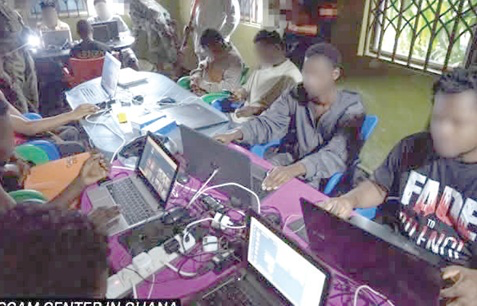
A joint operation by Ghanaian security agencies and international partners has led to the arrest of 19 individuals, the rescue of 117 victims of human trafficking, and the seizure of 303 electronic devices at a residential compound in Sasaabi, a semi-rural suburb of Accra.
The operation, part of an international initiative dubbed “Joint Disruption Week,” also led to the identification of 89 victims of online scams who suffered estimated losses of $8.3 million, and the removal of more than 3.7 million accounts used by fraudsters, the US Department of Justice (DOJ) disclosed in a statement issued on Tuesday, October 13, 2026.
The 117 suspected trafficking victims — all Nigerian nationals — were allegedly held against their will and forced to work in the scam operations. They are awaiting repatriation to Nigeria.
Ghanaian Agencies Led the Operation
The Ghana operation was led by the Cyber Security Authority (CSA), the Ghana Police Service Criminal Investigation Department, and the National Security Service, with support from the United Kingdom’s National Crime Agency (NCA), the Federal Bureau of Investigation (FBI), and Nigeria’s Economic and Financial Crimes Commission (EFCC).
According to the DOJ statement, the arrests followed additional enforcement activities conducted at six locations in Ghana during the final week of September 2026, which resulted in scores of arrests, the identification of 34 suspected trafficking victims, and the seizure of 129 electronic devices. In Nigeria, authorities arrested nine individuals and seized 53 electronic devices during the enforcement period. The combined operations accounted for 28 arrests.
The DOJ described the exercise as the first coordinated international disruption effort focused specifically on West Africa.
The Scale of the Scam Industry
The crackdown comes amid growing global concern over the financial toll of cyber-enabled fraud. According to figures cited by the DOJ from the FBI’s Internet Crime Complaint Center (IC3), investment scams were reported 72,984 times in the United States in 2025, with cryptocurrency investment fraud accounting for 72 percent of that category. Reported losses from investment scams rose from $3.96 billion in 2023 to $5.8 billion in 2024, while losses linked to investment scams involving cryptocurrency reportedly exceeded $7.2 billion in 2025.
Data from the IC3 also indicates that cyber-enabled fraud accounted for nearly 85 percent of all losses reported to the center in 2025, with cyber-enabled investment fraud losses escalating from $4.57 billion in 2023 to $8.65 billion in 2025 — a rise of 89 percent.
The schemes disrupted during Joint Disruption Week included law enforcement impersonation scams, digital “arrest” extortion schemes, cryptocurrency investment fraud — commonly known as “pig butchering” — fraudulent job offers, romance scams, online sales fraud, and recovery scams in which fraudsters demand upfront payments from previous victims while promising to recover money they have lost.
West African scam centres mirror those uncovered in Southeast Asia’s highly organised enterprises that recruit workers, train them in social engineering, and deploy multi-platform fraud campaigns targeting global victims.
Technology Partners Remove 3.7 Million Accounts
Several private industry partners collaborated with international law enforcement in the operation, including Meta, Adobe, Binance, Coinbase, Cyjax, Elliptic, Chainalysis, Flashpoint, Google, Microsoft, OpenAI, Silent Push, Starlink, and TRM Labs. These companies voluntarily took action on their own networks to disrupt scammers using their platforms to perpetrate fraud.
Meta removed more than 3.7 million accounts, pages, and groups from Facebook and Instagram targeting people in the United States, the United Kingdom, and beyond. Most of the removed accounts reportedly impersonated American and British users to target victims. The networks also reached victims in Germany, Brazil, Japan, India, South Africa, Turkey, and Nigeria.
Microsoft suspended accounts suspected of involvement, while cybersecurity firm Silent Push mapped more than 35,000 malicious domains and nearly 700 communication channels linked to suspected scam centres. Coinbase identified more than 65 active scam victims and prevented potential losses exceeding $415,000.
The companies shared leads on over 30 suspected scam centres with law enforcement, resulting in dozens of arrests, the rescue of trafficking victims, and cryptocurrency seizures. In total, over $11 million in potentially freezable funds were identified by the private sector partners.
US Executive Order and Strike Force
The operation was carried out under the framework of President Donald Trump’s Executive Order 14390, signed on March 6, 2026, which directs the prioritisation of cybercrime, fraud, and predatory schemes draining American families of their life savings, and unleashes every available tool to stop foreign-backed criminal networks that exploit Americans through cyber-enabled fraud.
The DOJ’s Criminal Division, through its Cyber-Enabled Scam Initiative and the Scam Centre Strike Force — launched in November 2025 by the US Attorney’s Office for the District of Columbia — were critical in executing the mission. The Strike Force’s purview includes cryptocurrency investment fraud, cyber-enabled fraud, human trafficking, and money laundering.
Human Trafficking and Forced Labour
The operation exposed the connection between online fraud and human trafficking, with criminal groups allegedly using scam compounds to carry out fraudulent activities while holding some workers against their will. The investigation uncovered allegations of physical and psychological abuse against trafficked individuals held in the residential compound.
In a separate but related operation, Ghanaian authorities repatriated 120 Nigerian citizens rescued during a major law enforcement sweep dubbed “Operation Cyberhunt,” led by the CSA in collaboration with the UK, Nigeria, and the United States. The rescued victims were identified largely as Nigerians, with arrangements made for their repatriation with logistical support from the Ghana Air Force and the Ministry of Defence.
Law enforcement officers recovered an extensive inventory of digital hardware during that operation, including 136 mobile phones, 130 laptops, and multiple internet connectivity devices. Officers also confiscated four motor vehicles, including one verified as stolen from Canada, along with high-value jewelry and 10 Nigerian passports. Eight individuals were being processed for prosecution.
Minister of Communications Samuel Nartey George said the exercise formed part of the government’s efforts to disrupt cybercrime networks and prevent the country from becoming a base for criminal activity. “Ghana under President John Dramani Mahama will remain an unfavourable destination for cyber criminals,” he stated.
International Reactions
Assistant Attorney General A. Tysen Duva of the DOJ’s Criminal Division commended law enforcement officers in Ghana and Nigeria. “The millions of bogus social media accounts taken down and dozens of arrests that took place as part of Joint Disruption Week are just the beginning,” he said. “I am especially grateful to the courageous law enforcement officers in Ghana and Nigeria who put themselves in harm’s way to seize evidence and arrest the criminals who prey on innocent people”.
FBI Director Kash Patel said the operation demonstrated the value of cooperation between law enforcement agencies and private industry. “We are demolishing Scam Centers across the globe and crushing a criminal industry preying on American citizens,” he stated.
Nick Sharp, Deputy Director of Fraud at the UK’s National Crime Agency, stressed that international partnerships were essential. “Fraud is a global problem and it takes partnership working across international boundaries to tackle it,” he said. “Collaborating in this way sends a clear signal to criminals that the combined capabilities of law enforcement and industry means that we will relentlessly pursue them and the infrastructure they rely on no matter where they operate”.
Meta’s Vice President and Deputy General Counsel, Chris Sonderby, echoed those sentiments: “Scams are a global threat that demand a global response”.
The DOJ said the operation demonstrated the importance of public-private cooperation in tackling organised cybercrime, particularly as fraudsters increasingly exploit digital platforms and operate across national borders.
The operation involved law enforcement agencies from 10 countries and 15 technology companies, including the US Secret Service, the US Department of the Treasury, Homeland Security Investigations, Australia, Canada, India, New Zealand, INTERPOL, and additional cybercrime units.


