



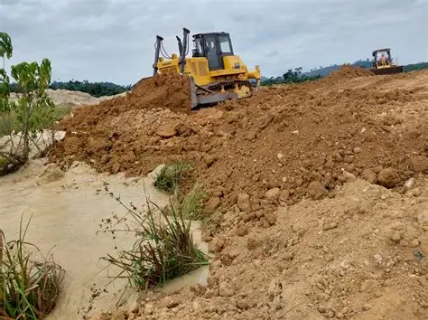
The Environmental Protection Authority (EPA) has issued a sweeping directive ordering an immediate halt to all land reclamation, mine-site rehabilitation, and water-body restoration activities being carried out without environmental permits, warning that no project—regardless of its funding source or institutional backing—is exempt from regulatory oversight.
In a public notice issued on Wednesday, October 14, and circulated on Thursday, October 15, the Authority said the growing number of reclamation and restoration projects operating without its oversight posed a serious regulatory and environmental concern. The directive applies to government-sponsored, publicly funded, privately funded, and donor-supported initiatives alike.
A Direct Warning to State Institutions
The EPA specifically named the Ministry of Lands and Natural Resources, the Forestry Commission, the Ghana Gold Board (GoldBod), the Minerals Commission, and the Mineral Development Fund, directing them to ensure that all projects they sponsor, fund, or supervise comply with permitting requirements. The Authority stressed that the award of contracts, approval of funding, possession of mining leases or concessions, and consent from traditional authorities do not replace an environmental permit.
“Protecting Ghana’s environment is a legal obligation. Compliance is not optional,” the EPA stated in the notice.
Contracting institutions have been directed to verify the environmental permit status of projects before allowing contractors to mobilise to sites.
Legal Basis: Regulation 40 of L.I. 2504
The directive is grounded in Regulation 40 of the Environmental Protection (Environmental Assessment) Regulations, 2025 (L.I. 2504), which places all reclamation and restoration activities under Ghana’s environmental assessment and permitting regime. The regulation covers a broad spectrum of activities, including the rehabilitation of abandoned mining sites, restoration of degraded lands, backfilling and reshaping of excavated terrain, revegetation, river dredging and desilting, modification of river channels, and interventions involving wetlands and aquatic ecosystems.
Background: A Crisis of Degraded Lands and Polluted Waters
The regulatory crackdown comes amid escalating environmental devastation caused by illegal small-scale mining, known locally as galamsey. Decades of unregulated extraction have left vast swathes of agricultural land scarred with open, unstable pits and destroyed cocoa plantations. Major river basins—including the Pra, Ankobra, Birim, and Offin—have been heavily polluted with toxic heavy metals such as mercury and cyanide, threatening municipal water processing systems and public health.
The scale of the damage is stark. In the Tano Nimri Forest Reserve alone, illegal mining contributed to the destruction of approximately 192.4 hectares of woodland between 2021 and 2024, leaving behind deep mining pits and severely disturbed soils. In the Eastern Region, the Kibi Water Treatment Plant has remained shut since August 2026 after the Birim River’s turbidity reached an alarming 50,000 Nephelometric Turbidity Units (NTU) due to extensive siltation from illegal mining. The Catholic Bishops’ Conference has renewed calls for a state of emergency over the worsening crisis.
While public and private interventions to remediate these damaged eco-zones are urgently needed, the EPA cautioned that poorly managed reclamation activities could cause further environmental destruction if the necessary assessments are ignored. Unsupervised backfilling can lead to catastrophic pit collapses, uncalculated river dredging often deepens siltation and destroys downstream fish spawning grounds, and improper soil grading risks leaching trapped toxins into underlying aquifers.
“The EPA supports Government’s efforts and legitimate private initiatives aimed at restoring lands and water bodies damaged by illegal and irresponsible mining. Such restoration is urgently needed,” the Authority stated. “However, the urgency to reclaim degraded lands cannot justify bypassing the environmental safeguards established to ensure that reclamation itself does not become another source of environmental destruction”.
Major Projects Affected
The directive casts a wide net over ongoing restoration efforts. Among the high-profile projects affected is GoldBod’s GH¢35 million reclamation initiative at the Tano Nimri Forest Reserve, undertaken in partnership with the Ghana Armed Forces Engineer Regiment. The project, which targets 50 hectares of severely degraded land in Compartment 161, involves backfilling dangerous mining pits, stabilising terrain, and constructing drainage channels to prevent silt from entering the Tano River.
Also impacted is the Jimi Land Reclamation and River Watercourse Rehabilitation Project, led by the Ashanti Green Initiative on behalf of the Asantehene, Otumfuo Osei Tutu II. The project, which covers approximately 153 hectares across three lots in the Obuasi East Municipality and surrounding districts, was already awaiting EPA permit finalisation at the time of the directive. The initiative aims to restore lands degraded by unregulated small-scale mining and protect the Jimi River, a vital water source for communities across the Adanse Traditional Area.
Compliance Mandate
All entities undertaking affected activities without permits have been ordered to report to the nearest EPA regional office or its head office for regulatory assessment. The Authority warned that anyone who continues operations in defiance of the directive will face action under applicable Ghanaian laws.
The EPA’s intervention reflects a broader push to enforce environmental accountability at a time when the consequences of unregulated mining have become increasingly difficult to ignore. Whether the directive will accelerate compliance or merely add another layer of bureaucratic delay to urgently needed restoration work remains to be seen. What is clear, however, is the Authority’s position: reclamation without regulation is no reclamation at all.


