



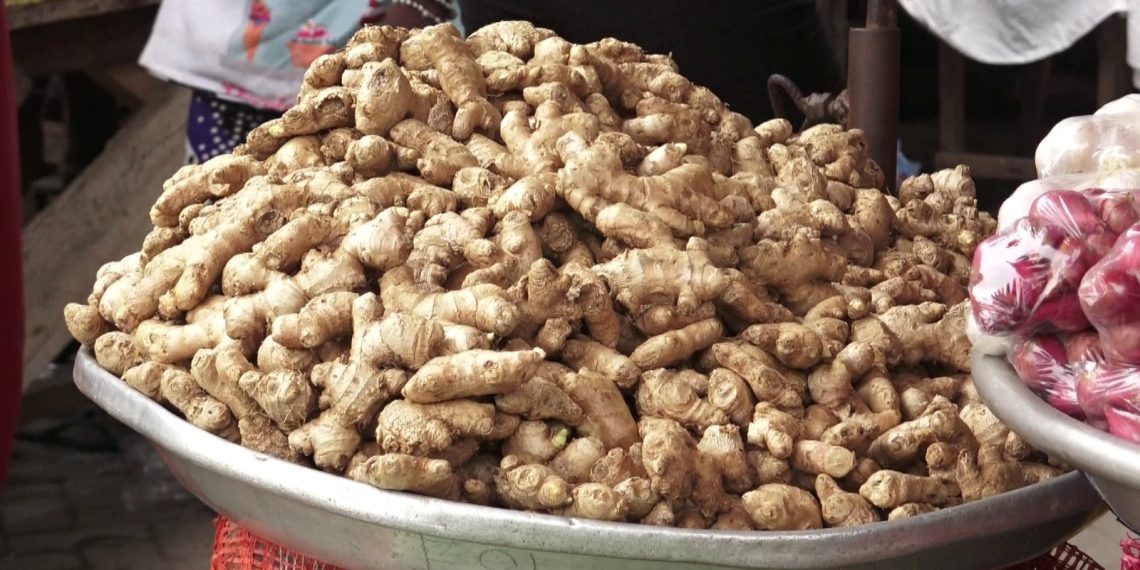
Ghanaian traders are increasingly turning to ginger imports from China and Morocco as a devastating disease outbreak continues to cripple local production, pushing prices to unprecedented levels and forcing households to cut back on the essential spice.
The crisis, now in its third year, has transformed Ghana from a budding ginger producer into a nation more than 99 percent dependent on imports, according to research from the Council for Scientific and Industrial Research (CSIR). National production has collapsed from approximately 102 tonnes in 2020 to just 10 tonnes in 2025, against an annual demand of 30,000 to 32,000 tonnes.
A Disease That Wiped Out a Sector
The root of the crisis is a bacterial wilt infection caused by Ralstonia solanacearum—a soil-borne pathogen that has devastated ginger farms across Ghana’s forest-savannah transition zones. The outbreak, first reported in the Kadjebi District of the Oti Region in October 2023, spread rapidly through major cultivation areas.
Deputy Minister for Food and Agriculture John Dumelo confirmed the severity of the situation in April 2026, stating: “There is a strange ginger disease that has affected farmers in the last two years, which is why ginger has become expensive. Most farmers, when they harvest, get very little produce”.
In some affected areas, yield losses have reached as high as 90 percent. Agricultural experts note that Ghana’s ginger sector was particularly vulnerable due to its reliance on recycled rhizomes for planting—a practice that amplifies the buildup and transmission of soil-borne pathogens over time.
Market Impact: From GH¢250 to GH¢6,000
The supply collapse has triggered dramatic price increases. A sack of ginger that sold for GH¢200–GH¢300 in 2022 now commands between GH¢5,000 and GH¢6,000, according to traders, having peaked at GH¢8,000 earlier this year. At the retail level, a bucket of ginger sells for about GH¢400, an olonka for GH¢300, and smaller quantities for GH¢100.
The price surge has made ginger the most inflated food item in Ghana, with the Ghana Statistical Service recording a 76.7 percent inflation rate for the spice in December 2025. Retail prices now range between GH¢120.83 and GH¢172.89 per kilogram in major cities such as Accra and Kumasi.
“Because ginger is expensive, consumers are no longer buying as they used to,” said trader Irene Pokua, highlighting the dual challenge facing traders who must contend with high procurement costs while consumer demand declines.
Currency Advantage Fuels Cross-Border Competition
Compounding the supply crisis, traders report that buyers from neighbouring Togo—where the CFA franc is stronger than the Ghana cedi—are offering more attractive prices to Ghanaian suppliers. Togolese traders turned to Ghana for supplies last year when their own production was affected by the same outbreak, intensifying competition for limited stocks.
“Last year, Togo was also affected by the virus outbreak, forcing traders to source ginger from Ghana. Because the CFA franc is stronger, Togolese buyers can offer better prices, leaving local traders struggling to compete,” explained trader Nimatu Mustapha.
Imports Bridge the Gap
With domestic production yet to recover, imports from China and Morocco have become a critical source of supply. China accounted for more than 23 percent of Ghana’s total imports in the final quarter of 2025, with agricultural products among the shipments. Production difficulties in Côte d’Ivoire have also reduced supplies from that traditional source.
“With local supplies still recovering slowly, imports from China and Morocco are filling the gap,” traders confirmed.
Calls for Government Intervention
Traders are urging the government to support local farmers and address the production challenges. “If the government supports farmers to increase local ginger production, traders will no longer need to import the product from other countries,” said trader Akua Stella.
The Ministry of Food and Agriculture has indicated it is working to find an antidote to the disease. However, experts warn that recovery will take time. CSIR research suggests that without comprehensive intervention, Ghana’s ginger import dependence is likely to persist, with annual import costs already reaching approximately US$500 million.
A Systems Failure
Agricultural analysts point to deeper structural weaknesses that allowed the crisis to escalate. These include an unreliable planting material system, productivity below potential (5–15 tonnes per hectare versus a potential of 20 tonnes), overstretched extension services, and weak research-to-farm pipelines.
“What is happening in the ginger sector reflects a familiar pattern in Ghanaian agriculture: production increases without corresponding system support, pests or diseases emerge, farmers absorb the losses, attention shifts—until the next crisis,” noted one agricultural expert.
For now, traders say prices are unlikely to ease significantly until fresh harvests become available in sufficient quantities—a prospect that remains uncertain as the nation continues to grapple with one of its most severe agricultural crises in recent memory.


