



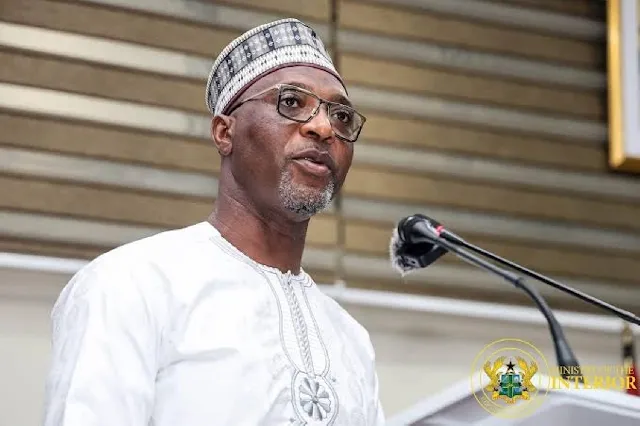
The Minister for the Interior, Muntaka Mohammed-Mubarak, has assured Ghanaians that the country remains safe and secure, declaring that Ghana is “much safer today” than when the government took office in 2025. Speaking on Joy FM’s Super Morning Show on Monday, October 12, 2026, the Minister provided a wide-ranging update on the state of national security, covering border management, the Gun Amnesty Programme, automated traffic enforcement, digital visa systems, security service recruitment, and the fight against drug trafficking.
“I can assure you that we are safer today than we were when we took over power,” Mr Muntaka stated, adding: “We are doing everything possible to ensure that you can go about your duties without necessarily having to be watching your back.”
Security Gains Highlighted
The Minister pointed to a significant improvement in the volatile Bawku area of the Upper East Region, which he said had gone 150 days without gunfire. “150 days, no gunshots,” he declared. The improvement has allowed authorities to ease the curfew in Bawku to between 10 p.m. and 5 a.m., while residents are now permitted to ride motorbikes between 6 a.m. and 6 p.m. — a restriction that had been in place for almost five years.
Mr Muntaka recalled that violence linked to the Bawku conflict had previously spread to other communities, including Binduri, Nalerigu and Walewale, with retaliatory attacks and buses burned along highways. “I mean, and I can bet you, these were periods that I could hardly sleep,” he said. The response combined security operations with mediation and peacebuilding efforts, including the involvement of the National Peace Council.
Nationwide, the number of curfews has declined. Ghana began 2025 with about 11 curfews and ended the year with about nine. “As we speak now, we have only three more curfews,” the Minister said.
Despite the positive assessment, Mr Muntaka identified ethnic conflicts, land disputes, and illicit drugs as continuing security challenges, along with the porous nature of Ghana’s borders.
Border Security: 300 Unapproved Crossing Points
The Minister disclosed that Ghana has only 48 approved entry points but more than 300 unapproved crossing points, describing the situation as a significant security risk. “The legitimate crossing points are 48. We have over 300 illegitimate crossing points,” he stated, stressing that cooperation with neighbouring countries remained essential to addressing cross-border threats.
To strengthen border management, Ghana has deployed a biometric border surveillance system designed to tighten security and facilitate trade. The system is expected to improve the screening of travellers and enhance the detection of criminal networks involved in trafficking, terrorism, and illicit trade.
Gun Amnesty Programme: 4,038 Firearms Surrendered
The Minister reported that the nationwide Gun Amnesty Programme, which ran from December 1, 2025, to January 30, 2026, resulted in the surrender of 4,038 unregistered firearms. The programme allowed individuals to voluntarily surrender or regularise unlicensed firearms without fear of arrest or prosecution.
“The nation is safer today because of your actions,” Mr Muntaka told Ghanaians, commending traditional authorities, religious leaders, civil society organisations, and the media for their role in the programme’s success. He stressed that the amnesty was “a temporary window of grace” and that the window is now closed, with security agencies intensifying intelligence-led operations to confiscate illicit firearms. Over 2,000 seized and surrendered firearms were destroyed on July 9, 2026, at the Police Depot in Accra.
TRAFFITECH-GH: Automated Traffic Enforcement
The Minister highlighted the upcoming rollout of TRAFFITECH-GH, an automated traffic law enforcement system that will deploy cameras and Personal Digital Assistant devices to detect traffic offences. The system is scheduled for full implementation on November 1, 2026, following a postponement from October 1.
Under the system, traffic offences will be captured through fixed and mobile cameras, in-vehicle cameras, and handheld radar systems. Evidence will be reviewed by a back-office control room, after which validated offenders will receive electronic notices detailing the offence, applicable penalties, and payment procedures. The system is expected to reduce opportunities for motorists to make unauthorised payments to police officers.
The Ghana Police Service has completed nationwide training for the rollout, with the Volta Regional back office established in Ho and equipped with the updated software.
E-Visa Portal and Digitalisation
Ghana launched its electronic visa portal on May 25, 2026, coinciding with the 63rd African Union Day. The platform replaces manual visa procedures with a secured, technology-driven online system designed to improve border security management, efficiency, and transparency. President John Dramani Mahama announced that holders of African passports would no longer be required to pay visa fees when travelling to Ghana, in line with the African Union’s Agenda 2063 on free movement of people.
The Minister for Foreign Affairs, Samuel Okudzeto Ablakwa, said the platform features an enhanced security system of international standard. The Minister for Transport, Joseph Bukari Nikpe, noted that the integration of the e-visa portal with Ghana’s passenger information systems would significantly improve border control and passenger screening.
NCABIS: National Crime Automated Biometric Identification System
The Ministry of the Interior is rolling out the National Crime Automated Biometric Identification System (NCABIS) to make criminal background checks more accessible. When completed, the system is expected to provide 751 centres across the country, enabling people to obtain background checks at the district level. Subsequent checks could be conducted online after initial registration, subject to verification that there had been no new criminal record.
Security Service Recruitment: 40,000 Youth Target
The government has announced plans to recruit approximately 40,000 young Ghanaians into the security services between 2025 and 2028. In 2025, 12,000 people were recruited into various security agencies, including the Ghana Armed Forces (over 5,000), Ghana Police Service (approximately 4,000), and the Ghana Immigration Service, Ghana Prisons Service, and Ghana National Fire Service (about 2,000 each).
The first batch of 10,000 successful applicants has commenced training, with another 10,000 to be selected from the current pool and undergo training next year. The recruitment exercise has seen the implementation of digital reforms, including a centralised e-recruitment portal, to enhance transparency and efficiency.
Unauthorised Sirens and Road Traffic Offences
The Minister disclosed that 1,814 cases of unauthorised siren use were recorded during a nationwide enforcement exercise. The Police Service is collaborating with the Ghana Revenue Authority and the Ministry of Trade to restrict the importation of unauthorised sirens into the country. Repeat offenders will face prosecution.
Fight Against Drug Trafficking
On narcotics, the Minister revealed that Ghana had no equipment capable of detecting narcotics when he assumed office in 2025. “When we came, there was not a single gadget in this country that could detect narcotics,” he said, explaining that officers had to rely on visual inspection after suspicious substances passed through routine scanning. The Ministry has since taken steps to address the equipment gap.
Mr Muntaka appealed to the public to provide information on suspected drug activities without making excessive financial demands on security agencies. He cited a case where an individual allegedly demanded US$20 million from the Narcotics Control Commission before providing information, and others requesting as much as GH¢5,000. “We are pleading with our citizens that we need to keep all of us safe. We don’t have unlimited resources,” he said. The Minister noted that about 99 per cent of the information received was credible, and assured informants that the government would cover transportation costs and provide security protection where necessary.
The Minister also alleged that suspected cannabis traffickers are using ambulances and bullion vans to transport the substance. “Sometimes, you’d see an ambulance coming from those areas, and then we will get intel that this is not carrying a sick person; it is carrying weed,” he said. Security officers who stopped and searched some of the vehicles discovered cannabis inside.
Ghana has recorded 28 drug seizures over the past 20 months, 11 of which involved cocaine. Five drug-related operations were conducted internationally, including two in Belgium and one each in Australia, France, and the Netherlands. The Narcotics Control Commission and partner agencies have made 217 arrests and 165 prosecutions, intercepting more than 8.5 tonnes of assorted narcotic drugs and 45.4 million tramadol tablets.
Call for Public Support
The Minister called on Ghanaians to support the security services by providing credible information on suspicious activities, cooperating with officers, and complying with the law. “If you see something, say something,” he urged, emphasising that drug trafficking is complex and requires effective international cooperation with neighbouring countries and foreign security agencies.


