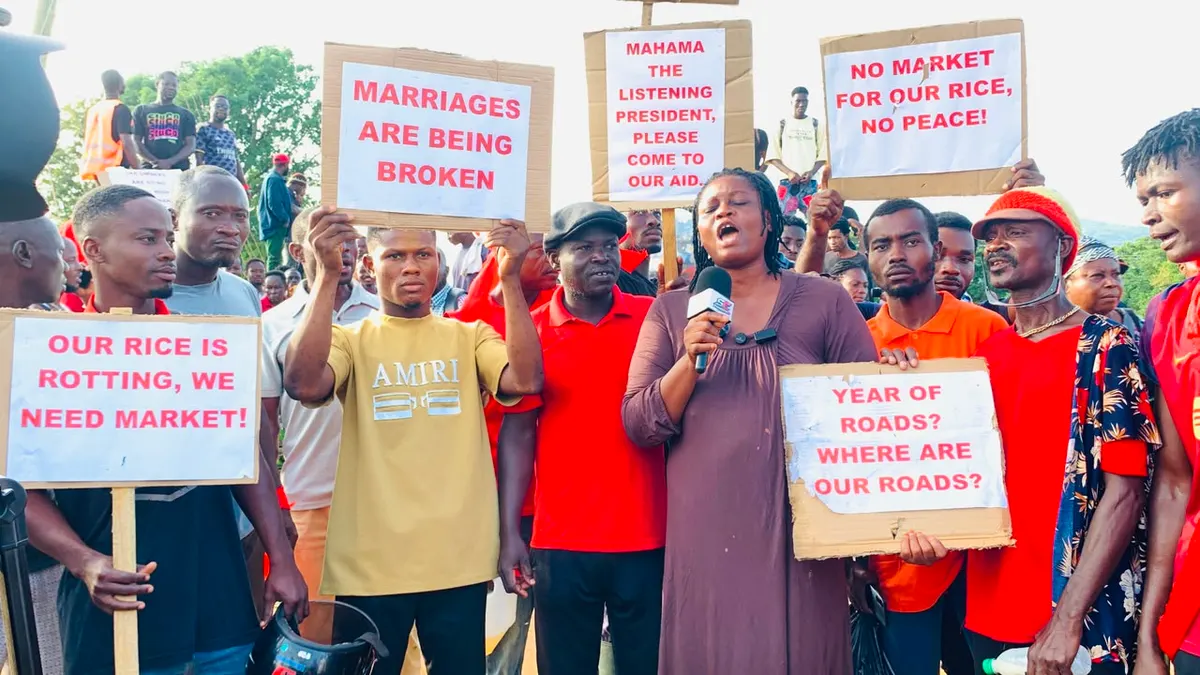
Hundreds of residents from Asutsuare, Akuse, and surrounding communities in the Shai-Osudoku District staged a peaceful demonstration on Saturday, 19 September 2026, demanding urgent government intervention over poor roads and the collapse of the local rice market.
The protest, organised by the Osudoku Youth Association (OYA), brought together residents, elders, women’s groups, farmers, traders, and young people. They marched through the principal streets of Asutsuare to Akuse before presenting a petition addressed to President John Dramani Mahama.
Carrying placards with inscriptions such as “Save Osudoku Rice Farmers,” “Fix Our Roads Now,” and “Complete Our Projects,” the demonstrators described the action as a constitutional exercise under Article 21(1)(d) of the 1992 Constitution to amplify their long-standing development concerns.
Rice Farmers in Crisis
Addressing journalists, the Chairman of the Osudoku Youth Association, Mr Richard Nii Sai, said the lack of a market for locally produced rice was the most pressing challenge facing the area.
He noted that Asutsuare and its adjoining communities, regarded as one of Ghana’s major rice-producing hubs, have produced rice in abundance since 2025. However, thousands of bags remain unsold in warehouses because imported rice continues to dominate the local market.
The district, with approximately 4,000 hectares of rice under irrigation and the capacity for two harvests per year, has become a victim of its own success. The District Chief Executive for Shai-Osudoku, Ignatius Godfred Dordoe, had earlier warned that the glut was crippling farmers, noting that locally produced rice sells for around GHS 600 per bag while cheaper imported rice sells for as little as GHS 400.
The OYA appealed to the government to introduce policies to protect the local rice industry and to direct the National Food Buffer Stock Company (NAFCO) to purchase the stockpile to prevent farmers from incurring huge financial losses.
In March 2026, President Mahama directed NAFCO to centralise the procurement of rice for schools and prioritise locally produced rice. However, farmers have accused NAFCO of failing to fully carry out the directive, with the company citing a need for GH¢770 million to purchase excess rice and grains from farmers nationwide.
The human cost has been grim. Reports said a farmer identified as Zola died by suicide after struggling to repay a bank loan linked to his farming activities. Philip Akpoka Anumah, President of the Osudoku Rice Farmers Association, noted that the GHS 350 per bag offered by buffer stock authorities falls below production costs, worsening farmers’ losses.
Roads in Ruins
The demonstrators also expressed concern about the deplorable state of the Asutsuare-Akuse, Asutsuare Junction, Osuwem-Tsopoli, and Volivo township roads. They said the roads have become almost impassable, especially during the rainy season.
Mr Sai disclosed that the poor road network has increased transportation costs, delayed access to healthcare, and contributed to significant post-harvest losses for farmers conveying produce to market.
The Asutsuare-Akuse road, in particular, has been in poor condition for over 30 years, according to residents. A Ghana News Agency visit in June 2026 observed heavy-duty equipment under the District Road Improvement Programme (DRIP) reshaping portions of the road, but residents say the intervention is only temporary and are demanding full tarred rehabilitation.
“We are not asking for too much. We are only requesting that our road be tarred,” said Ms Catherine Sogbadzie, a rice farmer and aggregator in Akuse. She noted that Akuse has been neglected for years, with transport fares from Tema and other trading centres becoming prohibitively high due to the poor nature of the road.
Mr Daniel Addo, another resident, appealed to President Mahama to intervene, stating that despite campaign promises by the Member of Parliament, Mr Ebenezer Okletey Terlabi, no major construction work has commenced.
“More than 50 trucks use this road daily. We have factories, rice farms, milling companies, and sand-winning operations here, but the road remains in bad condition,” he said.
Stalled Irrigation Project Threatens Food Security
Another major concern was the abandonment of Phase Two of the Kpong Irrigation Scheme Rehabilitation Project.
“The stalled project has left more than 300 farmers unable to cultivate over 600 hectares of developed farmland for the past two years, threatening jobs and food security,” Mr Sai added.
The Kpong Irrigation Scheme covers more than 4,000 hectares of farmland and serves approximately 2,500 smallholder farmers and 25 commercial farmers. The project is expected to generate about 7,020 direct jobs and support an estimated 21,672 indirect beneficiary households. However, it is currently on hold due to funding challenges.
The second phase is part of the West Africa Food System Resilience Project (FSRP), with $22.6 million in funding from the World Bank. The OYA appealed to President Mahama to direct the Ministry of Finance to release funds to enable the contractor to return to site and complete the project.
They said they had previously engaged the Ministers for Food and Agriculture and Finance, as well as the Greater Accra Regional Minister, but had yet to see what they considered positive action.
Abandoned Market and Public Facilities
The Association further called for the completion of the abandoned Asutsuare Market project, noting that market women continue to trade under the scorching sun and in the rain, while the unfinished structure has become a danger to residents. The project was intended to provide a modern trading facility but has been left incomplete for more than two years.
The OYA also demanded the immediate distribution of government-subsidised fertiliser to more than 2,400 farmers under the Kpong Irrigation Scheme and the completion of abandoned public toilet facilities in Asutsuare, Volivo, Osuwem, and Akuse. These facilities were constructed under the Ghana First initiative but have been left incomplete.
Call for Constituency Split
The demonstrators also called for the initiation of constitutional processes to split the Shai-Osudoku Constituency into separate Shai and Osudoku constituencies.
This demand echoes a campaign promise made by then-candidate John Dramani Mahama in September 2024, when he told a gathering in the constituency: “If there is an opportunity to redemarcate constituencies and districts, next year when the NDC comes to the office we will consider splitting Shai-Osudoku into two separate constituencies.”
The call for a separate Osudoku District has also been renewed by the Osudoku Paramount Chief, who has passionately appealed for the creation of a distinct district to accelerate local development and ensure effective governance.
A Community’s Patience Wears Thin
Mr Sai said the people of Osudoku overwhelmingly supported President Mahama in the 2024 general election after he visited the traditional area and promised to prioritise its development.
The demonstrators expressed confidence that the President would respond swiftly to their petition and address the seven development challenges facing the Osudoku Traditional Area.
The protest was peaceful and conducted in accordance with Article 21(1)(d) of the 1992 Constitution, which guarantees the right to freedom of assembly and demonstration. The OYA emphasised that their action was not partisan but a desperate plea for development that has been denied to them for far too long.
As the sun set over the rice fields of Asutsuare, the message from the people of Osudoku was clear: they have waited long enough. The bags of unsold rice in their warehouses and the craters in their roads are not just economic statistics — they are the daily reality of a community that feeds the nation but cannot feed itself.