



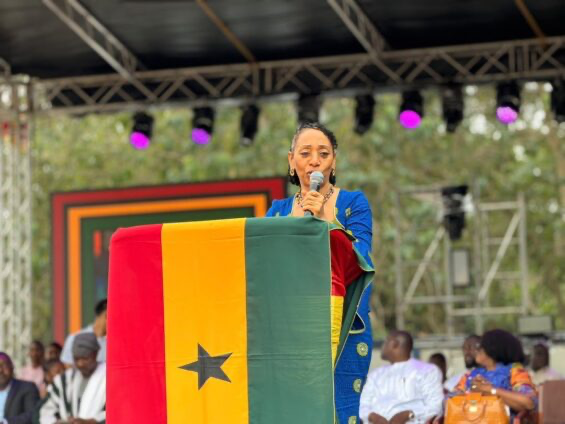
In an emotional homecoming that marked a significant turning point for Ghana’s most storied political family, Samia Yaba Nkrumah, daughter of Ghana’s first President Osagyefo Dr. Kwame Nkrumah, led the Nkrumah family back to their ancestral home of Nkroful on Saturday, offering a heartfelt apology for decades of absence and vowing to reignite the flame of her father’s Pan-African vision for a new generation.
The occasion was the 2026 NkrumahFest, held in the Ellembelle District of the Western Region, which brought together family members, political leaders, academics, Pan-Africanists, traditional authorities, and young people to commemorate the legacy of the man who led Ghana to independence in 1957 and became a global symbol of African liberation.
A Painful History, A Long Absence
For Samia Nkrumah, the return was far more than a ceremonial visit. It was a reckoning with a painful past that had kept the family away from Nkroful for decades.
“I want you to forgive us for staying away from our home for so long,” she told the gathering, her voice carrying the weight of personal and historical trauma.
Samia recounted the harrowing experiences that shaped the family’s long estrangement from their ancestral home. She spoke of witnessing the personal cost of her father’s political commitment, including surviving assassination attempts. She recalled seeing her father wounded and covered in blood following one of the attacks.
“We were traumatised, we were scared, we were confused,” she said.
Kwame Nkrumah survived multiple assassination attempts during his presidency, including the Kulungugu bomb attack in August 1962, which injured him and killed several others. The trauma of those years, culminating in the February 24, 1966 coup that overthrew his government while he was on a peace mission in Vietnam, left deep scars on the family.
The coup, code-named “Operation Cold Chop” by its architects, was backed by Western powers who viewed Nkrumah’s Pan-Africanist agenda and socialist leanings as a threat to their interests on the continent. Nkrumah never returned to Ghana, dying in exile in Bucharest, Romania, on April 27, 1972.
“But the good news is that we’ve come back,” Samia declared. “And we want to make a contribution to Ghana’s progress, to Ghana’s development, and to Ghana’s unity.”
Introducing the Next Generation
Samia introduced three of Nkrumah’s grandchildren who accompanied her to the festival, describing their presence as a source of pride and a symbol of the family’s commitment to reconnecting with their roots.
She emphasized that the family’s renewed engagement was not simply about honouring Nkrumah as a historical figure, but ensuring that his ideas continue to be examined and used to inspire future generations.
“We are coming back to recognize our father’s work. We are coming back to appreciate his ideas, and we are coming back to make sure that those ideas never die, but rather, they nourish us and give us the courage to make Ghana better,” she said.
Challenging the 1966 Narrative
Samia used the platform to challenge what she described as negative narratives surrounding the 1966 overthrow of her father’s government.
Referring to the statue of Nkrumah at the Kwame Nkrumah Memorial Park and Museum in Accra, she recalled that its head was severed from the body following the coup. The iconic statue, which stood in front of the old Parliament House, was decapitated by soldiers and toppled as crowds celebrated the coup.
She argued that the destruction of the statue and celebrations associated with the coup should not be interpreted as evidence that all Ghanaians supported Nkrumah’s removal from office.
“That negative propaganda that Osagyefo when he left, Ghanaians were happy is not true,” she said.
Historical accounts confirm that while some Ghanaians celebrated the coup, many others were deeply opposed to the overthrow of the man who had led the nation to independence. Nkrumah remained immensely popular among ordinary Ghanaians and throughout the African diaspora, and his vision of a united Africa continued to inspire liberation movements across the continent long after his removal from power.
Samia expressed appreciation to individuals and organisations working to document what she considers a more accurate account of Nkrumah’s life and legacy.
A New Statue, A Renewed Hope
Samia also spoke about the unveiling of a new Nkrumah statue at a roundabout in Sunyani, in the Bono Region, saying the experience moved her because of the contrast with the earlier destruction of his statue.
For her, the new monument represented what she sees as a renewed interest in Nkrumah’s ideas.
“When we unveiled the statue at the roundabout, I realised that yes, we are going to rise. Nzimaland will rise, Africa will rise, Ghana will rise, and Africans everywhere are going to rise,” she said, invoking the Akan word “Nzima” referring to the Nzema people of Ghana’s Western Region, from whom Nkrumah descended.
She stressed, however, that the purpose of such symbols should not be the worship of statues but the preservation of the ideas they represent.
‘We Want to Reintroduce Our Father’s Ideas’
Samia pledged the Nkrumah family’s continued support for NkrumahFest, commending its organisers for using the festival to expose younger generations to Nkrumah’s philosophy and Pan-African vision.
She specifically acknowledged the Minister for Lands and Natural Resources and Member of Parliament for Ellembelle, Emmanuel Armah-Kofi Buah, a convener of the festival.
“It is for this reason that the Nkrumah family will always support what our brother is doing, what Honourable Buah is doing with NkrumahFest, enlightening the younger generation. Honourable, the Nkrumah family is behind you,” she said.
She said the family’s participation was intended to help reconnect young Ghanaians and Africans with Nkrumah’s ideas.
“We are here because we want to reintroduce our father’s ideas to the younger generation. Because we believe he was speaking Africa’s truth,” she added.
Rejecting the ‘Isolationist’ Label
Samia also rejected descriptions of Nkrumah as an isolationist or a rigid leader whose ideas were disconnected from the wider world.
She argued that his strong Ghanaian nationalism and Pan-Africanism existed alongside relationships with people from different countries and continents.
“They say he was an isolationist. They say he was dogmatic, rigid in his ideas. Let me tell you, this is not true,” she said.
Nkrumah’s internationalism was evident in his close relationships with leaders such as Jawaharlal Nehru of India, Gamal Abdel Nasser of Egypt, and Josip Broz Tito of Yugoslavia, with whom he helped found the Non-Aligned Movement in 1961. His vision of African unity led to the establishment of the Organisation of African Unity in 1963, the precursor to the African Union.
A Festival of Ideas and Legacy
The 2026 NkrumahFest at Nkroful brought together members of the Nkrumah family, political leaders, academics, Pan-Africanists, traditional authorities, young people and other guests to commemorate Ghana’s first President and reflect on his vision for Ghana and Africa.
The festival has become an annual gathering dedicated to preserving and promoting Nkrumah’s intellectual legacy, featuring panel discussions, cultural performances, and educational activities aimed at young people.
A Legacy That Endures
Kwame Nkrumah’s legacy extends far beyond Ghana’s borders. He was a founding father of the Pan-African movement, a leading advocate for African unity, and an inspiration to liberation movements across the continent. His writings, including “Africa Must Unite” and “Neo-Colonialism: The Last Stage of Imperialism,” remain influential in academic and political circles worldwide.
His vision of a United States of Africa, though not fully realised, continues to inspire debates about continental integration and cooperation. The African Union, the continent’s premier political and economic organisation, traces its philosophical roots to Nkrumah’s ideas.
For Samia Nkrumah, who served as a Member of Parliament for Jomoro from 2009 to 2013 and was the first female chairperson of the Convention People’s Party, the return to Nkroful represents both a personal healing and a political reawakening.
As the festival drew to a close, the message from the Nkrumah family was clear: the ideas of Osagyefo Dr. Kwame Nkrumah are not relics of the past, but living principles that must be nurtured and passed on to future generations.
“The Nkrumah family is back,” Samia declared. “And we are here to stay.”


