



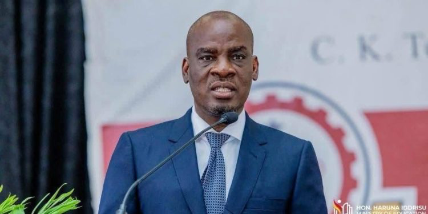
The Ministry of Education, in collaboration with the Ministry of Finance, is set to undertake a major procurement of furniture for selected Senior High Schools (SHSs) across Ghana, Education Minister Haruna Iddrisu has announced, in an intervention intended to accelerate efforts to end the double-track system in schools that already have adequate classroom infrastructure but lack sufficient furniture to accommodate all students at the same time.
The Minister made the disclosure during a surprise monitoring visit to selected schools in the Western Region, including Tarkwa Senior High School (TASCO), Asankragwa Senior High School and Asankragwa Technical Institute.
“There are many schools that if we provided them with furniture, we can take them off double track and we will do that. We will undertake a major procurement of furniture to fix that,” Mr Iddrisu said at Tarkwa Senior High School.
The visits, which extended into the night, formed part of the Ministry’s monitoring exercise following the commencement of the reporting of first-year students to senior high schools across the country. The Minister interacted with students and staff and inspected the arrangements put in place for the new entrants, assessing conditions in schools and identifying challenges that could affect teaching and learning.
The Furniture Bottleneck
Mr Iddrisu explained that some senior high schools have enough classrooms and other physical infrastructure to operate a single-track system but continue to run double track because they do not have adequate desks and other furniture for students.
He said providing such schools with the necessary furniture would immediately increase their capacity to accommodate students without requiring them to rely on separate academic tracks.
At Tarkwa Senior High School, the Minister identified the shortage of furniture as one of the key issues limiting the ability of some schools to completely phase out the double-track arrangement. He noted that the government had identified schools where classroom space was available but a shortage of desks and other furniture was preventing them from accommodating all students under a single-track system.
The planned procurement would therefore focus on addressing this gap and supporting schools already equipped with adequate classroom infrastructure.
GH¢3 Billion Infrastructure Programme
The furniture intervention forms part of a broader GH¢3 billion infrastructure programme designed to permanently end the double-track system. In July 2026, the Minister announced a new target of 2029 for the double-track system to end, through a major expansion of school infrastructure under the Secondary Education Transformation for Access, Relevance and Results for Jobs (STARR-J) programme. Cabinet approved the STARR-J infrastructure programme, which covers 210 senior high schools, senior high technical schools and Technical and Vocational Education and Training (TVET) institutions across the country.
The programme includes the rehabilitation of 112 senior high schools and 38 TVET institutions, the upgrading of 30 Category C schools to Category B and the conversion of 20 Category B schools to Category A.
He cited Presbyterian Boys’ Secondary School and Achimota School as examples of schools where student enrolment had increased sharply without corresponding expansion in classrooms, dormitories and laboratories.
“That’s why we’re introducing the STARR-J initiative. By 2029, we should be done with double track with this intervention. Some of the double-track schools, it’s just furniture. They are not asking for money. Director General of GES is here. I hear about a hundred schools. If we give them adequate furniture, they are out of double track. So it’s to coordinate the things we are doing,” he said.
The STARR-J programme would also provide new community day senior high schools at Nima and Kasoa, as well as a special needs education facility in the Volta Region. Another special needs school is being considered between Kintampo and a town in the Upper East Region.
World Bank Backing
The programme is being financed through a US$300 million World Bank facility approved by the Bank’s Executive Board on June 16, 2026, and subsequently approved by Parliament on July 22, 2026.
The World Bank has said the financing package will expand access to quality secondary education and equip more young people with the basic knowledge and skills necessary to transition to higher education and enter the labour market, addressing what it described as “an increased reliance on a double-track system with long breaks in school attendance” that has “led to discontinuity in learning.”
Under the project, key procurement activities include the construction of 10 new Senior High Schools and TVET institutions, the upgrade of 50 SHS/TVIs, the rehabilitation of 150 SHS/TVIs, the procurement of furniture for SHS and TVIs, and the procurement of science laboratory and workshop equipment and consumables.
GETFund Furniture Allocation
The furniture drive is already underway. GETFund has allocated GH¢230 million for the procurement of furniture for basic and senior high schools, with 226,635 mono desks already distributed to 547 schools in 2025. The government also plans to procure more than 2 million metal mono-desks and chairs for secondary schools and selected district education directorates.
Addressing Parliament earlier in 2026, Mr Iddrisu acknowledged the worsening furniture shortage across schools, recounting a visit to the Sefwi area where he witnessed pupils struggling with inadequate and poor-quality desks.
“It was sad to see a number of basic school learners struggling with furniture — not just its inadequacy, but the quality of the furniture that is being used,” he told Parliament.
He disclosed that government was reviewing the current procurement system to allow regional education directorates to procure furniture based on local needs instead of relying solely on centralised arrangements.
“If we were to adequately provide for furniture, we can take 100 schools out of the double-track system,” he added.
Improved Student Meals
During the Western Region tour, the Minister also announced plans to include eggs and chicken in meals served to students, signalling an effort to improve the nutritional content of meals provided under the second-cycle education system.
The announcement comes as schools receive large numbers of first-year students following the latest admission exercise, placing renewed attention on accommodation, feeding, teaching and learning facilities, as well as the general welfare of students.
The Minister also addressed the challenges in the education sector more broadly, noting that Ghana has recorded significant gains in enrolment under the Free SHS policy but admitted that infrastructure expansion has lagged behind increasing student numbers.
“What is lacking is the infrastructure of dormitories, laboratories and others,” he said.
On teacher shortages, he disclosed that government is currently recruiting 7,000 teachers and nearly 3,000 lecturers nationwide, though he admitted that Ghana requires at least 50,000 teachers to fully address staffing gaps across the country.
Background: The Double-Track System
The double-track system was introduced by the Akufo-Addo administration in September 2018 as a temporary measure to manage the surge in enrolment following the implementation of the Free Senior High School policy in 2017. Under the system, students are divided into two tracks — Green and Gold — with each track attending school for a portion of the academic year while the other is on vacation, allowing schools to accommodate more students than their infrastructure would otherwise permit.
Critics, including President Mahama when he was in opposition, argued that the system reduced teacher contact hours and compromised quality. “We will abolish the current shift (double track) system, reintroduce the more efficient three-term per academic year programme, and bring back the emphasis on skills training, technical and vocational education,” Mahama posted on Facebook in 2018.
A former deputy Director-General of the Ghana Education Service later defended the policy, stating that “had it not been for the double track system some almost 1.3 million people, 1,274,000 or so children, had access to school beyond what would have been possible.”
Under the Free SHS policy, enrolment at the secondary level expanded dramatically. In 2025 alone, the Free SHS programme received GH¢3.5 billion under GETFund — the highest allocation since the programme’s inception — while the government allocated GH¢4.2 billion in the 2026 Budget to the Senior High School Policy, particularly towards feeding.
The government has pledged to complete 27 abandoned E-block projects nationwide with an allocation of approximately GH¢996 million, with authorities reviewing contract values because many of the projects were awarded years ago and can no longer be executed under the original financial terms.
Ongoing Concerns
Concerns have emerged over the current school placement exercise, with about 54,985 students reportedly redirected to private Senior High Schools under a discounted-fee arrangement. Education think tank EduWatch also raised alarm over a projected placement gap, noting that although about 620,000 candidates sat for the 2025 BECE, an estimated 607,000 were expected to qualify for placement under the Free SHS programme, with the shortfall driven partly by the phased reduction of the double-track system in some schools.
The Ghana Education Service, however, dismissed reports claiming that about 72,000 candidates risked being denied placement, describing the figures as false and not based on facts, and assured stakeholders that the transition to phase out the double-track system would not limit access to Senior High or Technical Schools.
The Minister’s monitoring exercise is expected to continue in the Central Region, where he is scheduled to visit schools to assess preparations and the integration of first-year students.


