



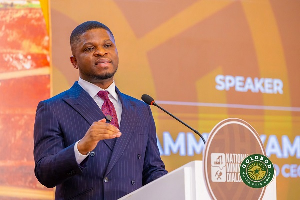
The Chief Executive Officer of the Ghana Gold Board (GoldBod), Sammy Gyamfi, has thrown his weight behind President John Dramani Mahama’s directive to restore the Narcotics Control Commission (NACOC) to Ghana’s list of Port Inspection Agencies, describing the Commission’s 2018 exclusion as a decisive blow to the country’s ability to intercept narcotics at its entry and exit points.
In a Facebook post on Monday, September 21, Gyamfi said he was deeply concerned by a recent drug seizure in another jurisdiction involving a shipment whose origin was traced to one of Ghana’s ports, arguing that such incidents exposed glaring weaknesses in the country’s monitoring and inspection systems.
“Clearly, these incidents could have only been occasioned by weak monitoring and inspection systems at our ports,” he wrote.
A Decade of Weakened Controls
Gyamfi noted that NACOC, the institution statutorily mandated to monitor, regulate, enforce and control narcotics trafficking in Ghana, was removed from the list of Port Inspection Agencies in June 2018 — a decision he said weakened the Commission’s port inspection function and denied it the ability to detect and prevent drug trafficking through the country’s points of entry and exit.
“While it is unclear what may have informed that decision in 2018, it is evident that the said decision weakened NACOC’s port inspection function,” he said.
The 2018 reforms, introduced by the then-government as part of efforts to streamline port operations and reduce cargo clearance times, cut the number of inspection agencies at the country’s ports from over 20 to just three — the Ghana Revenue Authority, Ghana Ports and Harbours Authority, and Ghana Standards Authority. NACOC, then known as the Narcotics Control Board (NACOB), was excluded from routine joint container inspections through a Cabinet memo.
Former Defence Minister Dominic Nitiwul has since clarified that NACOC was never physically removed from the ports but was excluded from the routine physical inspection of containers as part of the 2018 reforms. Security analysts, however, have long criticised the exclusion for undermining Ghana’s capacity to detect narcotics and other contraband hidden within shipping containers.
Presidential Directive and Immediate Measures
Gyamfi welcomed President Mahama’s directive for NACOC to be restored to the list of Port Inspection Agencies with immediate effect, granting the Commission “unfettered access to all entry and exit points; by air, land and sea”.
He also disclosed that the President had directed the immediate replacement of all scanners and personnel at Ghana’s ports as part of measures to strengthen checks and controls.
“I believe that these measures, if implemented effectively, will strengthen checks and control at our ports to forestall the recurrence of these unfortunate incidents,” he said.
The directive followed a high-level meeting at the Presidency on Wednesday, September 17, attended by key figures from national security, narcotics control, and transportation sectors, during which President Mahama gave all security and regulatory agencies at the ports two weeks to submit a comprehensive framework for harmonised, coordinated and accountable operations. A Joint Taskforce is also to be established to coordinate inspections, cut bureaucratic delays and enforce compliance across all port operations.
The Drug Bust That Sparked Action
The renewed focus on port security comes in the wake of a series of major narcotics seizures linked to Ghana. On September 10, 2026, French customs intercepted nearly 3.9 tonnes of cocaine concealed in a container of plastic waste that had departed from Ghana’s ports, a haul valued at approximately US$261.45 million. The seizure at the Port of Dunkirk triggered widespread concern, with four Ghana Revenue Authority Customs officers among 10 individuals arrested in connection with the shipment.
Earlier, in June 2026, Australian authorities seized 320 kilogrammes of methamphetamine from a charcoal consignment traced to Ghana. The Minority in Parliament petitioned Speaker Alban Bagbin to recall the House to investigate the seizures, citing concerns about Ghana’s export systems, customs controls, intelligence gathering and narcotics enforcement.
A Proven Partnership
Gyamfi, who has worked closely with the Major General Maxwell Obuba Mantey-led NACOC in the fight against gold smuggling, expressed confidence that the Commission would succeed in stemming the tide of drug trafficking with the necessary institutional support.
“As someone who has closely worked with the Major General Maxwell Obuba Mantey-led NACOC in fighting gold smuggling, I am confident that with the necessary support, the NACOC will succeed in stemming this tide,” he wrote.
That collaboration has already yielded tangible results. In July 2026, GoldBod presented GH¢12,645,862.48 to NACOC — representing 50 per cent of the proceeds from 17 gold bars seized from illicit gold traders in 2025. The gold bars, valued at approximately US$1.7 million, had been intercepted at the Paga Border Post from two Burkinabe nationals attempting illegal export.
The reward was presented under GoldBod’s intelligence and whistleblower incentive scheme, with 20 per cent allocated to NACOC officers who risked their lives during the operation and 20 per cent to the institution for deploying its personnel and resources. Gyamfi commended NACOC for its “professionalism, dedication and unwavering commitment to protecting Ghana’s borders”.
NACOC’s Statutory Mandate
NACOC was established under the Narcotics Control Commission Act, 2020 (Act 1019), which transformed the former Narcotics Control Board into a commission with enhanced powers and mandate to curb the drug menace in line with the United Nations’ Comprehensive Multidisciplinary Outline. Under the Act, the Commission enforces laws and exercises powers of entry, search, arrest and seizures, and is mandated to take measures to eliminate the import and export of narcotic drugs and plants as well as precursors by land, air and sea.
The Commission has previously demonstrated its capacity to intercept contraband even with limited port access. In April 2025, NACOC officers intercepted three wooden boxes containing narcotics at the export section of the Swissport Cargo Terminal at Kotoka International Airport, destined for Brussels.
A Necessary Correction
Gyamfi’s endorsement adds a significant voice to the growing consensus that NACOC’s exclusion from port inspections was a costly policy error. With Ghana’s two principal ports, Tema and Takoradi, handling more than 80 per cent of the country’s import and export cargo, the restoration of the Commission to the joint container inspection regime is seen as a critical step in balancing trade facilitation with national security.
“It is therefore refreshing to learn that President Mahama has directed that effective immediately, NACOC be restored to the list of Port Inspection Agencies,” Gyamfi said.
As the Mahama administration moves to implement the directive, all eyes will be on whether the restored NACOC, equipped with new scanners, personnel and a coordinated taskforce, can deliver on the promise of stronger port security and restore confidence in Ghana’s ability to safeguard its borders.


