



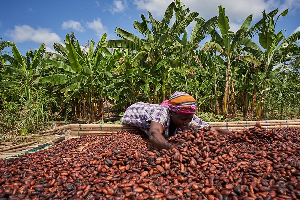
– The Cocoa Marketing Company (Ghana) Limited (CMC) has officially launched a comprehensive 24-hour operational model aimed at significantly reducing delays in the movement and export of Ghana’s cocoa, marking a major step in the implementation of President John Dramani Mahama’s 24-Hour Economy and Accelerated Export Development Programme .
The new framework, which commenced at the start of the 2026/27 cocoa season, is designed to keep critical sections of the cocoa logistics chain active beyond the traditional working day .
📌 The Three Pillars: Offload 24, Load 24, Export 24
At the heart of this initiative are three operational commitments designed to improve efficiency from the point cocoa arrives at CMC facilities through to processing and eventual export .
· Offload 24: This component enables CMC to receive cocoa from Licensed Buying Companies (LBCs) around the clock. This is intended to reduce truck queues, waiting periods, and congestion at CMC’s operational facilities in Tema, Kumasi and Takoradi .
· Load 24: This pillar supports the supply of cocoa to local processing factories beyond conventional working hours, allowing processors to make more efficient use of their installed production capacity .
· Export 24: This extends the processes of cocoa inspection, stuffing, sealing, documentation and shipment preparation so that exports can continue in alignment with vessel schedules and port operations .
🗣️ Leadership Comments and Rationale
Speaking at the launch event in Tema, CMC Managing Director Wisdom Kofi Dogbey highlighted the long-standing inefficiencies that the new model aims to address.
“The world does not stop at 5 p.m. or 4 p.m., and neither should Ghana’s cocoa ambition,” he said .
Mr. Dogbey explained that operations at CMC’s take-over centres had traditionally followed conventional working hours, which meant that trucks arriving later in the day could sometimes wait until the following morning, and documentation could be delayed even as ports and shipping lines continued to operate .
Using a vivid metaphor, he emphasised the importance of this change: “A chain cannot move faster than its slowest link. For too long, at certain times of the day, that link has been us. This season, we remove that constraint” .
The Managing Director clarified that the initiative does not mean requiring individual employees to work continuously for 24 hours. Instead, it involves organising productive activity around multiple shifts to ensure that infrastructure, human resources, and other productive assets generate economic value beyond the traditional working day .
🎯 Strategic Impact and Sector Context
The initiative is significant for Ghana’s cocoa sector, which is currently navigating a complex landscape. Ghana’s cocoa production for the 2026/27 season is projected to fall by 13% to 650,000 metric tonnes, down from the 750,000 MT produced in the 2025/26 season . This expected decline is linked to challenges including ageing cocoa farms, swollen shoot disease, and the possible impact of the El Niño weather pattern .
Against this backdrop of potential supply constraints, the efficiency gains from the 24-hour model are crucial. Faster movement of cocoa from LBCs to warehouses and vessels reduces exposure to humidity and handling risks, while quicker takeover leads to faster issuance of cocoa takeover receipts and ultimately prompt payment to LBCs who pay the farmers .
Chief Executive of the Ghana Cocoa Board (COCOBOD), Dr. Randy Abbey, said the initiative would help reduce vessel waiting times and demurrage, ease congestion, and increase handling capacity by allowing facilities to operate across three shifts instead of one . The expanded operations are also expected to create jobs for dock workers, quality control officers, weighbridge operators, security personnel, and logistics workers .
The strategic importance is further underscored by broader sector reforms. The new COCOBOD law, passed in July 2026, guarantees farmers no less than 70% of the gross free-on-board value of cocoa, and the government is committed to ensuring at least half of Ghana’s cocoa crop is processed locally before export from the 2026/27 season .
🤝 Stakeholder Alignment and Support
The launch brought together a wide array of stakeholders from across the cocoa value chain, including representatives of government, COCOBOD, LBCs, cocoa processors, the Ghana Ports and Harbours Authority, Meridian Port Services, the Ghana Revenue Authority, shipping lines, hauliers, and international cocoa buyers .
COCOBOD Board Chairman Dr. Samuel Ofosu-Ampofo provided a practical illustration of the delays the initiative seeks to address, recalling a recent visit to Takoradi where he saw trucks waiting to discharge significant volumes of cocoa beans that were ready for shipment. “When I asked, ‘When do you close?’ And they said, ‘By 5 o’clock, we have closed,'” he recounted, questioning the logic of such an early closure .
Presidential Advisor for the 24-Hour Economy and Accelerated Export Development, Augustus Tanoh, said a feasibility study conducted by a committee of experts had found the new operating model to be “operationally and commercially sound” .
📊 Implementation and Monitoring
CMC says the implementation of the programme will be closely monitored against measurable performance indicators, including truck turnaround times, volumes handled, documentation efficiency, shipment performance, safety, quality, and overall operational performance .
Mr. Dogbey urged Licensed Buying Companies to make use of evening delivery windows, encouraged cocoa processing companies to schedule trucks beyond daylight hours, and appealed to shipping lines to provide gate-in windows that align with CMC’s extended operating schedule .
The company says the initiative will improve speed and productivity without compromising safety or quality, helping Ghana to remain competitive in the global cocoa market. The rollout will begin at high-volume facilities in Tema and Takoradi, with efficiency gains measured against the cost of night operations .
As Ghana seeks to strengthen its position as a leading global cocoa producer, the success of this initiative will be closely watched by the entire industry.


