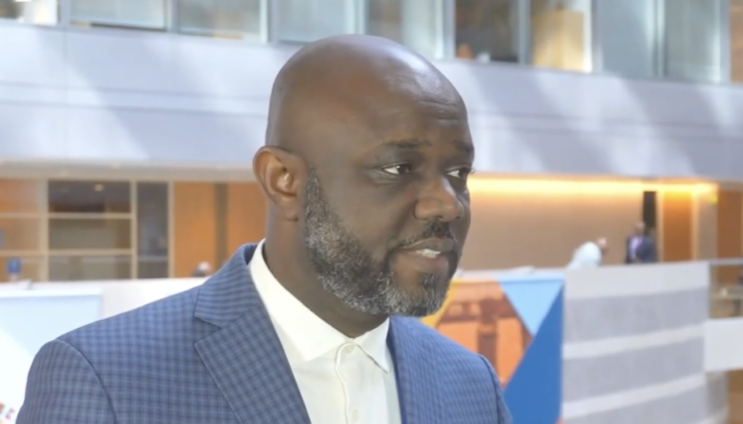
The Executive Director of the Africa Centre for Energy Policy (ACEP), Benjamin Boakye, has called for a comprehensive investigation into the recurring trips on Ghana’s 330kV transmission lines, warning that fixing the Akosombo switchyard alone will not prevent future nationwide power outages .
Speaking on JoyNews’ Newsfile programme on Saturday, August 22, following the nationwide blackout that affected parts of Ghana on Thursday, Mr. Boakye said the repeated system disturbances point to deeper weaknesses in the country’s electricity transmission infrastructure.
⚡ The Cascade Effect: How Line Trips Trigger Nationwide Blackouts
Mr. Boakye explained that a trip on the 330kV line can trigger a cascading failure that eventually results in a wider collapse of the power system.
Ghana’s electricity network comprises both 161kV and 330kV transmission lines, creating a risk of cascading failures when the higher-voltage network experiences a fault .
“When you have generation plants giving so much load on the 330kV line, and the 330kV line fails, the possibility of transferring all that load onto the 161 becomes really high,” he explained .
He said the 161kV network may not be able to carry the additional load when the 330kV line trips, potentially causing further disruptions and ultimately resulting in a nationwide blackout .
“It’s quite disturbing to have this number of trips in a short period of time. That is also not to acknowledge that trips don’t happen in the electricity system. Even in advanced world, you have some of these trips, but I think what is becoming alarming is the frequency that these trips are happening,” he said .
🔍 Investigating the Root Causes of Line Trips
Mr. Boakye stressed that investigations must go beyond preventing a complete system collapse and focus on identifying why the high-voltage lines are repeatedly tripping.
“The total blackout could be fixed if they do the switchyard there, but it wouldn’t stop any line from tripping,” he said .
“So you really have to also address what is causing the trips on the 330kV line, because even if you fix a sumo, that prevents a total collapse. But some parts will also collapse if there are consistent trips, so we need to really isolate the issues,” he added .
He said the causes could range from relatively minor technical faults to more serious problems involving grounding and earthing systems.
“There could be some minor ones, some could be major, some could be some ground faults, earthing systems. If they do that audit, they should be able to isolate the causes and be able to address them,” he stated .
🛠️ Context: The Akosombo Switchyard Fire and Temporary System
The recent disruptions are linked to challenges with the temporary transmission system being used following a fire at the Akosombo switchyard in April 2026 .
The fire, which occurred on April 23, 2026, destroyed the Switchyard Control Room and disrupted electricity supply across the country . The potential removal of nearly 1,000 megawatts (MW) from Ghana’s national electricity supply represented over 25% of national capacity at peak demand .
Energy Minister Dr. John Abdulai Jinapor explained that a full shutdown of Akosombo for six months to allow repairs would have created serious challenges, so the government opted for a temporary arrangement .
“I thought that shutting down Akosombo for six months was untenable, so we opted for the temporary arrangement,” he said, admitting that the temporary system is not as reliable as the original transmission system and has contributed to the two major power disruptions recorded this month .
Mr. Boakye pointed to inadequate protection at the Akosombo switchyard as another factor contributing to the cascading effect.
“Even with a one-size-one line, if the 330 does not trip, you’re not going to have the 16-1 also tripping. So we have to go down to the bottom of the issue, address how these trips happen, and perhaps do some investment to be able to isolate some fuel plants immediately. There is those disturbances so that it doesn’t cascade to the entire network to cause a nationwide blackout,” he said .
📊 Recurring Outages: A Pattern of Instability
Thursday’s incident was the second major system disturbance recorded in August, and the second nationwide blackout in less than a month .
On July 29, a disturbance at about 3:11 a.m. caused several generating plants to trip, leaving parts of Accra, Kumasi and northern Ghana without power for up to 18 hours in some areas. GRIDCo’s preliminary investigation attributed that incident to a likely lightning strike .
The repeated outages have renewed concerns about the reliability of Ghana’s power transmission system and the possibility of a return to “dumsor” .
The Akosombo-Volta transmission corridor is an important component of the national grid, and a major disturbance along it can have implications beyond the immediate location of the fault because of the interconnected nature of the system .
🏗️ The Need for Infrastructure Investment
Mr. Boakye argued that Ghana has not paid sufficient attention to the development and upgrading of its transmission infrastructure, and called for a more resilient and fully looped transmission network.
“What we haven’t taken serious is the transmission infrastructure and its upgrades and be able to loop it completely,” he said .
“If we had another 330 line perhaps coming from Akosombo, that would have been able to safely evacuate the power that was already on the 330kV line,” he noted .
The objective, he said, should be to contain the problem and prevent a failure affecting a major transmission corridor from becoming a nationwide blackout.
📋 Recommendations for GRIDCo and Government
Mr. Boakye called for immediate measures to isolate generation plants quickly when a major transmission line trips, describing such interventions as necessary to prevent isolated faults from escalating into nationwide outages .
He urged authorities to identify the least-cost measures and appropriate contingency arrangements that could be activated when major transmission lines fail.
The ACEP Executive Director also called for stronger protection around vulnerable sections of the network and continued investment in additional high-voltage transmission routes.
“Even with a one-size-one line, if the 330 does not trip, you’re not going to have the 16-1 also tripping. So we have to go down to the bottom of the issue, address how these trips happen, and perhaps do some investment to be able to isolate some fuel plants immediately,” he said .
🏁 Conclusion
As Ghana works to complete repairs on the Akosombo switchyard and restore the original transmission system by September 2026 , Mr. Boakye’s comments highlight the need for a comprehensive approach that addresses immediate technical faults while building long-term resilience into the national grid.