



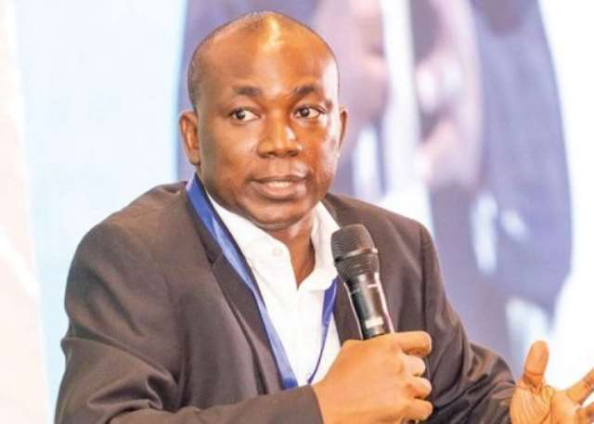
Economist Professor Godfred Bokpin has delivered a scathing critique of Ghana’s growing reliance on gold as the primary driver of economic stability, warning that the country is sacrificing long-term survival for short-term economic gains.
Speaking on the Joy FM Super Morning Show on Monday, August 24, Professor Bokpin said the focus on macroeconomic stability and the benefits of gold had overshadowed the severe environmental damage caused by irresponsible mining .
He warned that Ghana’s current economic gains could quickly be reversed if international gold prices fall sharply, leaving the country vulnerable to another major economic shock.
“Today, we have magnified the effect of the Gold Board to the extent that the discussion about irresponsible mining, the dangers, the existential threat seems infinitesimal in the face of so-called macroeconomic stability, which was just a price shock,” he said.
Professor Bokpin questioned the sustainability of the gains being celebrated, pointing to Ghana’s exposure to fluctuations in global gold prices.
“Look, if gold price today should dip by more than 40%, this macroeconomic stability we talk about will only exist in the textbook. What kind of gain is that?” he asked.
Economic fragility and IMF warnings
The economist’s warning comes amid growing concerns about Ghana’s over-concentration on gold. Data from the Bank of Ghana indicate that gold accounted for approximately 68.3 percent of Ghana’s total export earnings by July 2026, compared with 12.5 percent for cocoa and 9.4 percent for crude oil .
The International Monetary Fund has warned that gold accounts for more than 65 percent of Ghana’s merchandise exports, with a sharp decline in gold prices potentially reducing export receipts, foreign-exchange inflows and fiscal resources .
Under severe stress-testing scenarios modelled by the IMF, a 30% decline in gold prices could depreciate the cedi by up to 23.4% and reduce real GDP growth by between 0.73 and 1.55 percentage points .
“When it’s so exposed to price shock, global gold price shock, what kind of gain is that? Everything could just go within six to eight months of that price shock,” Professor Bokpin warned .
He urged policymakers to learn from historical commodity cycles, noting that commodity prices have repeatedly experienced sharp corrections after periods of strong growth.
“Literally every 10 years, prices of commodities correct from a bust, from a boom; they correct almost every 10 years,” he said.
Government’s position on gold-driven stability
The government has defended its gold strategy as a transformative economic intervention. Finance Minister Dr. Cassiel Ato Forson revealed in Parliament in July 2026 that the establishment of the Ghana Gold Board (GoldBod) had generated an additional $15 billion in foreign exchange inflows .
According to Dr. Forson, the policy improved Ghana’s current account balance by 6.4 percentage points, from a surplus of 1.9% in 2024 to 8.3% in 2025 .
“This was not simply a gold policy. This was a macroeconomic stabilization policy designed to strengthen the cedi, build external buffers and restore confidence in the Ghanaian economy,” Dr. Forson stated .
Environmental cost of mining
Professor Bokpin said the assessment of Ghana’s gold economy must go beyond foreign exchange earnings and macroeconomic indicators to account for the environmental and social costs of mining.
He called for a value-chain approach that properly captures the environmental cost of gold production, particularly the destruction of water bodies and ecosystems.
“As a country, we should adopt a value chain approach. Let’s account for the environmental subsidy. Ecological integrity we have destroyed,” he said.
Senyo Hosi, an economic policy analyst, has similarly warned that current interventions against illegal mining are failing to produce meaningful results .
“Our water bodies, our forest reserves, the quality of food, the quality and security of our country,” Hosi said, noting that water quality is regressing despite enforcement efforts .
‘We are not better off’
Professor Bokpin said Ghana could only claim to be better off if the full economic, social and environmental costs of gold production were incorporated into the analysis.
“If you put all of these things together, through the analysis, and you’re able to say that we are far better off, then that’s good news. But if you do that, what is the gain? What are we celebrating?” he asked.
When asked whether Ghana was better off after taking these factors into consideration, Professor Bokpin was unequivocal.
“We are not better off.”
He described the decision to tolerate severe environmental damage in pursuit of economic stability as selfish and a failure of leadership.
“It’s a selfish position to think that you can cause such harm to the environment and water bodies in the name of macroeconomic stability, and say you have gained,” he said.
“It’s a selfish position. This is not leadership. We are sacrificing long-term survivability for short-term praise.”
Malaysia’s example
Professor Bokpin urged Ghana to reconsider an economic model heavily dependent on the extraction and export of primary commodities, particularly where such activities come with high environmental costs.
“This is not leadership. Countries that made it didn’t do so by exploiting the environment like this,” he said.
“And any growth model that is heavily reliant on environmental destruction, primary commodities, is never sustainable” .
He cited Malaysia as an example of a country that successfully moved away from an economy heavily dependent on primary commodities.
“What we are discussing today was what was prevailing in the 50s and 70s in Malaysia, when the economy was heavily driven by copper and tin,” he said.
“From the 70s, 80s, 90s, they shifted away from primary commodities, and that is how Malaysia is where they are today” .
Malaysia’s economic diversification efforts included transitioning from primary commodities to manufacturing and services, with the share of primary exports declining significantly and the country moving up the commodities value chain .
Value addition and job creation
Professor Bokpin has repeatedly called for Ghana to add value to its gold locally rather than exporting raw minerals. He has argued that the maximum profit from exporting raw gold is between one and five per cent, while processing gold and responsible mining could yield returns of 10 per cent or more .
“More than 80 per cent of our gold export now is going to the United Arab Emirates. They are the ones who have set up manufacturing companies, adding value to raw gold that is exported from Ghana in London, and they wash it and resell it to the rest of the world for higher value. It is like we are not going to school,” he said .
He has also warned that Ghana is experiencing “jobless growth” because growth is not coming from labour-intensive sectors.
“About 23 percent of our economy is driven by gold. That has not significantly impacted our revenue and has not created a lot of decent jobs. So, although the economy appears to be growing, the employment response is weak because the growth is not coming from labour-intensive sectors,” he stated .
Questioning GDP measurement
Professor Bokpin also questioned whether Ghana’s Gross Domestic Product adequately captures the damage caused by economic activities such as irresponsible mining, noting that environmental destruction and social costs are not reflected in the measure.
“That is the reason why so many people think that GDP is not just gross domestic product, but gross domestic problem,” he said.
He warned that the human cost of irresponsible mining should not be dismissed in the pursuit of economic indicators.
“If one person dies today because of irresponsible mining, we have destroyed the water bodies. Is this macroeconomic stability or gain compared to a life?” he asked.
The Finance Minister has announced plans to increase Ghana’s international reserves to the equivalent of 15 months of import cover by the end of 2028 through the Ghana Accelerated National Reserve Accumulation Policy, and has reached an agreement with large-scale mining companies to purchase 30% of their annual gold production for refining by local refineries .
However, Professor Bokpin maintains that such measures do not address the fundamental vulnerability of an economy dependent on a single commodity.


