


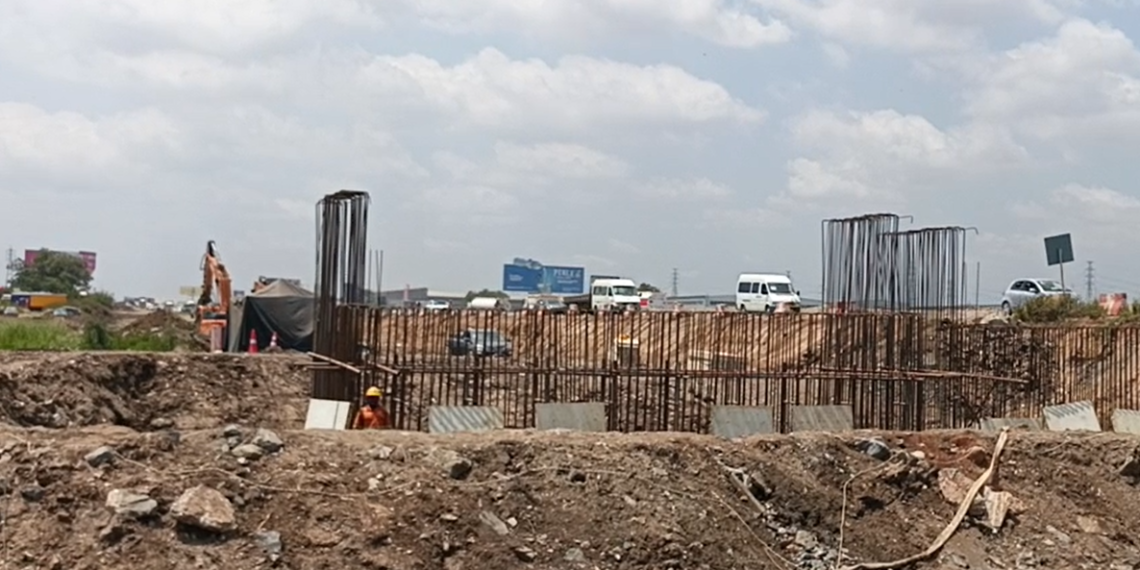
Construction on the long-awaited Accra-Tema Motorway reconstruction and expansion project has reached 53 percent completion, project officials announced Wednesday, though the US$339 million initiative remains slightly behind schedule due to persistent challenges in relocating underground utilities.
The 19.5-kilometer project, which commenced in August 2024, is being executed under a 30-year public-private partnership concession aimed at transforming one of Ghana’s most critical transport corridors . The concessionaire, A.T. Expressway Limited, confirmed that despite the delay, the target completion date of August 2027 remains unchanged.
Utility Relocation Bottleneck
Speaking at the launch of the company’s website in Accra, Chief Resident Engineer Ing. Kwabena Bempong attributed the lag to difficulties in moving pipelines and fibre-optic cables along the heavily developed corridor.
“The relocation of utility installations has affected the pace of work,” Bempong said, adding that measures were nonetheless being implemented to accelerate construction and meet the deadline . He expressed confidence that the contractor, Maripoma Enterprise Limited, would intensify work as the project transitions toward road surfacing.
Bempong noted that construction equipment and resources are now in place to ensure a steady supply of asphalt concrete for the upcoming paving phase.
A Modernized Corridor
The redesigned motorway represents a significant upgrade from the original 1960s-era infrastructure. According to project details, Section One will feature a two-lane, access-controlled expressway alongside an urban highway with three lanes in each direction. Selected segments will widen to five lanes per direction to facilitate merging and traffic movement between the two roadways.
The scope also includes substantial structural works: improvements to interchanges at Tetteh Quarshie, Community 18, and Lashibi, as well as 20 box culverts and three bridges at various stages of completion. Pedestrian crossing facilities are being incorporated to enhance safety and community connectivity on either side of the highway.
Financing and Oversight
The project is being implemented in collaboration with the Ministry of Roads and Highways and the Ghana Highway Authority. A.T Expressway Limited serves as the concessionaire, while Maripoma Enterprise Limited is the engineering, procurement, and construction contractor .
Louis Harrison, Chief Executive Officer of A.T Expressway Limited, revealed that the project is being sponsored by the Ghana Infrastructure Investment Fund (GIIF), demonstrating how institutional capital can support major infrastructure without placing the entire burden on the state . The financing structure, he noted, is partly dependent on the toll level to be approved by Parliament, with the company exploring local-currency financing to mitigate foreign-exchange risks.
The original motorway, opened in 1965 under Ghana’s first president, Kwame Nkrumah, was designed to link the capital to the industrial port city of Tema . It now carries approximately 60,000 vehicles daily—far exceeding its original design capacity—making the expansion essential for reducing congestion and supporting trade connectivity along the Accra-Tema economic corridor.
Background: A Highway Under Pressure
The Accra-Tema Motorway holds a unique place in Ghana’s post-independence infrastructure history. Built with German engineering influences and opened to traffic in late 1965, it was conceived as the first segment of a national motorway network that was never fully realized . For decades, the four-lane concrete highway served as the primary artery between Accra and the port of Tema, Ghana’s principal gateway for imports and exports.
However, the road has suffered from chronic underinvestment and maintenance challenges. By the 2000s, deteriorating pavement, inadequate drainage, and the absence of functional streetlights had turned the corridor into a safety hazard, prompting media campaigns and rehabilitation efforts that proved insufficient . The current expansion, structured as a public-private partnership, represents the most ambitious attempt yet to modernize the corridor and align it with contemporary traffic demands.
The project’s completion is expected to ease urban mobility, reduce unsafe pedestrian crossings, and strengthen trade logistics along one of West Africa’s busiest transport routes.