


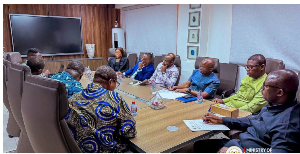
The Minister of Energy and Green Transition, Dr John Abdulai Jinapor, has held a strategic policy dialogue with the IMANI Centre for Policy and Education to review government policies and the future direction of Ghana’s energy sector.
The engagement, described by the minister as frank and constructive, focused on progress made so far, policies introduced under the current administration, and plans for the power, petroleum and renewable energy sectors. Dr Jinapor stressed the value of sustained dialogue with independent policy institutions in assessing government interventions, identifying gaps and strengthening accountability. He said such interactions help refine policy formulation and ensure decisions in the energy sector deliver meaningful results for Ghanaians.
Building a resilient, efficient and sustainable energy sector remains a core priority, the minister noted, adding that constructive stakeholder discussions of this kind support the country’s long-term energy objectives.
Dr Jinapor, Member of Parliament for Yapei-Kusawgu, assumed office as Minister of Energy and Green Transition in January 2025 under President John Dramani Mahama. A development finance expert and energy economist, he previously served as Deputy Minister of Energy and Petroleum and later Deputy Minister of Power between 2013 and 2017. He holds advanced degrees including an MSc in Energy Economics, an MSc in Development Finance, an MBA in Marketing and an MA in Economic Policy Management, and was awarded a PhD in Development Finance by Stellenbosch University in South Africa in December 2025. His research has focused on energy, foreign direct investment and environmental sustainability in Sub-Saharan Africa. He also chairs Ghana’s Nuclear Energy Programme Implementing Organisation and has served on the board of the Electricity Company of Ghana.
IMANI Centre for Policy and Education, founded in 2004 by Franklin Cudjoe, is one of Ghana’s leading independent think tanks. Ranked among the most influential policy organisations in Sub-Saharan Africa, it specialises in evidence-based research and advocacy across areas including energy, governance, economic policy and institutional reform. The centre has a long record of scrutinising energy sector issues, from power sector debt and tariff structures to petroleum agreements and renewable energy uptake, and regularly engages government and other stakeholders on policy performance.
The dialogue comes at a time when Ghana’s energy sector continues to navigate complex challenges while pursuing reforms. The power sector has faced issues of financial sustainability, with legacy debts that the government has moved to address through substantial payments to independent power producers, gas suppliers and other creditors. Efforts are underway to strengthen transmission and distribution infrastructure, expand generation capacity, improve payment discipline and reduce reliance on expensive liquid fuels by increasing domestic gas supply for power generation.
In the petroleum sector, the government is working to reverse declining crude oil production, restore investor confidence through legal and fiscal reforms, and attract new upstream investment. Recent commitments have been reported in the range of US$3.5 billion for expansion and drilling campaigns on existing fields. Plans also include revitalising local refining capacity at facilities such as the Tema Oil Refinery to enhance energy security and domestic value addition, alongside broader initiatives such as the proposed Petroleum Hub project.
On renewable energy and the green transition, the ministry’s expanded mandate reflects a push to scale up solar, wind, mini-grids, battery storage and other clean energy solutions. An updated Renewable Energy Master Plan targets significant capacity additions and substantial investment by 2030, while the government has announced moves to procure large-scale battery energy storage systems paired with solar generation to improve grid flexibility and reliability. Broader goals include raising electricity access, advancing nuclear power development and ensuring a just transition that supports economic growth and job creation.
Dr Jinapor has repeatedly emphasised that generation capacity alone is insufficient without reliable transmission, storage, efficient distribution and sustainable financing. He has also highlighted the importance of regional cooperation within ECOWAS on power trade, gas supply and shared infrastructure.
The engagement with IMANI forms part of wider efforts to open government energy policies to external scrutiny and feedback. Both sides used the platform to exchange views on implemented measures and the sector’s broader strategic direction, underscoring the role of independent policy institutions in improving outcomes in one of Ghana’s most critical economic sectors.