


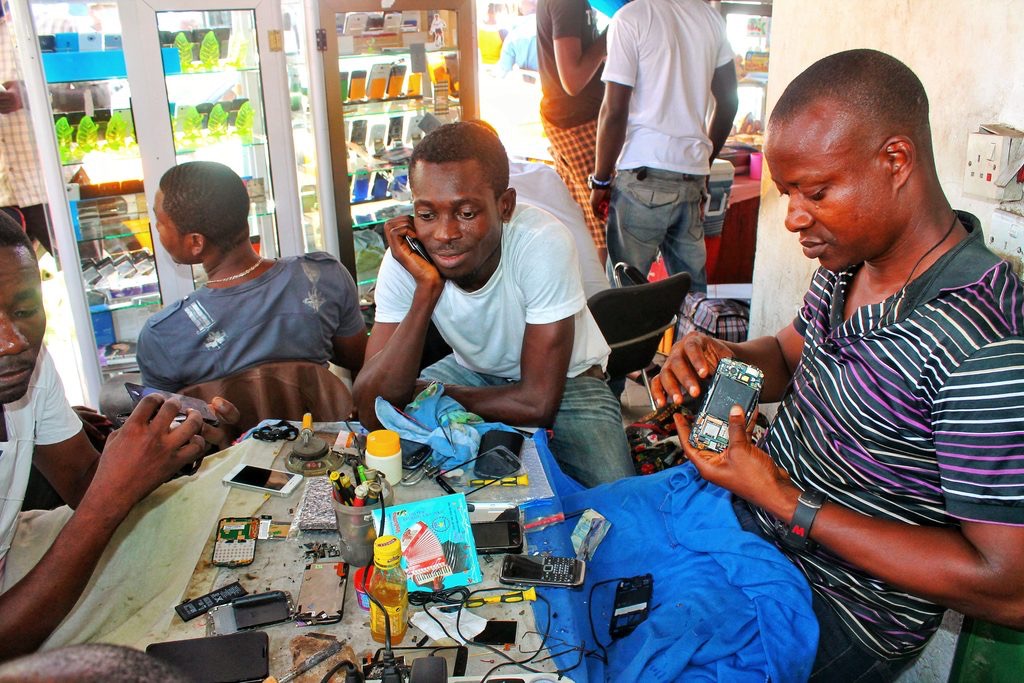
Tiptoe Lane, the narrow stretch behind the Kwame Nkrumah Circle in Accra, has reinvented itself repeatedly over more than five decades. Today, it stands as one of West Africa’s densest mobile technology micro-markets, where thousands of traders, technicians, students and apprentices make a living from an informal economy that grew without a grand plan — one business, one worker and one new chapter at a time.
Less than 300 metres long and stretching off Kwame Nkrumah Avenue in the Ayawaso Central Municipality, the lane is lined with glass cabinets packed with new and used smartphones, repairers working in cramped spaces, and accessories spilling through the narrow trading environment. Traders, technicians, students and customers from across Ghana converge on the area daily.
For Paul Kwesi Boateng of Boateng Phones and Accessories, the transformation is something he has lived through for over twenty years. “When I first started selling phones at Tiptoe Lane, people were living in the very space where my shop now stands. As the phone business began to boom, the occupants of this house eventually rented the space to me, and I now pay for the space every year,” he said.
A Street of Reinventions
The story of Tiptoe Lane did not begin with phones. In the post-independence years, the lane earned its early fame through photography and nightclub businesses. Modern Photo Company Limited has been in existence since January 1955, making it one of the oldest businesses on the lane. Ghanaians dressed in their Sunday best would carefully “tiptoe” into the studios to avoid dust, keeping their clothes and shoes clean for family portraits, passport photographs and graduation pictures.
The lane was also home to the Tip Toe Gardens Night Club, one of the top entertainment spots in the country in the 1960s and early 1970s. It attracted all the big names in local music as well as foreign bands that visited Ghana. Local bands that played regularly at Tip Toe included K. Gyasi’s Noble Kings, King Bruce’s Black Beats and Uhuru, as well as the Armed Forces Dance Band, Black Santiago, El Polos, The Saints, Super Eagles, Jerry Hansen’s Ramblers and Pobee Snr’s own bands, Honkies, Blue Monks and Adams Apple.
Modern Photo’s famous “Wall of Fame,” displaying portraits of musicians, actors and show business personalities, began in 1966 and became a landmark of the lane. Personalities who have had their photos on the wall over the years include Kojo Antwi, Paapa Yankson, C.K. Mann, Amakye Dede, and many others.
By the late 1980s and 1990s, the character of Tiptoe Lane began to change. As television spread and demand for traditional photography shifted, the Akan Drama theatre group and other performance troupes became part of the area’s entertainment scene, with the Akan Drama group operating from a nightclub known as Apollo Theatre. Actors, scriptwriters and costumers moved through the cramped spaces, while posters for Concert Party shows covered the walls.
By the late 1990s and early 2000s, Tiptoe Lane had become increasingly associated with the pursuit of opportunities abroad. Economic hardship, coupled with the fallout from the “Ghana Must Go” period and tighter visa restrictions, saw the area gain notoriety as a hotspot for “connection men” and document facilitators. Internet cafés, typing pools and photography studios produced passport photographs, bank statements, invitation letters and visa forms — some legitimate, many not. Police raids were common, yet the digital skills and document literacy developed during that period would later prove useful as the lane reinvented itself once again.
The Mobile Phone Revolution
From around 2005, the Global System for Mobile (GSM) revolution began changing Tiptoe Lane again. As Nokia and Motorola, and later Tecno and Infinix, spread across Ghana, the lane’s small shops increasingly shifted towards mobile phones, chargers, accessories and repairs.
Ghana now imports around five million mobile phones annually, with the value of shipments exceeding $200 million each year, according to trade analysts. Data from the National Communications Authority shows that more than 40 million mobile phones were active on networks in 2024, including over 23 million smartphones.
General Secretary of the Mobile Phone and Accessories Dealers Association (MPADA), Eric Asante, says traders eventually realised they had to organise themselves as their numbers increased. He recalls that phone sellers initially operated along the roads before deciding to gather in one place so customers could easily find them. That decision helped turn scattered roadside trading into the market that exists today.
The growth also attracted traders from outside Ghana. “For some foreigners, when they come, and they see that they have enough to acquire some shops, then they go, prepare adequately and come back, and also join us, and that’s how we became more,” Eric said.
MPADA, established in 2012, regulates dealers, agents, distributors and all players in the mobile phone industry in Ghana. In its first decade, the association successfully lobbied government to reduce the 20 percent import tax on mobile phones and accessories to 10 percent, making the purchase and usage of mobile phones more affordable.
The Foreign Competition Question
Boateng’s concern points to one of the tensions now shaping Tiptoe Lane. “For every ten shops here, eight are owned by foreigners, creating a major challenge for Ghanaian phone dealers. We welcomed them into the market, but now they are trying to take over businesses from the indigenes,” he said.
The issue has been a recurring flashpoint. In July 2025, the Circle Traders Association, led by Chairman Eric Gyamfi, shut down all shops at Tiptoe Lane in protest, calling for strict enforcement of the Ghana Investment Promotion Centre (GIPC) law to reduce the number of foreign mobile phone dealers in the market. The association expressed concern about foreign traders dominating retail spaces and creating unfair competition for local businesses.
In September 2025, the CEO of the Ghana Investment Promotion Centre (GIPC) visited Tiptoe Lane to engage traders on concerns involving foreign businesses operating in sectors reserved for Ghanaians.
The Informal Ecosystem
Technology enthusiast and music producer Kobby Spiky Nkrumah describes the market as the natural evolution of an informal economy. “I think just as every other informal market in Africa, it doesn’t start; there’s no plan. You know, it’s everyone just trying to survive,” he said.
Businesses simply began clustering around the opportunities available. “If there are repairers, there’ll be sellers. If there are parts sellers, people selling parts, there’ll be those who are importing their parts. And if some are importing their parts, there’ll be those who are wholesaling. And then if there’s wholesaling, there’ll be retail. And then if there’s retail, there’ll definitely be customers.”
The employment potential extends well beyond the shops visible along the lane. For young people, the ecosystem has become a way into work. Dennison, a student who entered the business immediately after Senior High School, is now an employee at Stranger Phones. Several other students spoken to at the market gave similar reasons, saying the work helps them cater for themselves and raise money towards school fees.
For Richmond Hammond, a laptop repairer, the opportunity came through learning a technical skill. After completing school, he learnt phone and laptop repairs from a master at Tiptoe Lane. He has since completed his apprenticeship and opened his own shop.
Fire Safety and Flooding: A Constant Threat
The physical environment is a growing worry. Richmond said: “My greatest fear and worry are that the market is too enclosed, and I fear what could happen if a fire breaks out. We’re pleading with the government and the Ghana National Fire Service to provide fire extinguishers and find ways to expand or better organise the space for us.”
His fears are well founded. On January 20, 2026, an early morning fire ravaged several wooden shops and structures at Tiptoe Lane, leaving traders — mostly phone dealers and accessories sellers — distraught. One trader, a Nigerian woman who had lived in Ghana for 10 years, said her shop was completely destroyed, leaving only the dress she was wearing as her sole possession.
In May 2023, about 10 shops with phone accessories worth thousands of cedis were destroyed by fire at Tip-Toe Lane. Flooding has also been a recurring problem, with traders facing ruin after devastating floods destroyed shops and merchandise.
The Path Forward
For Kobby Spiky, the market’s next challenge is about making the skills developed there more recognised. “We need to create sort of like a proper certification model for these technicians, because once the people are good, once they are certified, people trust them. And then you legitimise their hustle in a place like Tiptoe Lane,” he said. He sees an even bigger opportunity in refurbishing old devices and recycling electronic waste.
Industry analysts have also called for the development of technology retail hubs and training centres in key commercial areas such as Kwame Nkrumah Circle, which could equip traders with skills in device maintenance, digital commerce and responsible e-waste handling, helping transform what is currently an informal trade into a more organised micro-enterprise sector.
As demand for commercial space rises, some residential facilities are being converted into shops, raising questions about whether continued commercial expansion will gradually affect residents, increase congestion and change the residential character of the neighbourhood.
The challenge for authorities will be to provide structure without suffocating the informal enterprise that created the market in the first place. Because Tiptoe Lane did not become a tech hub through a grand plan. It grew through opportunity, one business, one worker and one new chapter at a time. As Kobby Spiky puts it, “one person starts it, another person joins in.”