


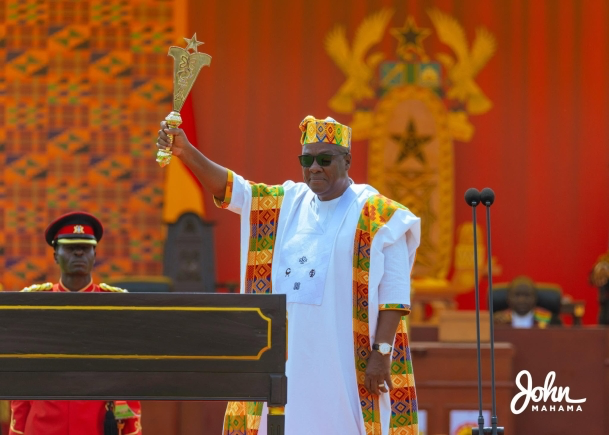
The New Patriotic Party (NPP) has filed a suit at the Supreme Court asking for a definitive interpretation of the constitutional provisions on presidential term limits. The party wants the apex court to rule that the limit is a maximum of two terms in total — whether those terms are served consecutively or non-consecutively.
The writ of summons and statement of case, dated July 28, 2026 (with some reports citing July 29), were filed by the NPP’s solicitor, Godfred Yeboah Dame of Dame & Partners. The Attorney-General is named as the defendant. The action invokes the Supreme Court’s original jurisdiction under Articles 2(1) and 130(1) of the 1992 Constitution.
At the heart of the case is the interpretation of Articles 58(2) and 66(1), (2) and (3)(a). Article 66(1) states that a person elected as President shall hold office for a term of four years from the date of swearing-in. Clause (2) provides that “a person shall not be elected to hold office as President of Ghana for more than two terms.” Clause (3)(a) deals with the vacancy of the office upon the expiration of the term.
The NPP is seeking declarations that:
• The phrase “two terms” means a maximum of two terms, whether consecutive or non-consecutive.
• No person may be elected President more than twice or hold the office for more than two four-year terms (a total of eight years), regardless of whether the terms are successive or separated by a period out of office.
• A person who has already served one presidential term remains eligible for only one additional term, even if the periods in office are not consecutive.
• A Vice-President who assumes the presidency and serves more than half of the unexpired term of a predecessor is eligible to contest for election as President for only one term thereafter.
The party argues that interpreting the limit as applying solely to consecutive terms could create a loophole. In such a reading, a person who serves one term, loses an immediate re-election bid, and later returns to office might then be able to serve two further terms — effectively exceeding the constitutional ceiling.
The suit arises against the backdrop of public discussion about the eligibility of President John Dramani Mahama to contest the 2028 election. Mahama first assumed the presidency in July 2012 following the death of President John Evans Atta Mills and was elected in his own right in the December 2012 election. He served until January 2017 after losing the 2016 election to Nana Akufo-Addo. He returned to power in the December 2024 election and was sworn in on January 7, 2025, for what is widely regarded as his second and final term under the current constitutional framework.
Mahama has publicly stated that he will not be a candidate in the next elections. The National Democratic Congress (NDC) has also rejected suggestions of any third-term ambition. Nonetheless, the NPP maintains that an authoritative judicial clarification is necessary to settle the constitutional question and prevent future ambiguity.
The two-term limit is an entrenched provision of the 1992 Constitution. Amending it would require a rigorous process, including a national referendum in which at