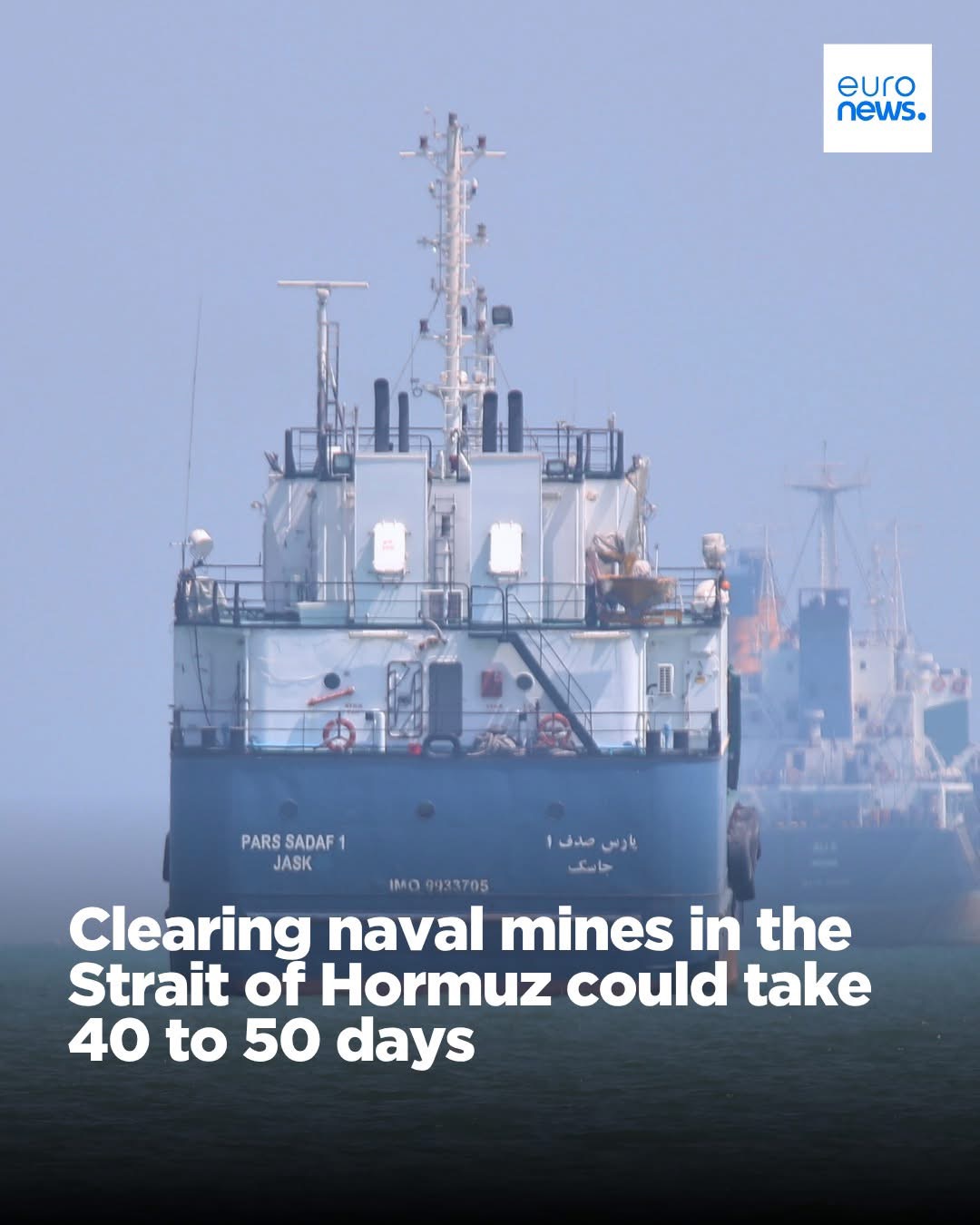
Even after a landmark agreement between the United States and Iran to reopen the Strait of Hormuz, regular vessel traffic through the world’s most critical oil shipping chokepoint is unlikely to fully resume for several weeks, with mine-clearance operations expected to last between 40 and 50 days before insurers and shipping firms regain confidence.
Five Western maritime security sources told Reuters that clearing the waterway — using both conventional minesweepers and advanced underwater drones — could take more than a month. Until then, war-risk insurance premiums remain sharply elevated, and shipping lines are refusing to commit vessels to the strait.
According to data from S&P Global, war-risk premiums are still running as high as 30 times above pre-conflict levels. Prewar rates were below 0.1% of a vessel’s value per transit; today, premiums stand at 1% to 4%, translating into insurance bills of $3 million to $8 million for a single large tanker passage. Lloyd’s of London has maintained coverage options, but insurers say the crisis is far from over.
Mine-free corridors yet to be established
The mine threat has paralyzed traffic even as a diplomatic breakthrough is announced. Iran has threatened to deploy naval mines but has not commented on whether its forces have already planted them. The RAND Corporation noted in an analysis last month that “the risk that even a few Iranian mines may have landed in the Strait of Hormuz has helped paralyze shipping traffic”.
Jakob Larsen, chief safety and security officer at the shipping association BIMCO, told Reuters that Hormuz transits at present would be “very risky” and called for “mine-free routes” to be established before commercial shipping resumes.
A 90% drop in tanker traffic
The crisis has already exacted a heavy toll. Tanker traffic through the strait has collapsed by 90% to 95% compared with prewar levels, according to analysts. At its narrowest point — just over 30 kilometers wide — the strait normally handles around 20% of the world’s daily supply of oil and liquefied natural gas.
The Biden administration and now the Trump administration have sought to restore freedom of navigation. On June 15, US President Donald Trump announced that an agreement with Iran would see the strait reopened with no transit fees, and he claimed that oil tankers had already begun moving through a “Southern Highway” route near Oman. However, Iranian authorities say that more than 300 non-Iranian ships, mostly tankers, had requested safe passage since early May — a fraction of typical volume.
Multinational mine-hunting operation taking shape
Under the terms of the preliminary agreement signed in Switzerland on June 19, Iranian forces are expected to lead the mine-clearance effort within the first 30 days. However, Britain, France, Germany and the Netherlands have all dispatched warships and minesweepers to the region.
The Royal Navy has deployed a new uncrewed mine-hunting system aboard the support ship RFA Lyme Bay, with autonomous sonar equipment and underwater sensors ready for a potential mission in the strait. The US Navy has also turned to AI-driven solutions, awarding a contract to Domino to accelerate mine detection capabilities.
In addition, the US Navy can deploy systems such as the Archerfish — a remotely controlled, torpedo-shaped device about 2 meters long that carries an explosive charge and transmits video to operators via cable — to destroy mines.
Global economic damage already severe
The closure of the Strait of Hormuz has already rippled through the global economy. According to UNCTAD, a 50% increase in oil prices would raise annual oil import costs for fragile economies by about $20 billion. The disruption has pushed:
· Fuel prices up 30%
· Fertiliser prices up 50%
· Airfares up 25%
The global growth outlook for 2026 has been reduced to 3.1%, with inflation exceeding 4%. Wood Mackenzie estimates that a prolonged closure would push global GDP growth below 2% in 2026, resulting in “modest but permanent economic scarring”.
Approximately 20,000 seafarers remain stranded and over 2,000 commercial vessels face heightened restrictions, according to UN figures.
No quick return to normal
Even after the last mine is neutralized, shipping costs are unlikely to fall quickly. Marine insurers are demanding months of sustained stability before restoring normal cover. The Lloyd’s Market Association has said insurance for vessels transiting the passage will remain subject to high rates until the security environment improves.
“The threat of mines in the area remains a concern immediately as well as further down the line,” Larsen said. “And mine-free routes need to be established”.