



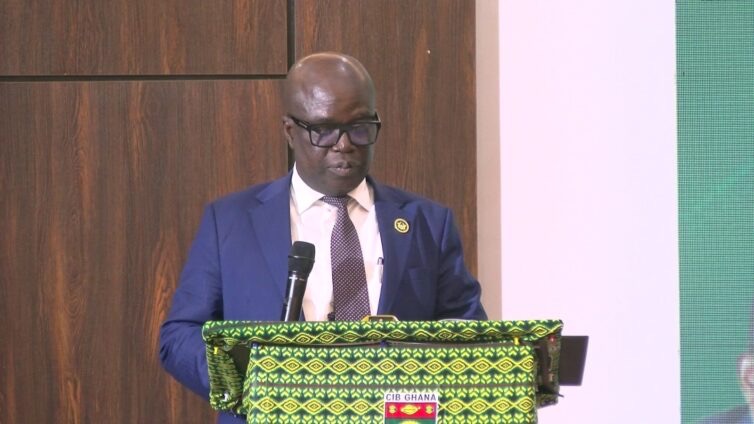
The Bank of Ghana (BoG) has cautioned that reductions in the monetary policy rate do not automatically translate into lower lending rates, stressing that the effectiveness of monetary policy depends largely on how decisions are transmitted through the banking system to businesses and households.
The warning was contained in remarks delivered on behalf of Governor Dr Johnson Asiama by Director of Research at the Bank of Ghana, Dr Simon Harvey, at the Chartered Institute of Bankers Ghana’s third Post-MPC Policy Seminar on Tuesday, September 29, 2026. It comes after the Monetary Policy Committee (MPC) maintained the policy rate at 14% following its 132nd regular meeting held on September 23 and 24, 2026.
Transmission Neither Automatic Nor Instantaneous
In the Governor’s remarks, Dr Harvey explained that monetary policy transmission is neither automatic nor instantaneous, noting that a change in the policy rate does not necessarily result in an immediate or proportional adjustment in the cost of borrowing.
“Banks must consider their cost of funds, credit risk, operating costs, capital requirements, expected losses, and the overall risk environment when pricing loans,” he said.
He explained that the effectiveness of monetary policy should not be measured solely by changes in the benchmark rate but by its impact on lending and deposit rates, credit availability, investment, consumption, employment and broader economic activity. “The ultimate objective is to ensure that monetary policy decisions translate into outcomes that support price stability and sustainable economic growth,” the Governor’s remarks stated.
Three Consecutive Holds at 14%
The MPC unanimously voted to keep the policy rate at 14% for a third consecutive meeting, having last cut it by 150 basis points from 15.5% in March 2026 to its lowest level since October 2021. Announcing the decision in Accra on September 24, Governor Asiama said headline inflation stood at 5% in August 2026, up from 4.6% in July, driven by non-food inflation rising to 6.8% from 6.1% due to pass-through effects from utility tariff adjustments and high crude oil prices. Inflation nevertheless remained below the lower bound of the Bank’s 8±2% target band and well below the 11.5% recorded in August 2025.
The Committee assessed the risks to inflation and economic growth as broadly balanced, citing resilient domestic economic activity—with real GDP expanding by 6% in the second quarter of 2026—alongside risks from elevated crude oil prices hovering above US$100 per barrel, expected El Niño conditions and global supply chain constraints.
Lending Rates Decline but Gap Persists
Average lending rates have fallen significantly. BoG data show the average lending rate stood at 15.9% as of end-August 2026, down from 24.2% a year earlier and from 20.58% in January 2026. The rate hovered around 15.83%, 15.64% and 15.80% in May, June and July respectively.
However, the Ghana Reference Rate (GRR), the benchmark used by banks to price loans, stood at 10.61% in August 2026, from 10.59% in July. The gap between the average lending rate and the GRR—nearly five percentage points—reflects persistent concerns about the pace of transmission, even as the central bank has cut the policy rate by a cumulative 1,400 basis points from 28% in April 2025 to 14% in March 2026.
Average lending rates also vary widely among banks. BoG’s Annualised Percentage Rate (APR) Report for May 2026 put the average APR across all lending categories at 17.64%, with the highest rate among commercial banks reaching 39.27%. A one-year household credit product from one bank was priced at 28.13%, while the best SME rate stood at 11.03%.
Banks Must Improve Risk Management
Dr Harvey stressed that banks must improve their credit assessment and risk management practices, while borrowers must demonstrate discipline in meeting their repayment obligations. According to him, the banking sector’s ability to extend credit at affordable rates is closely linked to the quality of its loan portfolio and the broader economic environment.
The Governor’s remarks also emphasised that credit expansion must be productive and sustainable rather than driven solely by the desire to increase lending volumes. “Rapid credit growth without proper risk assessment can lead to defaults, impairment charges and ultimately weaken the banking system,” the statement cautioned.
He noted that a credible and predictable monetary policy framework, supported by fiscal discipline and an efficient banking sector, was essential to strengthening the transmission process.
High NPLs Weigh on Lending Costs
The Bank of Ghana has previously identified high NPLs and the risk profile of borrowers as major contributors to the gap between the average lending rate and the GRR. The industry’s NPL ratio stood at 16.1% at end-June 2026, well above the prudential limit of 10% that the central bank has directed banks to meet by the end of 2026.
The BoG has introduced a Notice on Regulatory Measures to Reduce high NPLs, aimed at strengthening credit underwriting standards, loan recovery processes, and sanctioning wilful defaulters. This has resulted in the decline of NPLs, reduction in lending risks and ultimately lower borrowing costs across the industry, the central bank said.
The Bank is also enhancing the credit reporting and collateral registry framework to reduce information asymmetry and improve alignment of borrowers’ risk profiles with the collateral realisation process. It has inaugurated Steering and Technical Committees to guide the listing of commercial banks on the Ghana Stock Exchange, framing it as a strategy to redirect domestic savings into local assets and strengthen governance.
Operational Reforms to Strengthen Transmission
BoG has been recalibrating its operational framework to strengthen the link between policy decisions and market rates. Governor Asiama has said the central bank reintroduced the 14-day BoG bill as its main instrument for open market operations, returning to operations at the very short end of the market where central banks are supposed to operate.
“We have reintroduced the 14-day bill as our main instrument for conducting OMOs. This shift aims to improve market functioning and enhance the transmission of policy signals,” he said at a public lecture on monetary policy in August 2026.
The central bank also replaced its dynamic Cash Reserve Ratio framework with a uniform requirement of 20% to be held in domestic currency, a measure Governor Asiama said was intended to strengthen the operational framework. A new Foreign Exchange Operations Framework has also been introduced to stabilise the local currency and reduce exchange-rate pass-through into domestic prices.
The Governor has articulated that the ultimate effect of monetary policy depends not simply on the level of the policy rate, but on how financial institutions and markets respond through lending rates, deposit rates, liquidity allocation, credit decisions and investment. “For me, that is what monetary policy modernization is fundamentally about. It is not only about better models or more instruments to enhance efficiency and ensure effective policymaking. It is about reducing the distance between the policy we intend, the policy the market understands, and the policy the economy ultimately experiences,” he said.
Private Sector Credit Rebounds
Despite the transmission challenges, credit conditions have been improving. Private sector credit growth rebounded to 35.5% in August 2026 from 13.3% a year earlier, translating to 29.0% growth in real terms, according to Governor Asiama. The low interest rate environment and eased credit conditions pushed the growth, with gross loans and advances increasing by 39.4% year-on-year to GH¢124.3 billion.
The 91-day Treasury bill rate also fell to 5.4% in August 2026 from 10.3% a year earlier.
What Happens Next
The Governor has said he expects full transmission of monetary policy easing to lending rates as the low-interest environment is sustained. “Once we engineer and sustain the low-interest environment, and it is realistic, we will see full transmission,” he said at the 130th MPC press briefing in May 2026.
The MPC will reconvene for its final meeting of 2026, with analysts suggesting that the central bank could resume cutting the policy rate if pressures from elevated fuel prices ease. Whether the gap between the policy rate, the reference rate and actual lending rates narrows will depend on continued improvements in asset quality, sustained fiscal discipline, and the banking sector’s willingness to extend credit at rates that reflect the broader easing of monetary conditions.


