



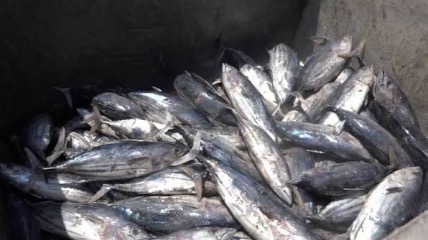
Ghana’s tuna industry is gradually collapsing under high operating costs, heavy taxes and inadequate government support, the Vice Chairman of the National Fisheries Association of Ghana (NAFAG), Richster Amarh Amarfio, has warned.
According to him, the sustained challenges facing operators have already wiped out the country’s pole-line fishing sub-sector, with no pole-line vessel currently operating in Ghana. “We were collapsing and the factors that are collapsing us have so much eaten into our industry such that one sub-sector, which is the pole-line sector, is completely gone. We don’t have a single pole-line vessel in Ghana today,” Mr Amarfio told Citi Business News.
A Fleet in Freefall
Ghana is permitted 37 tuna vessels under the International Commission for the Conservation of Atlantic Tunas (ICCAT), the regional body responsible for managing tuna stocks in the Atlantic. Of this allocation, 17 vessels use purse seine nets, while 20 operate with the hook-and-line method. None of the 20 hook-and-line vessels is currently operational, leaving only the 17 purse seine vessels in active operation. The collapse has consequences beyond fishing, with Ghana’s tuna fleet supplying fish to local processors including Pioneer Food Cannery and Cosmo Foods.
The crisis was already evident in January 2026, when Amarfio warned that 19 out of the 20 pole-and-line tuna vessels had completely collapsed and ceased operations, with all industrial trawl vessels laid up at Tema port unable to fish.
Fuel Costs as the Primary Killer
Mr Amarfio said the cost of fuel remains one of the biggest pressures on tuna operators, as vessels receive no fuel support and have to purchase fuel at prevailing market prices. With fuel currently costing about GH¢18 per litre, a vessel can require as much as 270,000 litres for a fishing trip, translating into millions of cedis in fuel expenditure alone.
The situation is particularly stark given that artisanal canoe fishers benefit from a 50% government subsidy on premix fuel, with the price reduced by 16% effective January 1, 2026. Industrial tuna operators, however, receive no such support and purchase fuel at the full market cost.
A Tax Burden on a Sector Classified as Agriculture
Beyond fuel costs, Mr Amarfio said fishing companies face taxes on fish stocks, spare parts and equipment despite the sector being classified under agriculture. He also cited high port charges, dry-docking costs and expenses associated with maritime security services required for operations in international waters.
Licensing costs have also surged, with vessel owners who previously paid US135 per GRT. For a vessel measuring 1,000 GRT, that means a licence cost of US35,000. Port charges are pegged to the US dollar, exposing fishing businesses to additional pressure whenever the exchange rate shifts.
Security has become another major expense. Following incidents involving armed attacks and hijacking threats at sea, vessels have had to carry armed naval personnel, with the companies bearing the cost.
“Basically, it looks like we’ve been left on our own. Nobody actually cares what is happening within our industry and we are collapsing gradually,” Mr Amarfio said.
The Bait Problem and Dry-Docking Delays
The collapse of the hook-and-line fleet is also linked to difficulties securing live anchovies, which are used as bait. Vessels must quickly harvest the bait and store it in tanks before heading to tuna fishing grounds, but restrictions on the use of light as an aggregating device made that increasingly difficult.
“Restrictions on the use of light as an aggregating device made it harder for hook-and-line vessels to secure live bait, forcing some operators to spend up to two weeks searching for bait and another two weeks fishing, leaving little room to break even and contributing to the collapse of the entire fleet,” he said.
Maintenance infrastructure presents another challenge, with vessels reportedly facing prolonged waits for dry-dock services, including periods of up to two years at the Port of Abidjan in Côte d’Ivoire.
The Korean Crew Dependency
Another major concern, Mr Amarfio said, is the shortage of trained Ghanaian crew, with the industry relying heavily on ageing Korean workers. “All tuna vessel captains are currently Korean, and many are ageing, creating a growing need to develop a local pool of specialised crew,” he said.
He called for investment in training and certification of Ghanaian captains and engineers, noting that the Regional Maritime University currently lacks the infrastructure and training vessel needed to adequately prepare personnel for the fishing industry. “We have failed to build capacity. We have raised this issue several times with Regional Maritime University. It is so expensive for my company for instance to import a Korean captain and pay him in hard currency at high rates. We would wish to have Ghanaian crew who will be doing those. Today we don’t have a single Ghanaian fishing captain that any company can employ,” he said.
A Vital Economic Contributor
Mr Amarfio said the tuna industry generates more than US400 million annually, with the European Union as the primary destination for Ghanaian tuna exports. Italy alone accounts for 73% of Ghana’s tuna exports.
The tuna industry is central to Ghana’s broader fisheries sector, which contributes about 4% to national GDP and supports the livelihoods of nearly 10% of the population. The sector provides direct employment to 100,000 fishermen, with three million more working along the value chain. Fish constitutes about 60% of Ghanaians’ animal protein intake, with an annual per capita consumption of 25 kilogrammes.
Ghana’s purse seine fleet lands around 75,000 tonnes of skipjack and yellowfin tuna a year, dwarfing landings from the pole-and-line fleet, which averaged around 5,000 tonnes annually.
A Sector in Recovery, Not Subsidised
The industry’s challenges come despite a significant achievement: in early 2026, the Ghana Tuna Association’s purse seine and pole-and-line fleets earned Marine Stewardship Council (MSC) certification, validating the sustainability of Ghana’s Atlantic skipjack and yellowfin tuna fisheries. The certification positioned Ghana among a select group of globally recognised sustainable fisheries, with only 66 tuna fisheries worldwide holding MSC certification as of mid-2025.
However, the certification has not translated into financial relief. “As an industry, we are challenged because we are in full recovery, we are not a subsidized sector. We pay [taxes],” Mr Amarfio said in a separate interview.
The EU Yellow Card Shadow
The industry’s export competitiveness is further constrained by the European Union’s yellow card, issued in 2021 over concerns about illegal, unreported and unregulated (IUU) fishing. The yellow card designates Ghana as a non-cooperating country in the fight against IUU fishing and has limited the country’s access to the lucrative EU seafood market.
The Fisheries Ministry has been engaged in ongoing dialogue with the European Commission’s Directorate-General for Maritime Affairs and Fisheries to address the concerns and secure the lifting of the yellow card. Fisheries Minister Emelia Arthur has said the yellow card significantly impacts industrial fishers exporting tuna, which brings in nearly US$400 million to Ghana.
Calls for a Dedicated Development Authority
Mr Amarfio is calling for deliberate government intervention to protect the sector and unlock its economic potential. He proposed the establishment of a dedicated development authority for the fisheries sector, similar to the specialised support provided to other major economic sectors such as cocoa and gold.
He also wants greater investment in tuna research and value addition, noting that the sector’s potential extends beyond the sale of fish to products such as fish oil, fish meal and other applications.
The Fisheries Ministry has said it is collaborating with stakeholders to roll out a comprehensive fishers’ protection package covering vessel licensing, insurance for fishing assets, social security arrangements, and transparent access to fisheries subsidies, including premix fuel. However, these measures have so far focused primarily on the artisanal sector.
What Happens Next
The combined strain of ageing vessels and rising maintenance, fuel, labour, licensing, security and port costs is making it increasingly difficult for fishing businesses to remain viable. With the entire hook-and-line fleet already lost and the purse seine fleet under growing pressure, the survival of one of Ghana’s most important foreign-exchange earners hangs in the balance.
Whether the government moves to establish a dedicated fisheries development authority, invest in local crew training, and address the structural cost disadvantages facing industrial operators will determine whether Ghana’s tuna industry can be rebuilt—or whether it follows the pole-and-line fleet into collapse.


