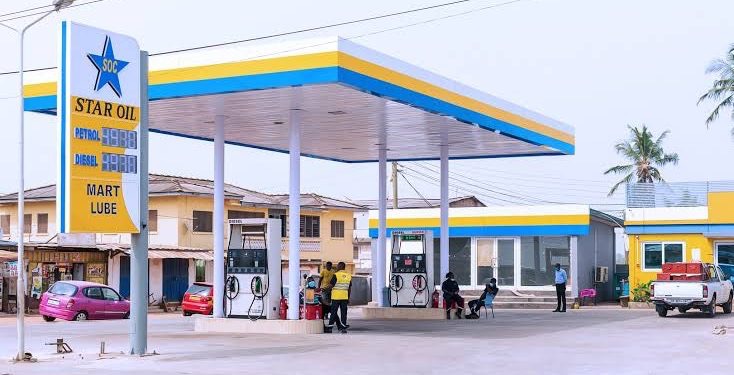
Star Oil Ghana Limited has announced its decision to rejoin the Chamber of Oil Marketing Companies (COMAC), ending a nine-month hiatus, while simultaneously calling for fundamental reforms to the Chamber’s governance structure to ensure fairer representation of members.
In a letter dated 1 October 2026 and addressed to the Chief Executive Officer of COMAC, the company said its membership would resume after it suspended its participation in January 2026 over concerns about the Chamber and its representation of members’ interests. The letter, signed by Star Oil’s CEO Philip Tieku, said consultations with oil marketing companies and other industry stakeholders, alongside appeals from fellow COMAC members, had prompted it to reconsider its position.
The company said its return was informed by the need for a strong industry body capable of representing the collective interests of oil marketing companies and engaging effectively with regulators, government and other stakeholders.
However, Star Oil said its return would also provide an opportunity to push for changes to COMAC’s governance arrangements, particularly provisions in the Chamber’s constitution that grant permanent board representation to three oil marketing companies because they are founding members.
The Governance Question
While acknowledging the contribution of the founding companies to COMAC’s establishment and development, Star Oil argued that permanent board membership based solely on historical status was no longer appropriate for a modern industry association.
“The downstream petroleum industry has changed considerably over the years. The relative size, market share, investment and contribution of individual OMCs have also evolved significantly,” the company stated.
Star Oil argued that COMAC’s governance structure should reflect the current composition of the industry and give all members a fair opportunity to participate in the Chamber’s leadership. The company also raised concerns that the existing arrangement concentrates influence among a small number of companies, adding that some permanent board members are not consistently represented by their highest decision-makers at board meetings. According to the company, this can weaken decision-making and limit the Chamber’s ability to respond promptly to important industry issues.
Star Oil is therefore advocating a transparent, democratic and periodically renewable process for board representation, which it believes would strengthen participation, accountability and commitment among members.
Background: A Nine-Month Absence
Star Oil’s return marks the end of a contentious period that began on 21 January 2026, when the company announced the immediate and indefinite suspension of its COMAC membership. At the time, Star Oil cited unfair representation within COMAC and the association’s failure to advocate consumer-friendly pricing policies, particularly its disagreement with the National Petroleum Authority’s fuel price floor policy.
The price floor, introduced in April 2024 as an amendment to the Petroleum Products Pricing Guidelines, sets a minimum ex-pump price for petrol, diesel and LPG. The stated goal was to prevent destructive undercutting and protect compliant businesses from illegal petroleum products sold at artificially low prices. Star Oil argued that the policy restricted competition and prevented cost savings from being passed on to consumers.
COMAC Chairman Gabriel Kumi defended the price floor at the time, saying it was necessary to protect the downstream petroleum industry from illegal activities and predatory pricing. He described COMAC as a democratic institution where decisions were taken by majority vote at board level, and noted that a high-level team had been constituted to engage Star Oil’s leadership and restore its membership.
COMAC CEO Dr Riverson Oppong had also expressed optimism about re-engaging Star Oil, saying at the time: “We will engage Star Oil. The Board Chairman has initiated processes to reach out to them and encourage a reconsideration of their decision. Star is not an ordinary member; he is the number one player in the industry and the Vice Chair of the Chamber.”
Those reconciliation efforts have now borne fruit, with Star Oil’s return coming after what the company describes as extensive consultations with industry stakeholders.
Star Oil’s Market Trajectory
Star Oil’s decision to rejoin COMAC carries particular weight given its dramatic rise in Ghana’s downstream petroleum sector. The indigenous company, once ranked 13th in sales volume in 2020, overtook long-time leader GOIL PLC to become Ghana’s largest oil marketing company by 2025, commanding a 14 per cent market share with annual sales of about 819 million litres and a nationwide network of 254 filling stations. It also contributes an estimated GH¢2.63 billion annually in taxes and levies, equivalent to approximately seven per cent of Ghana’s IMF bailout package.
In the first half of 2025, Star Oil sold over 403 million litres of petroleum products, including about 193.9 million litres of gasoline and 139.3 million litres of diesel. Its petrol liftings rose by 46.37 per cent to 228.4 million litres, enabling it to dethrone GOIL PLC, which recorded 189.4 million litres during the same period.
However, the competitive landscape has remained fluid. GOIL reclaimed the top spot in early 2026, with sales of 158.2 million litres in January and February, representing an 11.93 per cent market share, narrowly edging out Star Oil’s 155.7 million litres, or 11.74 per cent. The see-saw battle between the two indigenous giants has reshaped the competitive dynamics of a market where the top ten OMCs control roughly 61 per cent of total sales while nearly 190 others compete for the remainder.
An Industry Body at a Crossroads
The governance reforms Star Oil is advocating would mark a significant departure for COMAC, which traces its origins to the Association of Oil Marketing Companies (AOMC), registered in October 2003. The association rebranded to COMAC in 2024 under the leadership of CEO Dr Riverson Oppong, reflecting its expanded mandate as an advocacy institution for Ghana’s downstream petroleum sector.
COMAC currently represents over 196 members, including OMCs and LPGMCs, and works closely with key stakeholders including the Ministry of Energy, the Ministry of Finance, the Bank of Ghana, the National Petroleum Authority, the Energy Commission, the Environmental Protection Agency, the Tema Oil Refinery, the Ghana Revenue Authority and the Bulk Oil Storage and Transportation Company.
Its Governing Board is currently chaired by Gabriel Kumi of Trinity Oil Company Limited, with Joshua Larbi of JP Trustees as Vice Chairman. Board members include representatives from Vivo Energy Ghana, GOIL PLC, TotalEnergies Marketing Ghana, Nick Petroleum Ghana, Petronax Energy, Icon Energy, Beap Energy Ghana and Manbah Gas Company.
The three founding-member companies with permanent board representation are understood to be GOIL PLC, TotalEnergies Marketing Ghana and Shell Ghana. Together, these companies operate approximately 950 filling stations across the country — GOIL with 500, TotalEnergies with 300 and Shell with 150 — and have historically supported the price floor framework.
Broader Industry Pressures
Star Oil’s governance push comes amid broader structural challenges in Ghana’s downstream petroleum sector. Following price deregulation in 2015, the number of licensed OMCs surged from 139 to over 200, while BDCs grew from 31 to over 53, creating a crowded and increasingly fragmented market. The proliferation of operators, combined with the aggressive price competition between GOIL and Star Oil, triggered a bruising pump price war in early 2026 that drove petrol prices below GH¢10 per litre for the first time in nearly a decade.
The price war prompted the NPA to ban fuel and LPG pump discounts in March 2026 and order uniform pricing nationwide, a move that Star Oil criticised as restricting its competitive strategy of selective price reductions at some outlets. The tension between market liberalisation principles and regulatory intervention has since become a defining feature of the industry’s operating environment.
Industry observers have noted that the existing governance arrangement at COMAC, which concentrates board influence among a small number of founding companies, may not adequately reflect the sector’s transformed composition. The Africa Sustainable Energy Centre (ASEC), commenting on Star Oil’s original withdrawal in January, said trade associations must accommodate divergent perspectives to remain legitimate, warning that failure to do so risks turning such bodies into shields for inefficiency rather than platforms for reform.
What Star Oil Wants
Star Oil’s letter makes clear that its return to COMAC should be seen not only as a resumption of membership and board representation, but also as a commitment to working with other members to make the Chamber more representative, responsive and effective.
The company is advocating for a governance framework that aligns board representation with current industry realities rather than historical status, ensuring that all members have a fair opportunity to participate in the Chamber’s leadership through a transparent, democratic and periodically renewable process.
For COMAC, Star Oil’s return represents both a significant boost to its membership and a challenge to its established order. How the Chamber responds to the call for governance reform will determine whether the industry body can evolve to reflect the downstream petroleum sector it represents — or risk further fragmentation in an industry already navigating volatile global markets, domestic fiscal pressures and an increasingly competitive operating environment.