



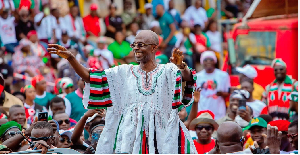
A new Citizens Perception Survey has placed Johnson Asiedu Nketiah, National Chairman of the National Democratic Congress (NDC), ahead of other potential contenders in the party’s yet-to-be-officially-declared flagbearer race.
The survey, conducted by Professor Smart Sarpong, Associate Professor and Senior Research Fellow at Kumasi Technical University, sampled 9,330 respondents across 11 regions between September 10 and 20, 2026. It comprised 5,580 stakeholders and 3,750 core NDC delegates. The regions covered were the Upper East, North East, Northern, Savannah, Bono, Ahafo, Western, Western North, Central, Greater Accra, and Ashanti.
Respondents were asked, among other things, who could best unite the NDC and who was most suitable to lead the party. On unity, Asiedu Nketiah, popularly known as “General Mosquito,” topped the list with 24.5 percent, followed by Food and Agriculture Minister Eric Opoku with 20.4 percent. Finance Minister Dr. Cassiel Ato Forson followed with 12.5 percent, while Education Minister Haruna Iddrisu polled 9.4 percent. Chief of Staff Dr. Julius Debrah recorded 6.1 percent, Vice President Professor Naana Jane Opoku-Agyemang 5.2 percent, and Professor Joshua Alabi 3.6 percent.
On suitability to lead the party, Asiedu Nketiah again led with 27.6 percent, narrowly ahead of Opoku at 26.4 percent. Dr. Ato Forson followed with 16.1 percent, while Iddrisu polled 10.4 percent.
The results add to a growing series of polls that have placed the veteran politician near the top of the NDC’s leadership conversation, even though the party has not opened nominations and none of the potential aspirants named has publicly declared an intention to contest.
Professor Sarpong cautioned that the survey should not be read as a prediction of the eventual outcome. He noted that the contest had not formally begun and that rankings could shift once aspirants picked nomination forms, underwent vetting, and began active campaigning.
A Political Career Spanning Decades
Asiedu Nketiah’s showing reflects a political journey that began in 1988, when he served as an Assemblymember for the Wenchi District Assembly in the then Bono-Ahafo Region, now the Bono Region. He was later elected to the Consultative Assembly that drafted Ghana’s 1992 Constitution.
He served as Member of Parliament for Wenchi West from 1993 to 2005. During his 12 years in Parliament, he sat on key committees including Appointments, Finance, Public Accounts, and Mines and Energy, and served as Minority spokesperson on Food, Agriculture, and Cocoa Affairs. From 1997 to 2001, he was Deputy Minister for Food and Agriculture (Crops).
In December 2005, he won nearly 80 percent of the votes to become the third General Secretary of the NDC, a position he held for 17 years—the longest in the party’s history. He was re-elected in 2010 with 93 percent of the votes and again in 2018, defeating Koku Anyidoho by a landslide.
In December 2022, he contested and won the National Chairmanship, defeating incumbent Samuel Ofosu-Ampofo with 5,569 votes to 2,892. His nickname, “General Mosquito,” was earned during his time as a minister when he refused to support the appointment of what he considered an unqualified minister, drawing a comparison to Sierra Leonean rebel leader Sam Bockarie, who bore the same moniker.
Earlier Polls Show Tightening Race
The new survey aligns with earlier polls that have consistently placed Asiedu Nketiah at or near the top of the NDC flagbearer conversation. A Global InfoAnalytics poll in July 2026 showed him leading with 27 percent support among NDC delegates, down from 29 percent in April, while Dr. Ato Forson gained momentum, rising from 19 percent to 22 percent. In a direct contest between the two, Asiedu Nketiah led with 34 percent to Dr. Forson’s 33 percent, with 33 percent of delegates undecided.
An Africa Policy Lens survey in April 2026 showed a tighter race, with Asiedu Nketiah at 31.9 percent and Julius Debrah at 30.1 percent—a margin of less than two percentage points. Haruna Iddrisu followed with 17.9 percent, while Dr. Ato Forson garnered 13.0 percent.
The survey also examined the broader political environment. It found that 52.1 percent of respondents described Ghana’s political temperature as calm, while 35.3 percent described it as somewhat calm. Within the NDC, 63.1 percent described the internal environment as calm.
Professor Sarpong urged political parties to pay attention to the minority who perceived tensions within their structures, warning that unresolved concerns could affect participation in internal elections.
Unemployment and lack of job opportunities emerged as the most urgent community-level concern, cited by 40.4 percent of respondents, followed by poor road infrastructure and access to healthcare.
Asiedu Nketiah has previously said he has never lost an election throughout his political career and has advocated for leadership rotation within the NDC, reflecting on his own journey from General Secretary to National Chairman.


