



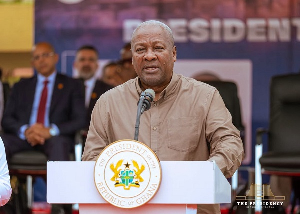
President John Dramani Mahama has officially declared that Ghana will hold a national referendum in 2027 to decide on a raft of far-reaching constitutional amendments, setting the stage for the most profound reshaping of the country’s foundational law since the 1992 Constitution came into force.
Addressing a gathering of legal practitioners, civil society leaders, and parliamentary stakeholders at the Jubilee House on Thursday, Mahama framed the upcoming vote as a “non-negotiable national imperative” rather than a political gambit. He stressed that the referendum would not be subject to parliamentary dilution, as the changes target entrenched clauses that constitutionally require direct citizen approval.
“Ghanaians must own the final architecture of their governance. The 2027 referendum will be a watershed moment—a collective decision on whether we modernize our democratic compact or cling to a structure designed for a transitional era,” Mahama said, urging all political actors to approach the process with “patriotism over partisanship.”
Core Amendments on the Table
Although the full Constitutional Instrument is yet to be gazetted, presidential aides have confirmed that the proposed revisions will zero in on three contentious pillars:
· Electoral Commission Reforms: A move to strip the President of sole appointive powers over EC commissioners, replacing it with a cross-institutional selection panel that includes nominees from the judiciary, the Ghana Bar Association, and civil society groups.
· Judicial Independence: Restructuring the Judicial Council to reduce executive dominance in Supreme Court appointments, with new criteria emphasizing seniority and proven integrity over political affiliation.
· Fiscal Devolution: Entrenching legally binding clauses that compel the central government to transfer at least 30% of national revenue to local assemblies, addressing decades of complaints about Accra’s excessive concentration of power.
A Decades-Old Unfinished Business
The 1992 Constitution—crafted as a bridge from Jerry Rawlings’ military junta to multi-party democracy—has long been criticized for its hyper-presidential framework. Mahama’s administration is now dusting off the 2011 Constitutional Review Commission (CRC) report, which offered over 200 recommendations. Successive governments have shelved most of those proposals, citing political inconvenience, but Mahama has vowed to “break the cycle of selective implementation.”
The Daunting Legal Math
The referendum carries a heavy procedural burden. Under Article 291, amendments to entrenched provisions—covering human rights, judicial independence, and electoral integrity—must pass a referendum requiring a 50% voter turnout and a 75% “Yes” vote of all ballots cast. Given Ghana’s historical referendum turnout (which hovered around 42% in 2019), achieving the threshold presents a formidable challenge.
To mitigate this, the Electoral Commission is expected to launch an aggressive voter mobilization drive starting in mid-2026, while the government plans a year-long civic education campaign to explain the amendments in local languages.
Opposition and Civil Society React
The opposition New Patriotic Party (NPP) offered a guarded welcome but questioned the timing, with some MPs suggesting the 2027 date could be used as a political wedge ahead of the 2028 general elections. Mahama has responded by pledging to establish a bipartisan parliamentary oversight committee chaired by a retired Supreme Court justice, promising that the drafting process will be “transparent from clause one to clause last.”
Meanwhile, the Ghana Centre for Democratic Development (CDD-Ghana) hailed the announcement as a “critical test of our democratic maturity.” Its executive director urged the government to release the full draft bill within six months, warning that any opacity would erode public trust.
As Ghana approaches its 70th independence anniversary in 2027, the referendum looms as the defining political event of Mahama’s second term—a high-stakes gamble that will determine whether the nation is ready to rewrite the rules of its democracy, or remain tethered to the compromises of its past.


