



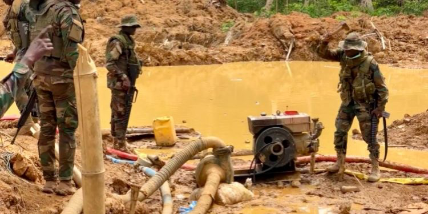
– The staggering scale of environmental devastation wrought by illegal mining in Ghana has been laid bare, with the Ministry of Lands and Natural Resources revealing that nearly 8,900 hectares of forest reserves have been decimated—an area equivalent to over 12,500 football pitches.
The grim statistic, released during a high-level policy dialogue with the IMANI Centre for Policy and Education in Accra, highlights a crisis that has plagued the West African nation for decades. Lands Minister Emmanuel Armah-Kofi Buah presented satellite imagery of the ravaged landscapes, underscoring the severity of the situation. “What you are looking at is not an earthquake. It is a forest reserve,” he declared, pointing to the brown, scarred earth where lush canopies once stood.
The Toll on Protected Areas
According to the Ministry, nine of Ghana’s 288 gazetted forest reserves have been severely degraded by illegal artisanal mining, commonly known as galamsey. These reserves, which serve as critical water catchment areas for major rivers like the Pra, Birim, and Offin, are now facing irreparable damage. The Forestry Commission reports that its staff are increasingly overwhelmed and face significant safety risks when attempting to enforce regulations in these volatile zones.
The figures, current as of July 2026, paint a picture of intense, clandestine activity. Enforcement operations have led to the arrest of 258 individuals, while authorities have seized or immobilized 234 excavators, 2,728 pumping machines, and 1,724 changfan machines (localized gold-processing devices). In addition, 461 motorbikes and tricycles, frequently used to smuggle equipment and ore through dense bush, have been impounded.
The Port Blockade and Equipment Control
In a strategic move to tackle the menace at its source, the government has tightened controls on the importation of heavy machinery. Minister Buah disclosed that over 4,000 excavators are currently detained at Ghana’s ports, awaiting compliance with a rigorous new documentation and clearance regime. This backlog stems from a policy shift enacted in late 2025, designed to clamp down on the influx of earth-moving equipment that has historically fueled the illegal mining boom. The minister warned that the economic implications are significant, as the equipment sits idle while the country grapples with how to handle the massive inventory.
Prosecution: The Systemic Bottleneck
Despite the uptick in arrests, Mr. Buah struck a candid note regarding the weakness of the judicial response. “The challenge we are having is not the arrest. It is the prosecution,” he admitted. The Ministry is currently collaborating with the Attorney-General’s Department to address pervasive legal hurdles. Prosecutors often struggle with low bail amounts set by magistrates, insufficient forensic evidence to link suspects to specific sites, and the sheer volume of cases clogging the courts. Moreover, many arrested individuals are low-level “foot soldiers” who are easily replaced, while the financiers—often well-connected politicians or businessmen—remain elusive.
Licensing Overhaul Targets ‘Land Banking’
To address the structural flaws in the sector, the government is proposing major amendments to the Minerals and Mining Act. The most radical reform is the reduction of the maximum initial duration for large-scale mining leases from 30 years to 20 years. Additionally, stricter “use-it-or-lose-it” obligations will be imposed on holders of exploration and prospecting licences, requiring them to demonstrate actual ground activity within specified timeframes. Mr. Buah criticized the long-standing practice of speculators hoarding concessions for decades. “People are just sitting on concessions for 30, 40 years. They are not doing anything. They are waiting for the next big investor to come so they can cash out,” he said, vowing to dismantle this speculative culture.
The Blue Water Guards and Civil Society Engagement
The government has also recruited and trained approximately 2,000 Blue Water Guards—a specialized unit tasked with protecting water bodies and providing intelligence to security forces. While the initiative has yielded useful results in curbing river pollution, Mr. Buah acknowledged disciplinary challenges within the ranks, including allegations of bribery by miners looking to buy protection. He assured the public that these issues are being addressed as the unit evolves.
The dialogue with IMANI, a prominent policy think-tank, signals a shift toward greater civil society involvement. IMANI’s policy analysts reiterated that the fight against galamsey cannot be won solely through law enforcement. They stressed the need for community ownership, urging that local chiefs and residents be given a direct stake in decisions regarding mining concessions to reduce the appeal of illicit activity.
A National Crisis
Illegal mining represents a dual threat to Ghana: environmental collapse and economic hemorrhage. The destruction of 8,900 hectares of forest contributes to the silting of rivers, contaminating drinking water with mercury and cyanide and decimating fish stocks. This, in turn, threatens the livelihoods of smallholder farmers who depend on the affected ecosystems. As the Minister concluded his presentation, he reiterated that while the statistics are dire, the new multi-pronged approach—combining import controls, licensing reform, and community engagement—marks a pivotal moment in Ghana’s long-standing battle to reclaim its natural heritage. The nation now watches closely to see if these sweeping reforms can translate into tangible on-the-ground victories.


