



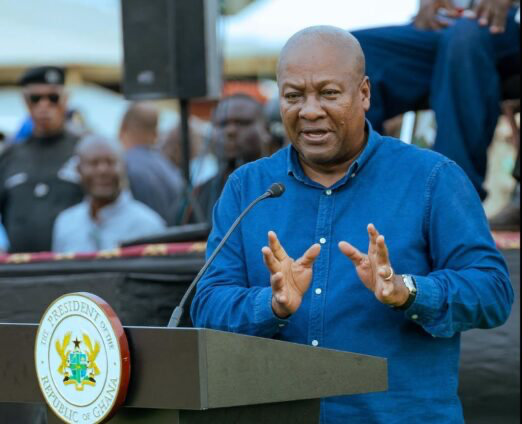
President John Dramani Mahama has announced a bold five-year strategic roadmap aimed at drastically cutting Ghana’s dependence on imported medicines—a move that could reshape the nation’s pharmaceutical landscape and ease the financial burden on the state health system.
Speaking at the launch of the Free Primary Health Care (FPHC) programme in Zuarungu on Thursday, Mahama revealed that the comprehensive plan had been submitted to him by the National Vaccine Institute, the Ministry of Health, the Pharmaceutica Association of Ghana (PAG), and other allied institutions. The strategy, he said, targets a gradual but sustained shift toward local production of essential drugs, with an eye on eventually exporting surplus to neighbouring West African markets.
“We import 70 per cent of the medicines we use—yet we have the raw materials, the skilled workforce, and the industrial capacity to produce the majority of these drugs right here in Ghana,” Mahama told a crowd of health workers, traditional leaders, and community members. “This five-year plan is not a wish list; it is a binding commitment to break the cycle of dependency.”
The Import Dependency Problem
Ghana currently spends an estimated $500 million annually on pharmaceutical imports—a figure that has ballooned over the past decade due to a weak local manufacturing base, high production costs, and persistent supply chain disruptions. While the country boasts over 40 registered pharmaceutical manufacturers, most operate below capacity, producing mostly generics for common ailments like malaria and antibiotics, while relying heavily on imports for chronic disease treatments, vaccines, and advanced biologics.
The President’s announcement comes on the heels of a 2025 World Bank report that flagged Ghana’s “alarming vulnerability” to global supply shocks, particularly after the COVID-19 pandemic exposed the fragility of African health systems dependent on foreign suppliers.
What the Five-Year Plan Entails
Although the full document has not been made public, sources close to the Ministry of Health indicate that the strategy encompasses:
· Incentive packages: Tax holidays and reduced utility tariffs for local manufacturers that meet World Health Organization (WHO) Good Manufacturing Practice (GMP) standards.
· Technology transfer agreements: Partnerships with Indian and Chinese generic drug giants to set up local production lines for high-demand drugs like metformin, insulin, and antihypertensives.
· Vaccine manufacturing acceleration: The National Vaccine Institute will spearhead local fill-and-finish operations, with a target to produce 40% of routine vaccines domestically by 2028.
· Public procurement quotas: A directive requiring all government health facilities to prioritize locally manufactured drugs over imports—except in cases of critical shortage—to guarantee market demand.
Economic and Health Benefits
Mahama stressed that local production would not only shield Ghana from currency volatility and shipping delays but also directly reduce the cost of medicines by an estimated 25–40%. This, he argued, is essential for the sustainability of the FPHC programme, which provides free primary care to vulnerable populations.
“If we produce these drugs here, procurement costs drop. That means we can stock more essential medicines at primary health posts, and patients won’t have to travel to regional hospitals for basic treatment,” he explained.
The plan also envisions a regional export hub. With ECOWAS neighbours like Burkina Faso, Togo, and Côte d’Ivoire facing even higher import reliance, Ghana could position itself as the sub-region’s pharmaceutical powerhouse—provided it meets WHO prequalification standards.
Parallel Reforms: NHIS Overhaul
In tandem with the pharmaceutical push, Mahama announced major adjustments to the National Health Insurance Scheme (NHIS). He confirmed that the government had uncapped funding for the scheme and was now making timely payments to healthcare providers—a long-standing grievance that had led to strikes and service denials.
Additionally, NHIS tariffs have been reviewed upward to reflect the actual cost of treatment. Crucially, Mahama declared that “there should be no co-payment” at any health facility for services covered under the scheme. He warned that facilities found demanding out-of-pocket fees for covered services would face sanctions.
Upgrading Specialist Infrastructure
Beyond primary care, the President outlined investments under the Ghana Medical Trust Fund to support patients battling cancer, cardiovascular diseases, and renal failure. Major hospitals are being equipped with advanced diagnostic tools—including CT scanners and catheterization laboratories—while a dedicated cardiothoracic centre in Tamale is nearing completion to serve patients from the northern regions, who currently must travel to Accra or Kumasi for such surgeries.
Political and Industry Reaction
The Pharmaceutical Association of Ghana (PAG) welcomed the announcement but urged the government to address persistent energy costs and raw material import tariffs, which currently make local production 20% more expensive than imports. “The plan is excellent, but we need a clear implementation timeline and sustained political will,” said PAG President Dr. Emmanuel Adjei in a separate statement.
Meanwhile, the opposition NPP cautiously supported the initiative but questioned the five-year timeline, noting that similar pledges have been made by previous administrations without measurable results. Mahama countered by pointing to the newly established Pharmaceutical Investment Council, which will monitor progress quarterly and publish public scorecards.
The Bigger Picture
As Ghana approaches its 70th independence anniversary in 2027, the pharmaceutical plan dovetails with the President’s broader industrialisation agenda, which includes local production of textiles and processed foods. Health experts argue that reducing drug imports is not just an economic issue—it is a national security imperative. With global supply chains increasingly politicised and volatile, Ghana’s push for self-reliance could serve as a model for other African nations.
Mahama concluded his address with a stark warning: “We cannot build a wealthy nation on the backs of sick citizens. Health is wealth, and wealth begins with the medicines we make ourselves. This plan will be my legacy—and I expect every Ghanaian to hold us accountable to it.”
The President was accompanied by Health Minister Kwabena Mintah Akandoh, Attorney-General Dominic Akurutinga Ayine, and several MPs from the Upper East Region, underscoring the administration’s focus on decentralising healthcare delivery.


