



President John Dramani Mahama has directed a review of the menu for Senior High School (SHS) students, as the Education Minister, Haruna Iddrisu, assured students across the country that adequate provisions have been made for their meals for the 2026/2027 academic year.
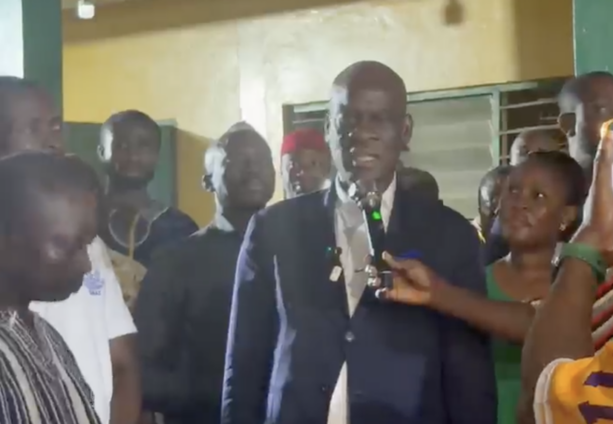
Mr Iddrisu announced the presidential directive during a visit to Tarkwa Senior High School on Friday, September 18, as students returned to school following the release of the academic calendar by the Ghana Education Service (GES).
“I will follow further to examine the data and then we’ll ensure that you don’t lack food. We make adequate provision for your meals,” Mr Iddrisu told students. “I’m happy to announce that President Mahama has directed that we review your menu to make it better.”
The assurance comes amid sustained efforts by the government to address challenges associated with feeding under the Free SHS programme, which has been dogged by intermittent food shortages since its inception in 2017.
GH¢4.2 Billion Allocated for Feeding
The government has allocated GH¢4.2 billion for feeding Free SHS students in 2026, as part of a total GH¢9.6 billion allocation for the programme. The Education Minister has also announced plans to increase the feeding grant from GH¢8 to GH¢15 per student as part of broader reforms. While this increase has already been implemented for students in public special schools, its extension to all SHS students is part of the government’s wider reform agenda under President Mahama’s “Reset Agenda.”
President Mahama has previously attributed the feeding challenges to the manner in which the Free SHS programme was introduced by the previous administration. Speaking during a Citizens’ Engagement in Wa, he said his government inherited a situation where the programme “had been introduced without a dedicated funding source.”
“As a result, schools depended on delayed budget releases every year. Headmasters constantly complained about inadequate funding and shortages of food,” he said. Some schools, he noted, had to feed students with whatever food items were available because supplies arrived irregularly.
The President said the government has since established dedicated funding arrangements for SHSs and student feeding. “Today, we have established dedicated funding for Senior High Schools. We have also created dedicated financing for student feeding, and complaints from headmasters have reduced considerably,” he said.
Feeding Challenges a Thing of the Past – Minister
The Education Minister has been consistent in his assurances that feeding challenges under the Free SHS programme have been resolved. Speaking at the commissioning of the National Teaching Council’s regional office complex in Tamale in June 2026, he acknowledged that food shortages had, in the past, created serious difficulties for some schools, leading to disruptions in academic work and forcing students to return home before the completion of the school term.
“Having examined the feeding of Free Senior High School students, we realised that there were many times that schools had to be closed down or, in the course of the academic year, students had to be asked to go home because there was inadequate food. That is now a thing of the past,” he said.
He attributed the improvement to strengthened financing arrangements through the Ghana Education Trust Fund (GETFund), which he said would ensure consistent support for the programme. “There are adequate resources and adequate funding from GETFund to finance Free Senior High School,” he stated.
The government’s efforts have also included clearing outstanding arrears owed to food suppliers. In April 2026, GETFund released over GH¢199 million to senior high school heads to settle outstanding feeding bills, following concerns over unpaid bills for perishable food supplies that had triggered threats of possible shutdowns in affected schools.
A Programme Under Review
The directive for a menu review forms part of a broader, structured evaluation of the Free SHS policy. President Mahama has repeatedly said the review is not intended to abolish the policy but to critically assess its implementation and strengthen its delivery and sustainability. The review focuses on three key areas: financing, infrastructure, and quality assurance.
According to Mr Iddrisu, the restructuring has already begun yielding results, particularly in the management of funding and resources. He pointed to the decoupling of GETFund as a key decision that has made additional resources available to address challenges such as food supply in senior high schools. “In a reviewed manner, there would no longer be any food shortages to CHASS and to any secondary school,” he said.
The government has also secured a US$300 million facility from the World Bank to support efforts to eliminate the double-track system, with President Mahama assuring that by the end of 2027, no school in Ghana should still be operating the double-track system.
2026/2027 Academic Year Underway
SHS and Senior High Technical School (SHTS) students resumed classes on September 18, 2026, following the release of the academic calendar by GES. Under the calendar, Form One and Form Two students in single-track schools are expected to complete the academic year on July 30, 2027. Form Three students are scheduled to complete the academic year on June 18, 2027, coinciding with the conclusion of the 2027 West African Senior School Certificate Examination (WASSCE).
The calendar also provides for a Christmas break from December 19, 2026, to January 4, 2027, and an Easter break from March 25 to March 30, 2027.
A Policy That Transformed Access
The Free SHS policy, introduced in 2017 under the previous administration, was designed to abolish financial barriers to secondary education by providing subsidies for tuition, textbooks, meals, accommodation, and other resources. Between 2017 and 2021, the government spent GH¢5.12 billion (approximately US$392 million) on implementing the policy, which significantly increased enrolment and reduced dropouts, particularly among children from low-income families and those in rural areas.
However, the programme has faced persistent challenges, including overcrowding, inadequate infrastructure, and delays in funding releases that contributed to food shortages in schools. The government’s current reform efforts aim to address these structural issues while sustaining the policy’s core objective of expanding access to secondary education.
As the new academic year begins, the Minister’s assurance of adequate food provisions, alongside the presidential directive for a menu review, signals an effort by the government to address both the availability and quality of meals served to students under the Free SHS programme. The details of the revised menu and when the changes will take effect are yet to be announced.


