



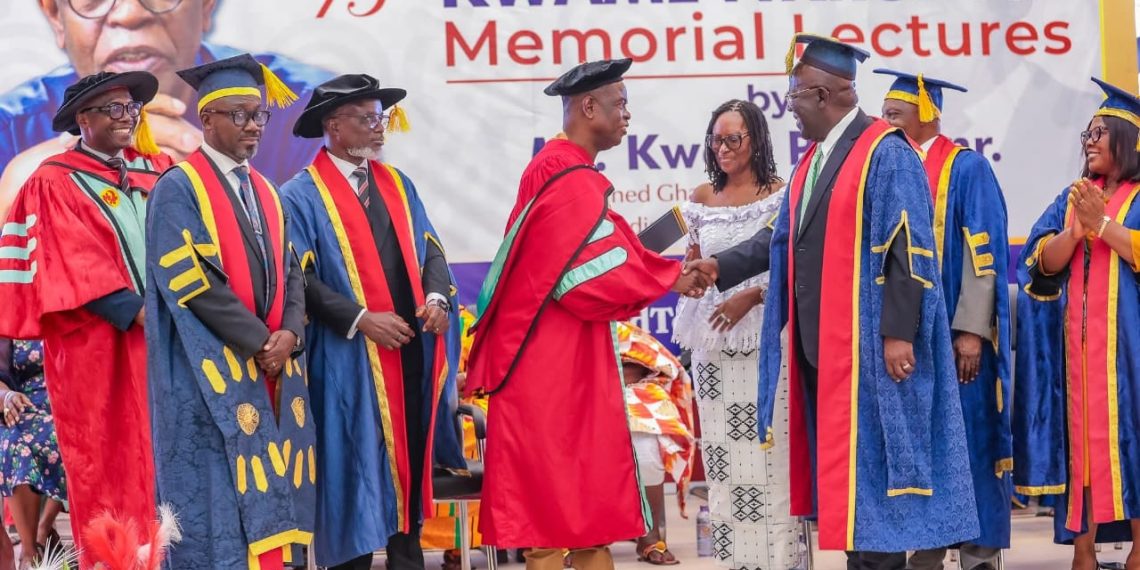
The University of Cape Coast (UCC) has conferred an honorary Doctor of Letters (D.Litt.), honoris causa, on veteran journalist, publisher, and Pan-Africanist Kwesi Pratt Jnr., recognising more than five decades of work in journalism, public discourse, and the ideals of African emancipation.
The honour was conferred on Friday, September 18, 2026, during a special congregation held as part of the 15th Kwame Nkrumah Memorial Lectures. The conferment followed Mr Pratt’s delivery of the second of the two memorial lectures under the theme, “Kwame Nkrumah, Yesterday, Today and Tomorrow: Perspectives on Constitutionalism, Development and Pan-Africanism”.
“A Vibrant Democracy Depends on Courage”
Chancellor of UCC, Dr (Sir) Sam Esson Jonah, said the honour recognised Mr Pratt’s longstanding contribution to Ghana’s media and civic space and his consistent use of journalism and public engagement to hold power accountable and promote social justice and Pan-Africanism.
“In honouring him today, the University recognises that a vibrant democracy depends on courage, independent journalism, and the openness to new ideas,” Sir Sam said. He described Mr Pratt’s public life as reflecting “a relentless commitment to the public good and an unshakable belief in the power of informed civic engagement”.
Sir Sam said the conferment was also a reminder that education should go beyond awarding academic credentials. “Education must not merely confer credentials. It must cultivate ethical leadership, critical thinking, and civic courage,” he said. He challenged students to draw lessons from the lives and work of Dr Kwame Nkrumah and Mr Pratt, particularly the courage to question established ideas and contribute to society. “Don’t underestimate the power of ideas,” he told them.
“I Never Imagined This”
In accepting the honour, Mr Pratt said he never imagined that he would one day have the opportunity to deliver the Kwame Nkrumah Memorial Lectures and subsequently receive an honorary degree from UCC. “I never in my life thought that one day I would be given the honoured opportunity to deliver the talk of Nkrumah,” he said.
He traced his political and intellectual formation to his early years in Accra, where he was introduced to Nkrumahist ideas and organisations, which instilled in him the belief that there was no greater honour than contributing to the freedom of African people. He said he has spent his life working with various left-wing organisations, including the Student Movement for African Unity, the Kwame Nkrumah Revolutionary Guards, and the Socialist Movement of Ghana.
Mr Pratt said although he was growing older and would not live to see all his political dreams realised, he remained committed to the struggle for a united Africa. “My dreams may not be realised in my lifetime. They may be gone. But as long before the dream of a united Africa under the banner of scientific socialism would be realised,” he said. “Until that time comes, until freedom comes, when like all of us, we are compelled to give up our body and our spirit, we shall continue to struggle until final victory”.
A Five-Decade Career in Journalism and Public Service
Mr Pratt’s association with journalism stretches back to 1969, when he began his broadcasting career as co-host of the Uncle Frank Show on GBC Radio. By the mid-1970s, he had become a familiar voice and face on GBC radio and television, appearing as a panellist on Leaders of Tomorrow and presenting programmes including In Town and Talking Point. He entered print journalism in 1975 as a reporter with the Ghanaian Times before joining the Ghana News Agency as a senior reporter in 1976.
His career subsequently took him through public communication and journalism positions including Public Relations Officer of the National Youth Council, Central Regional Secretary of the Ghana Journalists Association, editor of Frontline Message, and Public Relations Officer at the Ministry of Youth and Sports. He also worked at the Information Services Department and served as Public Relations Officer for the Ministry of Fuel and Power before becoming Associate Editor of The Ghanaian Voice in 1987.
In 1993, Mr Pratt founded The Insight newspaper, which he has edited for more than three decades. He was elected President of the Private Newspaper Publishers Association of Ghana in 1994 and published the book Street People in 1995. His public service has also included membership of the National Media Commission from 2014 and serving as Chairman of the Board of Kasapa Mobile Communications Company since 2016. Since 2020, he has served as General Secretary of the Socialist Movement of Ghana and as a member of the leadership of the Pan-Africanism Today Project.
Mr Pratt is also the founder and owner of the Pan African Television network in Ghana and is affiliated with the Socialist Movement of Ghana. He was a member of the Alliance for Change, the organisers of the 1995 Kume Preko anti-government demonstration. Born on September 7, 1953, Mr Pratt received his early education in Accra and Kumasi before attending Nima I Middle School, Presbyterian Boys’ Boarding School at Aburi, and Tema Secondary School. He later received professional journalism training at the Ghana Institute of Journalism.
His work has attracted recognition beyond Ghana. In 2025, he received the Ghana Journalists Association Award for Championing Press Freedom and was awarded the Medal of Friendship by the Government and People of Cuba.
The Kwame Nkrumah Memorial Lectures
The honour formed part of UCC’s wider commemoration of the legacy of Kwame Nkrumah through its memorial lecture series, which was instituted in 1974 and inaugurated in 1976. The university said the lectures are intended to promote discussion on the social, economic, and political development of Africa and the Black world.
The 2026 lectures focused on constitutionalism, development, and Pan-Africanism, with Mr Pratt using the platform to examine the continuing relevance of Nkrumah’s ideas to Ghana and Africa. UCC Vice-Chancellor Prof. Denis Worlanyo Aheto said Mr Pratt’s decades of work as a journalist, publisher, political commentator, and public intellectual had contributed significantly to national discussions on Ghana’s political, economic, and social development, as well as African emancipation and self-determination.
At the opening of the lectures, Sir Sam Jonah called for Nkrumah’s ideas to receive greater prominence in Ghana’s educational system. He criticised Ghana’s education system for not doing enough to teach students about the ideas and intellectual contributions of the country’s first President. “The ideas Nkrumah stood for are hardly taught in Ghanaian schools,” Sir Jonah said. He compared Ghana’s situation with universities in the United States, where Nkrumah continues to be studied in African and African American Studies programmes. “The American student meets Nkrumah as a thinker. Too many Ghanaian students meet him only as a statue”.
Sir Jonah specifically called on the leadership of UCC to consider adding Nkrumah’s intellectual works to the university’s curriculum. “I would gently commend a thought to the Vice-Chancellor and to Convocation: that a university which carries Nkrumah’s name on its lecture series might also carry his ideas in its curriculum,” he said.
A Voice on Reparatory Justice
The university also commended Mr Pratt’s recent book, Reparations: History, Struggle, Politics and Law, which examines reparatory justice, historical memory, and sovereignty. The book was launched in Accra on September 9, 2025, with support from the Pan-African Progressive Front, and President John Dramani Mahama, who wrote the foreword, described reparations as a matter of justice rather than charity. “Reparation is not a charity; it is justice, and it must be visible,” the President said.
The publication, which was also presented at the African Union Summit in Malabo in July 2025, estimates the debt owed to Africa in trillions of dollars, including between $2 and $3 trillion for the unpaid labour of enslaved Africans, $4 to $6 trillion for colonial exploitation, $500 billion for debt cancellation, $50 billion for stolen artefacts, and $1 trillion for climate reparations.
Mr Pratt has called for reparations to be seen not only as compensation for past crimes but as part of restructuring global systems. “Reparation is not simply compensation for past crimes; it is about restructuring the world, redistributing surplus value, and removing the inequality rooted in the colonial era,” he said. The book has received strong reviews, with one reviewer describing it as “a bold, unapologetic 152-page demand for reparative justice — not only for slavery but also for colonialism”.
A Lasting Tribute
Mr Pratt also used the occasion to pay tribute to UCC, describing it as an institution that has contributed significantly to intellectual development and public life in Ghana. He recalled his association with the University dating back to 1976, when he lived in Cape Coast while working as a journalist. He said the University at the time served not only students and lecturers but also the wider community, providing a space where people engaged in intellectual discussions and debates about Ghana and Africa. “It was in this university that we made the greatest friends,” he said.
As the special congregation drew to a close, the conferment of the honorary doctorate on Mr Pratt stood as a recognition not only of a career spanning more than five decades but of a life dedicated to the ideals of independent journalism, democratic accountability, and the enduring vision of a united and liberated Africa.


