



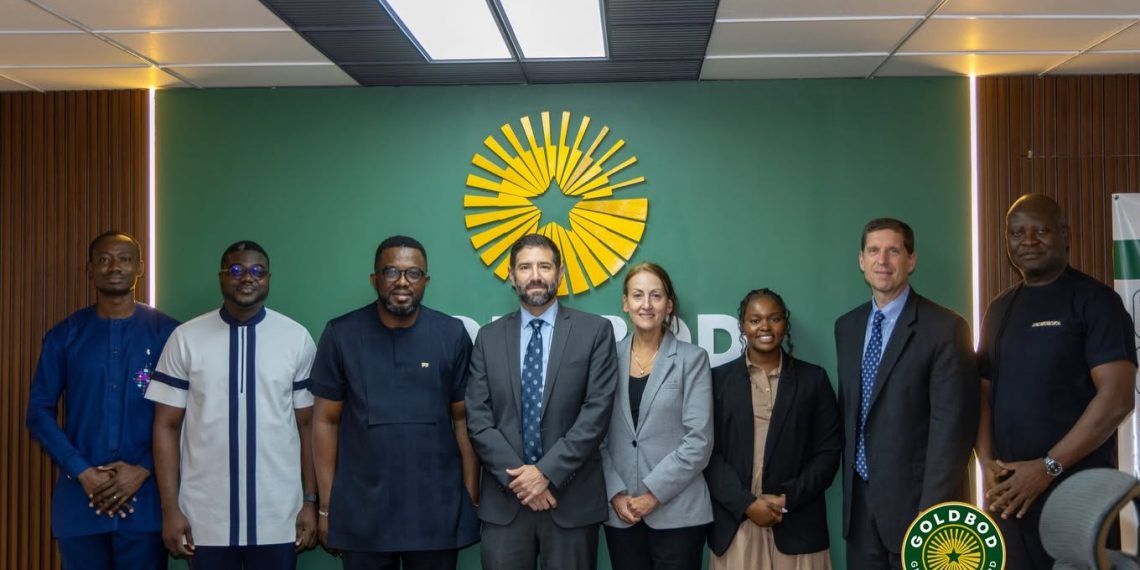
A delegation from the United States Department of the Treasury has visited the Ghana Gold Board (GoldBod) to learn about Ghana’s sweeping gold sector reforms, as the West African nation moves to deepen local value addition, strengthen traceability and reform its national assay regime.
The delegation, accompanied by officials of the Economic Section of the U.S. Embassy in Accra, visited GoldBod on Friday, September 18, 2026. The delegation was received by GoldBod Deputy Chief Executive Officer Richard Nunekpeku, together with the Director of Responsible Mining, Professor Ishmael Quaicoe, and the Deputy Director of Mining Operations, James German.
Mr Nunekpeku briefed the delegation on GoldBod’s mandate under the Ghana Gold Board Act, 2025 (Act 1140), and its role in implementing the Ghana Accelerated National Reserve Accumulation Programme (GANRAP). He also outlined initiatives being pursued by GoldBod to strengthen Ghana’s position across the gold value chain, including efforts to promote local gold refining, reform the national assay regime and develop nationwide gold traceability systems. The Deputy CEO also highlighted GoldBod’s plans to provide bankable geological assessments and formalise the artisanal and small-scale mining (ASM) sector.
A New Institutional Architecture for Ghana’s Gold
The Ghana Gold Board (GoldBod) was established by an Act of Parliament in 2025 to oversee, regulate and undertake the buying, selling, assaying, refining, exporting and other related activities in respect of gold and other precious minerals in Ghana. Per section 78 of Act 1140, GoldBod took over the rights, obligations, assets, liabilities and workforce of the Precious Minerals Marketing Company (PMMC) Limited, which had its origins in the Ghana Diamond Marketing Board established in 1963.
GoldBod is the sole authority with the exclusive right to buy, sell, weigh, grade, assay, value and export gold and other precious minerals in Ghana, and functions under the oversight and supervision of the Ministry of Finance. The Board is backed by a seed capital of $279 million advanced by the government of Ghana, and oversees the purchase, assay, refining and export of a minimum of 3 tonnes of gold every week to off-takers across the globe.
GANRAP: A Gold-Backed Reserve Strategy
Central to GoldBod’s mandate is its role in implementing GANRAP, Ghana’s first-ever comprehensive national policy specifically designed to build the country’s external reserves and secure long-term macroeconomic stability. Presenting the policy to Parliament in February 2026, Finance Minister Dr Cassiel Ato Forson described it as a historic and strategic shift in how Ghana manages its external buffers, moving away from costly borrowing and short-term reserve-building measures toward a structured, gold-backed and reform-driven accumulation framework.
Under GANRAP, the government is targeting an ambitious increase in reserves to the equivalent of 15 months of import cover by end-2028, with intermediate milestones of 8.6 months by end-2026 and 11.8 months by end-2027. The policy includes an operational weekly gold purchase target of approximately 3.02 tonnes, to be achieved through the acquisition of at least 2.45 tonnes weekly from the ASM sector and the invocation of pre-emption rights to secure a minimum of 0.57 tonnes weekly from the large-scale mining sector.
The Minister noted that between 2017 and 2024, Ghana relied heavily on Eurobonds, swaps, sale-and-buy-back transactions and commercial bank borrowing to build reserves at significant cost, accumulating US$5.65 billion in related expenses from 2022 to 2024 alone. GANRAP represents a fundamental departure from that approach, leveraging Ghana’s gold resources as a strategic anchor for reserve accumulation.
Local Refining and Value Addition
In a significant policy shift, GoldBod has directed all Self-Financing Aggregators (SFAs) to refine gold doré in Ghana before exporting the refined gold, effective September 1, 2026. The directive, issued by the GoldBod Compliance Directorate on August 24, 2026, forms part of the Board’s mandate under Act 1140 to regulate the purchase, sale, refining, value addition and export of gold in Ghana. Under the new directive, no unrefined gold doré will be approved for export from September 1, and all refining must be undertaken at a refinery approved or designated by GoldBod.
The policy builds on a landmark agreement signed in January 2026 between GoldBod and Gold Coast Refinery, under which GoldBod will supply one metric tonne of gold every week to be refined locally. The deal is expected to significantly deepen value addition in the country’s gold sector, reduce Ghana’s dependence on foreign refineries, and generate savings on foreign refining costs, increased export earnings, higher tax revenues and job creation. GoldBod has secured a 15 per cent equity stake in Gold Coast Refinery as part of the partnership.
Reforming the National Assay Regime
GoldBod has also moved to reform Ghana’s national assay regime, making X-Ray Fluorescence (XRF) assay the mandatory standard for determining gold purity in all gold purchases by GoldBod and its licensed buyers, effective September 1, 2026. The new directive replaces water-density testing as the definitive method for determining gold purity. The government has also announced plans to establish Ghana’s first-ever fire assay laboratory by the end of 2026, in a move aimed at tightening accountability and improving revenue mobilisation in the mining sector.
The reforms to the assay regime are designed to ensure a uniform and transparent system in which GoldBod can independently verify the purity and value of gold before it is exported. Under the previous system, large-scale mining companies assayed their own gold, creating potential conflicts of interest and opportunities for under-declaration.
Traceability: A Blockchain-Powered System
GoldBod is also developing a nationwide blockchain-powered Track and Trace system, scheduled for rollout by the end of 2026. The system is designed to ensure that every gram of gold purchased in Ghana is traceable to a verified and lawful source, sealing smuggling loopholes and preventing illegal mining (galamsey) gold from entering the national supply chain.
The traceability system is a critical component of GoldBod’s strategy to position Ghana’s gold as a responsibly sourced, conflict-free product that meets international standards. It is also expected to strengthen Ghana’s compliance with anti-money laundering and counter-terrorism financing (AML/CFT) requirements, an area where the government has taken significant steps, including the establishment of a dedicated AML/CFT Desk at GoldBod and the initiation of API integration for real-time data sharing between the Office of the Registrar of Companies and GoldBod.
Formalising Artisanal and Small-Scale Mining
GoldBod is spearheading efforts to formalise Ghana’s artisanal and small-scale mining (ASM) sector, which provides livelihoods for millions of Ghanaians and has historically been a major source of gold production. In 2025, the ASM sector produced a record 3.1 million ounces of gold, and GoldBod purchased and exported ASM gold worth approximately GH¢40 billion (US$4 billion) between February and May 2025 alone.
The government, through the Responsible Cooperative Mining and Skills Development Programme (rCOMSDEP), has commenced a nationwide registration exercise to formalise artisanal mining groups into legally recognised cooperatives. The exercise will provide the government with a verified database of registered miners and groups, from whom it will purchase gold through GoldBod, ensuring traceability and legitimacy in the supply chain. GoldBod has also invested $2.5 million in new artisanal mining sites development.
Ghana’s ASM formalisation model is gaining recognition beyond its borders, with Zambia studying Ghana’s approach as a blueprint for its own $1.8 billion gold ambition. GoldBod has also begun discussions with Better Brands Zimbabwe on a potential partnership to strengthen Zimbabwe’s artisanal gold sector.
Environmental Restoration: Reclaiming Degraded Lands
The delegation was also briefed on GoldBod’s efforts to reclaim degraded forest landscapes affected by mining activities. In June 2026, GoldBod signed a landmark agreement with the Ghana Armed Forces and the Forestry Commission to roll out a National Land Reclamation and Rehabilitation Project, estimated at GH¢36.35 million, targeted at restoring areas degraded by illegal mining activities across the country.
The first phase of the project focuses on restoring 50 hectares of degraded land within the Tano Nimiri Forest Reserve, with GH¢27.9 million allocated for civil engineering works and GH¢7.2 million earmarked for afforestation over a ten-year period. The project involves land reshaping, ecosystem restoration and the planting of native tree species to rehabilitate the landscape.
A Geopolitical Dimension
The US Treasury delegation’s visit comes amid heightened international interest in Ghana’s gold sector. In March 2026, Reuters reported that the United States, China and several other Western governments had mounted an unusually coordinated diplomatic push to persuade Ghana to halt a proposed increase in gold royalties, which they said could harm some of the world’s biggest miners.
Ghana proceeded with the new royalty regime on March 10, 2026, despite the opposition, as part of a wider push by African governments to capture more value from surging commodity prices. The royalty framework introduces a sliding scale linked to bullion prices, with mining companies warning that the upper end could make Ghana one of the most expensive mining jurisdictions in Africa.
The US Treasury’s visit to GoldBod may signal a recalibration of engagement, focusing on transparency, traceability and responsible sourcing rather than the contentious royalty issue. GoldBod’s reforms align with international efforts to combat illicit financial flows in the gold trade and promote responsible mineral sourcing, areas of mutual interest to Ghana and the United States.
A Sector in Transformation
Ghana is Africa’s largest gold producer, and the sector is a critical source of foreign exchange, government revenue and employment. In 2025, Ghana’s gold exports reached a record $20 billion, driven by both large-scale and artisanal production. The reforms being implemented by GoldBod are intended to ensure that a greater share of that value is retained in Ghana and that the sector contributes more effectively to national development.
The US Treasury delegation’s visit provided an opportunity for the delegation to gain an understanding of GoldBod’s mandate, ongoing reforms and the institution’s role in Ghana’s gold sector. As Ghana continues to strengthen its gold value chain, the engagement with international partners will be critical in building confidence, attracting investment and ensuring that the country’s gold resources are managed transparently and sustainably for the benefit of all Ghanaians.


