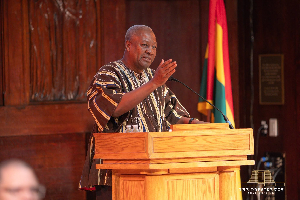
President John Dramani Mahama has directed the government to take every necessary action to end the ongoing nationwide strike by pre-tertiary teacher unions and ensure teachers return to the classroom immediately, the government has disclosed.
Minister of State in charge of Government Communications, Felix Kwakye Ofosu, said the President had been fully briefed on the disruption caused by the industrial action, which entered its fourth day on Wednesday, October 1, 2026.
“He has instructed that every necessary action be taken to ensure that teachers go back to the classroom,” Kwakye Ofosu said on Joy News’ PM Express on Wednesday, September 30. “Government values the contributions of teachers, and the teachers are highly valued, highly respected human resources, and because of their importance, one can ill afford for them to withdraw their services over any extended period of time.”
Kwakye Ofosu expressed confidence that the dispute would be resolved within days, stating that engagements were already underway. President Mahama has since convened a meeting with the teacher unions, the Education Ministry, and the Ghana Education Service (GES) for Friday, October 2, 2026, to discuss their demands and the implications for the national compensation budget.
Root of the Impasse: Payment Discrepancies
Government has identified a discrepancy in information between the Accountant-General’s Department, the Ministry of Finance, and the Ghana Statistical Service (GSS) as the key issue delaying the resolution of the strike.
“I think both the Finance Ministry and the Accountant-General have clarified that on their part they have done what has to be done,” Kwakye Ofosu said. “I think there is some gap between what the Accountant-General and the Minister of Finance have done and what the GSS said, so it is that gap that needs to be closed.”
According to the government spokesperson, both the Finance Ministry and the Accountant-General’s Department maintain that they have taken the necessary steps on their part, and government remains willing to pay teachers once the outstanding differences are resolved.
The Strike and Its Demands
The strike was declared on Friday, September 25, 2026, by three major pre-tertiary teacher unions: the Ghana National Association of Teachers (GNAT), the National Association of Graduate Teachers (NAGRAT), and the Pre-Tertiary Teachers Association of Ghana (PRETAG).
The unions are demanding the payment of outstanding promotion arrears, the automatic placement of teachers who passed promotion examinations in December 2025 and February 2026 on the appropriate salary scales with arrears effective January 2026, the implementation of the 20 percent Deprived Area Allowance, and the opening of negotiations on a new Collective Agreement on conditions of service.
The existing Collective Agreement expired, and negotiations for a new agreement — which the unions say should have been completed by June 2026 — remain outstanding. The unions said the matter had been raised with the Fair Wages and Salaries Commission (FWSC) several times without resolution.
Education Minister Haruna Iddrisu said the government currently has data on about 29,000 teachers in relation to the outstanding arrears, while the full process is expected to cover nearly 80,000 promoted teachers.
The Controller and Accountant-General’s Department (CAGD) has processed and paid 6,079 promotion cases submitted by GES, with the affected teachers receiving their September 2026 salaries and applicable arrears backdated to January 1, 2026. However, the department attributed delays to the late submission of required documents by GES, which had submitted only 6,079 of 58,620 expected promotion cases.
Unions Reject Promises, Demand Action
The teacher unions have rejected government appeals to call off the strike, insisting they will only return to the classroom after concrete steps are taken to address their demands. The decision was taken after a meeting with the Education Minister.
“Indeed, we met the minister and his team this afternoon with regard to our strike action. It has been the old story of promises upon promises,” said Isaac Baah, Head of Salaries, Grievances and Negotiations at GNAT. “At the moment, we are not taking promises. We want action.”
“Until we see the salary and the arrears reflecting on our payslips and credited to our accounts, until we see that, we are not going back to school,” he added.
The unions have also declared the strike indefinite, with PRETAG warning it could intensify the action if the government fails to resolve outstanding payments within the shortest possible time.
Nationwide Disruption: Classrooms Empty, Vendors Counting Losses
The strike has paralysed academic activities across the country, with classrooms largely empty and pupils left to fend for themselves.
In the Ashanti Region, food vendors around schools are counting severe financial losses as freshly prepared meals remain unsold. Yaa Pomah, a vendor near Anglican Secondary School, lamented that she had come out early hoping to clear her stock, but with no students around, the food was going to waste.
Maame Esi, a roasted plantain vendor near Kumasi Girls’ Senior High School, complained about the sharp slump in sales, with her perishable stock spoiling quickly and leaving her with mounting debts and no daily income to support her family.
First-year students at Ejisu Senior High School have appealed directly to their teachers to end the strike, saying they feared the prolonged disruption would affect their orientation and academic progress.
At Apenkwa Presby School in Accra, Junior High School Three students have resorted to self-study and peer-led lessons, with those proficient in Mathematics and English leading discussions to help classmates maintain their academic preparation.
The Ghana Education Service has warned that the strike threatens the academic calendar, while students, parents, and informal traders are calling for an immediate compromise to restore normal academic activities.
Presidential Intervention
Kwakye Ofosu indicated that presidential intervention could become necessary if efforts by the relevant ministries and the Controller-General’s Department reach a deadlock, but emphasised that the matter currently remains within the purview of the Education Ministry, Finance Ministry, and Controller-General’s Department.
“As I speak, there are engagements that are going on, and I’m confident that in a matter of days, that matter should be resolved, so they return to the classroom as quickly as possible,” he said.
With President Mahama now personally convening Friday’s meeting, pressure is mounting on all sides to reach a swift resolution. The coming days will determine whether the government’s assurances translate into the tangible action the unions demand — and whether Ghana’s classrooms will fall silent for much longer.