



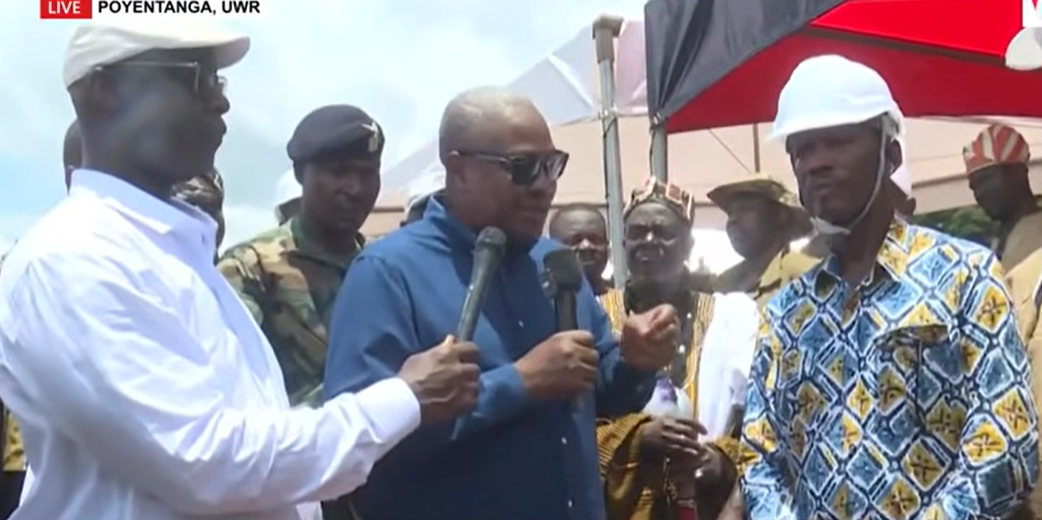
President John Dramani Mahama has described the government’s 24-Hour Markets initiative as a key intervention to stimulate economic activity and provide decent spaces for trading across the country, as his administration accelerates the rollout of the flagship programme.
Speaking at Poyentanga in the Upper West Region on Saturday, September 12, as part of his Resetting Ghana Tour, the President said markets play a critical role in driving commerce and supporting livelihoods, particularly by providing farmers and traders with accessible spaces to sell their goods.
“Markets are the lifeblood of trading and economic activity and so every district should have a decent place where people can come and do business. Farmers can bring their produce to come and sell,” he said.
The President emphasised that the initiative is not merely about constructing physical market facilities but also creating platforms to support economic activity within communities.
A Nationwide Rollout Across 261 Districts
The 24-Hour Markets initiative forms part of the government’s broader 24-Hour Economy agenda, which seeks to expand economic opportunities, increase productivity and create jobs. Under the programme, the government plans to establish markets across all 261 districts, with the facilities expected to serve as centres of commerce and economic activity at the local level .
The policy was officially launched in July 2025, with President Mahama describing it as a shift from “slogan to strategy” and part of a broader national reset aimed at unleashing productivity, expanding opportunities, and accelerating exports . The 24-Hour Economy Authority Bill was subsequently passed by Parliament and signed into law by the President in February 2026, with GH¢110 million allocated in the 2026 Budget to operationalise the programme .
Model Markets as One-Stop Commercial Hubs
The model markets are designed to be far more than traditional trading centres. According to government officials, each facility will include a comprehensive suite of amenities: lockable stores, market stalls, warehouses, cold storage units, supermarkets, food courts, restaurants, guest rooms, office spaces, daycare centres, clinics, pharmacies, police posts, fire stations, livestock handling facilities, sanitation infrastructure, and branches of the Women’s Development Bank .
“The 24-Hour Economy Market will have facilities such as modern stores, shops, storage, warehousing units, cold storage, women’s banking system, digital payment systems, transport terminals, health and sanitation facilities, security infrastructure, hospitality, rest areas, fire stations, police stations, crèche, and other social services,” Local Government Minister Ahmed Ibrahim said during a Government Accountability Series press briefing in Accra .
Minister Ibrahim charged Metropolitan, Municipal and District Chief Executives to prioritise the completion of the markets in their areas, warning that the flagship policy that brought the government to power must be delivered nationwide, not just in Accra .
Farmers and Traders at the Centre
President Mahama has consistently spaces framed the markets for as a direct intervention to support agricultural producers our and local commerce. During pepper an inspection of the farmers Nadowli-Kaleo 24-Hour Market project on September 10, he said the facilities would “create reliable outlets for farmers to sell their produce and provide opportunities for traders to earn decent incomes” .
“These 261 markets across the country will provide trading, onion farmers, maize farmers, and many others,” the President said .
He explained that contractors awarded the projects were expected to have the financial capacity to commence work with their own resources, rather than waiting for mobilisation payments. Contractors would receive payment once they attained 15 percent completion, allowing them to sustain momentum until the projects were finished. “The money is available, so there is no reason why any contractor should fail to advance the work to this stage,” he stated .
Sod-Cutting Ceremonies Signal Momentum
The government has held multiple sod-cutting ceremonies across the country in recent months. The maiden 24-Hour Market was launched at Dormaa Ahenkro in the Bono Region in March 2026 , followed by ceremonies at Juapong in the Volta Region , Assin Breku in the Assin North District , and Kwadaso in the Ashanti Region .
At Juapong, the President announced that although the town is not a metropolitan assembly, the government had awarded it a Category Four market — the same category allocated to metropolitan assemblies — in recognition of its commercial importance and economic potential .
The Juapong facility will include 100 lockable stores, 150 market stalls, warehouses, a supermarket, food courts, a modern restaurant, guest rooms, office spaces, a daycare centre, a clinic, a pharmacy, a branch of the Women’s Development Bank, a police post, a fire station, livestock handling facilities, a cold store, sanitation facilities and an open retail trading area .
Rooted in the 24-Hour Economy Vision
The markets are a central plank of the broader 24-Hour Economy policy, which the government describes as “the boldest economic transformation initiative in Ghana’s recent history” . The policy aims to unlock round-the-clock economic activity, deepen value chains across key sectors, boost productivity and exports, and create quality jobs in agriculture, manufacturing, logistics and services.
The government has set a target of creating approximately 1.7 million sustainable jobs over four years, backed by a US300 million and US$400 million as seed capital to attract private sector investment .
President Mahama has been keen to clarify that the 24-hour economy concept is not simply about asking people to work at night, but about using Ghana’s productive capacities more efficiently — whether through additional shifts for some firms, better logistics, extended public services, stronger security, improved transport systems or digital support infrastructure .
A Market for Every District
As the President continues his Resetting Ghana Tour across the regions, the 24-Hour Markets initiative has become a central feature of his engagement with local communities. With contracts awarded and construction underway in multiple districts, the government is betting that these modern commercial hubs will become the economic anchors of local communities — places where farmers can sell, traders can earn, and the round-the-clock economy can take root.
The President’s message at Poyentanga was clear: every district deserves a decent place to do business, and the government intends to deliver.


