



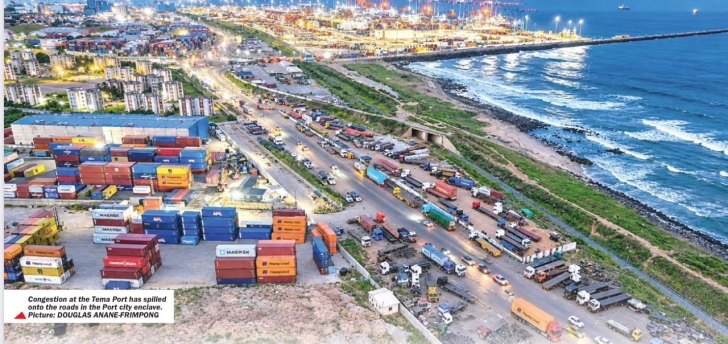
Container congestion at the Port of Tema has spilled onto the roads of the port city, triggering urgent calls from the business community for measures to address a crisis that is now affecting road safety, emergency access, and the cost of doing business across Ghana’s industrial heartland.
The congestion, which has seen heavy-duty trucks queue for kilometres and park along highway shoulders, has become a city-wide problem. Tema hosts Ghana’s largest port, handling over 70 per cent of national cargo traffic, alongside major health facilities including the International Maritime Hospital in Community 3 and the Tema General Hospital in Community 9 .
A Journey That Now Takes Two Hours
The First Vice-President of the Ghana Institute of Freight Forwarders (GIFF), Nana Asiamah Peprah I, said the congestion was inflicting direct damage on businesses by increasing both the time and cost involved in moving goods.
He stated that a journey that normally took 30 minutes could now take as long as two hours, creating a severe disadvantage for businesses that depend on the efficient movement of goods and people.
“Every congestion, in fact, the normal congestion in the ports always affects businesses and those businesses will also pass it on to the consumers,” he said .
Nana Peprah explained that the parking of trucks on road shoulders was largely a consequence of limited capacity at some terminals to receive empty containers after cargo had been discharged. Some shipping lines’ private container terminals had become full, forcing trucks to queue at alternative facilities — in some instances, extending the queues from the MPS terminal all the way to Nungua Barrier .
He stressed that the situation had been raised at meetings with port and other relevant authorities, but practitioners were yet to see the proposed solutions implemented. Authorities and shipping lines needed to identify additional spaces outside the Tema Port enclave where containers could be temporarily stored, he said .
Importers Call for Reclaiming Port Lands
The Executive Secretary of the Importers and Exporters Association of Ghana (IEAG), Samson Asaki Awingobit, urged the Ghana Ports and Harbours Authority (GPHA) to consider using some properties and spaces currently leased to private businesses for additional container terminal facilities, especially where lease agreements were approaching expiration .
Mr Awingobit said additional modern container terminal facilities could increase holding capacity, improve cargo-handling efficiency and support the movement of goods and vehicles. He made the call at a press conference in Accra to assess five months of the implementation of the Publican AI Trade Solution and other developments in Ghana’s port and trade environment .
The IEAG also called for stronger enforcement against shipping lines that fail to promptly evacuate or repatriate empty containers after the associated import cargo has been cleared. Mr Awingobit argued that the accumulation of empty containers at terminals occupies valuable operational space and contributes to congestion .
GPHA Acknowledges Landside Congestion
The concerns come against the backdrop of measures announced by the GPHA to address landside congestion. In a statement issued on August 7, 2026, the authority acknowledged landside congestion at the Port of Tema and attributed the situation partly to massive growth in import traffic, the evacuation of empty containers, and road congestion .
The GPHA said similar challenges were being experienced at several ports across the West African sub-region, resulting in delays in container evacuations and the transfer of laden and empty containers .
The measures include increased vessel calls, enhanced truck deployment and container-transfer operations, as well as improved yard and traffic management to maximise available terminal capacity. The authority further appealed to importers, clearing agents and cargo owners to expedite the clearance and evacuation of their consignments, saying the prompt removal of cargo would create additional space within the port .
Structural Bottlenecks Behind the Gridlock
The congestion is not merely a matter of volume. An assessment by the Ghana Shippers Authority (GSA) published on September 3 revealed that about 70 per cent of containers at Tema’s Terminal 3 undergo full physical inspections — seven times the rate recommended by the World Customs Organization .
Terminal 3, which opened in 2019 after a US$1.5 billion investment, can handle 3 million TEUs a year and accommodate vessels carrying up to 24,000 TEUs. It has already handled 2.5 million TEUs in 2026, before the peak season .
The costs are significant. The cement industry incurred between US50 million in demurrage charges over eight months. Petroleum product distributors paid US$44 million to shipping companies in the first half of 2025, with businesses passing these additional costs on to final consumers .
Tema currently has no rail connection to its hinterland, unlike Abidjan, and relies on a single congested access road. Inland container depots that could help relieve pressure remain underused .
Pressure Spills Beyond the Port Enclave
Increased container truck movements now extend well beyond the port enclave, adding pressure to road space shared by heavy-duty vehicles, motorists, commercial vehicles, motorbikes and pedestrians.
The situation is particularly acute along the Nungua Beach Road corridor towards Sakumono and other adjoining routes, where longer travel times have become the norm. The movement and parking of heavy-duty trucks along sections of the road have added to the chaos .
Pressure is also being felt along routes towards Ashaiman, where increased movement of container trucks combined with regular vehicular traffic is placing additional strain on the road network .
For residents, the issue goes beyond delays and inconvenience. They are concerned about the need for safe interaction between heavy-duty trucks and other road users. The size of articulated trucks parked along the road creates blind spots, requiring drivers to take additional care around smaller vehicles, motorbikes and pedestrians .
Emergency Access at Risk
A particularly alarming concern is access for emergency services in and outside Tema. With traffic congestion occurring along the affected corridor, emergency vehicles now require additional time to move through and around busy areas — a delay that could prove fatal in a medical emergency .
The Daily Graphic, in an editorial, warned that the situation cannot be dismissed as normal port congestion. “When traffic congestion locks up the corridor around Tema, emergency vehicles cannot move. In an emergency, minutes are the difference between life and death. We cannot afford to learn this lesson from a tragedy,” the editorial stated .
Drivers Left With Few Options
Motorists travelling on the Nungua Beach Road say traffic conditions have become more challenging, particularly during peak periods. The road between Tema Community Three and Sakumono has become an important corridor for vehicles serving the port and surrounding communities .
Some drivers told the Daily Graphic that they had limited access to designated parking areas where they could safely keep their vehicles while waiting for cargo assignments. One driver, who sought anonymity, acknowledged that parking on the shoulders of the highway was not permitted, but said the non-availability of suitable parking spaces remained a concern. He explained that some trucks were waiting for customers to assign them cargo to destinations in other countries within the sub-region .
Government Acknowledges Infrastructure Gap
Transport Minister Joseph Bukari Nikpe has acknowledged container congestion at the Tema Port as a major challenge, stressing the government’s move to improve infrastructure and ease the movement of cargo.
“Currently, we are faced with a challenge, the container congestions in the port, and I believe this worries all of us,” he noted during a visit to the Meridian Port Services (MPS) Terminal .
According to the Minister, the congestion reflects a gap between the growth in cargo volumes and the expansion of infrastructure supporting port operations. While the development of Terminal 3 has increased the port’s capacity to handle cargo, supporting infrastructure has not kept pace .
“We are putting in Terminal 3, the containers, the cargo is coming, but we didn’t continue to improve other infrastructure that is linking up with the port,” he added .
Mr Nikpe said government is consequently considering improvements to roads and harbour routes, alongside the development of additional berths to accommodate more vessels, and assured stakeholders that government will fast-track activities to remove the challenge .
A National Competitiveness Problem
The congestion has thrown into sharp relief the structural issues that have made the situation perennial: yard capacity and container dwell time, uncoordinated truck arrivals, limited evacuation and decongestion mechanisms, and road infrastructure and traffic management .
The Daily Graphic editorial called on the GPHA, the Customs Division of the Ghana Revenue Authority, Meridian Port Services and the entire port community to treat the situation as an emergency. It recommended enforcing a strict truck appointment and call-up system, creating dedicated lanes for emergency vehicles, completing truck parks and expanding port access roads, and accelerating the Boankra Integrated Logistics Terminal and other inland container depots .
“Tema Port is the gateway to Ghana’s economy. When it sneezes, the whole economy catches a cold, and the consumer pays for the medicine through higher prices,” the editorial warned. “The trucks must move. The containers must move. And Ghana’s economy must not be held hostage on the roads of Tema” .
As the peak import season approaches, the pressure on Tema’s roads and port infrastructure is only expected to intensify — raising urgent questions about whether Ghana’s premier maritime gateway can be decongested before the situation escalates further.


