



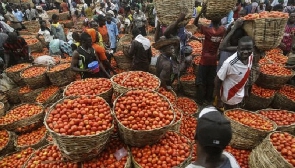
Ghana is set to launch a landmark initiative aimed at achieving national tomato self-sufficiency, with a full rollout target of 400,000 tonnes in annual production, as the government moves to end decades of dependence on imported tomatoes and tomato paste.
The Ghana Tomato Self-Sufficiency Initiative (GHATSI), a public-private partnership between the Ministry of Food and Agriculture (MoFA) and agribusiness firm FarmMate LTD, will be officially launched on Tuesday, September 15, at the Anlo Senior High School Park in Anloga, Volta Region. The event will be led by the Minister for Food and Agriculture, Eric Opoku.
A US$400 Million Import Bill
Despite possessing favourable land, water, and climate conditions, Ghana currently spends over US$400 million annually importing fresh tomatoes and tomato paste, according to the Ministry of Food and Agriculture. This import dependency is largely driven by a persistent December-to-July off-season deficit, when local production collapses and demand surges.
The scale of the challenge is stark. National demand for fresh and processed tomatoes exceeds 1.4 million tonnes annually, yet local production meets only about 15 to 18 per cent of that requirement, according to researchers at the Council for Scientific and Industrial Research (CSIR). Fresh tomato imports alone are estimated at 100,000 to 120,000 tonnes annually, while processed imports are equivalent to 400,000 to 450,000 tonnes of raw tomato.
The economic pain has been felt acutely by consumers. Fresh tomato prices surged by 158.3 per cent year-on-year in August 2026, the highest increase among all commodities tracked by the Ghana Statistical Service. A basket of tomatoes that sold for about GH¢200 last year now costs as much as GH¢700, according to traders.
First Phase: 10,000 Acres Across 12 Regions
The first phase of GHATSI, covering the 2026/2027 production cycle, aims to supply approximately 100,000 tonnes of tomatoes, cultivated across more than 10,000 acres in 40 districts, 12 regions, and over 100 communities.
The initiative is designed to establish an integrated, year-round domestic tomato value chain by linking farmers and land to production enhancement, structured finance, multi-peril crop insurance, aggregation, industrial processing, and guaranteed market access.
Under the Farmer Enhancement Package, participating growers will receive financed agro-inputs, irrigation support, extension and technical services, and multi-peril crop insurance, with repayment settled directly at off-take. This model is intended to eliminate the twin risks that have long discouraged large-scale tomato cultivation: unpredictable markets and climate-driven crop failures.
A Structural Transformation Agenda
Beyond ending import dependency, GHATSI seeks to raise and secure farmer incomes through contract farming, create sustainable youth employment across the value chain, eliminate avoidable post-harvest losses, and reduce risks from climate and pest shocks.
The initiative builds on earlier efforts that have already demonstrated significant potential. A partnership between the West Africa Food System Resilience Programme and FarmMate recorded 240 tonnes of tomatoes in its first round of production in the Upper East Region during the 2025 dry season, engaging about 100 farmers across 110 acres.
More broadly, dry-season tomato production supported by the Food System Resilience Programme has seen over 1,200 producers across 20 districts cultivate 543 hectares of irrigated land during the 2024/25 and 2025/26 seasons, yielding 5,613 tonnes and generating more than GH¢24.5 million in revenue. Average yields rose from 4-5 tonnes per hectare to 11 tonnes per hectare, while gross margins jumped from GH¢4,555 to GH¢14,150 per hectare.
Processing Capacity and Industrial Linkages
The broader GHATSI framework envisions nearly 16,200 hectares under cultivation nationwide, alongside processing units capable of producing an estimated 200,000 tonnes of tomato paste annually. Developers plan to complement these facilities with packaging centres, pre-processing units, and logistics platforms in key agricultural zones.
This industrial dimension is critical. Ghana’s largest tomato-based processing facility, Nutrifoods Ghana Limited — which produces the Tasty Tom brand — is recognised as the largest tomato-based processing and canning facility in West Africa, employing nearly 2,000 people. A robust domestic raw tomato supply is essential to keeping such operations viable and competitive.
Complementary Efforts Across the Country
GHATSI does not operate in isolation. The Irrigation Company of Upper Region Limited (ICOUR) has allocated 500 hectares across the Tono and Vea Irrigation Schemes for tomato production, following a directive from the Minister for Food and Agriculture after trade disruptions linked to Burkina Faso’s export restrictions in 2025 and early 2026.
ICOUR is introducing a contract-based production model that links growers with off-takers before planting, under which buyers sign agreements with farmers, provide part of the production inputs, and purchase the crop after harvest. The company was historically known as a hub for quality tomato production but had shifted focus to rice in recent years.
Meanwhile, under the Feed Ghana initiative launched in 2025, the Ministry of Food and Agriculture identified 81 communities and supported them to cultivate about 1,000 acres of tomatoes. This year, the government aims to scale that up to 40,000 acres.
Immediate Relief Expected from Current Harvest
While GHATSI ramps up, Deputy Minister for Food and Agriculture John Dumelo has announced that tomato prices are expected to fall sharply in the coming weeks as increased supplies from local farmers begin reaching the market. The government is also preparing to expand dry-season tomato production from December 2026 to June 2027, with lands already cleared and seedling nursing and transplanting expected to begin in October.
Government has provided farmers with solar-powered boreholes and irrigation inputs to support production during the dry season, a critical intervention given that the recent price surge was attributed partly to reduced rainfall in major tomato-growing areas.
A Test of Execution
Ghana’s tomato sector has long been constrained by structural challenges: low yields averaging 7 to 10 tonnes per hectare compared with potential yields of 20 to 80 tonnes under improved varieties, heavy reliance on rain-fed agriculture, high input costs, and post-harvest losses of between 20 and 60 per cent. Only about 9,000 hectares of the 15,000 hectares covered by 22 public irrigation schemes are currently in use.
The launch of GHATSI represents the government’s most ambitious attempt yet to address these systemic weaknesses. With the first phase targeting 100,000 tonnes across 10,000 acres and the full rollout aiming for 400,000 tonnes annually, the initiative will be judged by whether it can translate political commitment into sustained production gains — and whether Ghanaian farmers and consumers finally see the benefits in their fields and their markets.


