



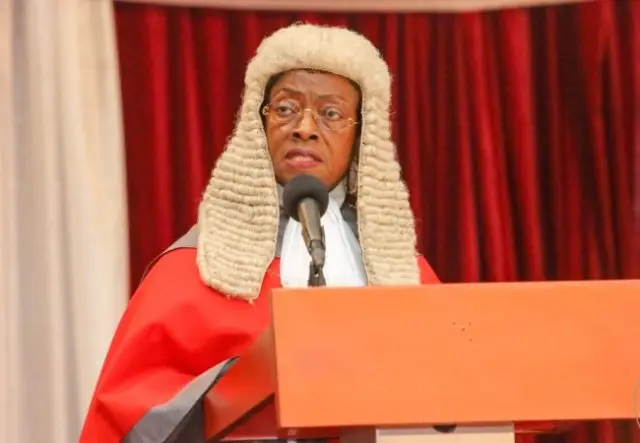
In a legal twist that has confounded observers, retired Chief Justice Sophia Akuffo finds herself at the center of a constitutional paradox of her own making.
The controversy stems from her recent disagreement with the Council of State’s finding of a prima facie case against suspended Chief Justice Gertrude Torkornoo. But critics, including US-based legal scholar Professor Stephen Kwaku Asare—popularly known as Kwaku Azar—are asking a pointed question: What changed?
The Agyei Twum Precedent
The Council of State’s role in screening petitions against a Chief Justice is not a constitutional accident. It is the direct result of the Supreme Court’s landmark decision in Agyei Twum v Attorney-General .
In that 2006 ruling, the Supreme Court held that before appointing a committee of inquiry, the President must determine—in consultation with the Council of State—whether a petition discloses a prima facie case against the Chief Justice .
The court reasoned that a literal interpretation of Article 146(6) would lead to an absurdity: any frivolous complaint, no matter how baseless, would force the President to empanel a full inquiry committee, undermining judicial independence and separation of powers .
Justice Sophia Akuffo presided over that court.
The judgment gave the Council a prominent role in the screening process. It can be reasonably assumed that Justice Akuffo and her colleagues deemed the Council competent to make that determination.
What Is a Prima Facie Determination?
A prima facie determination asks a limited question: taking the allegations at face value, do they disclose grounds warranting a full inquiry? It does not decide whether the allegations are true .
As Kwaku Azar has explained, the prima facie stage is “a threshold filter,” not a judgment . Its purpose is to ensure that serious allegations are not dismissed out of hand, nor frivolous ones allowed to waste state resources.
Preliminary screening occurs across civil, criminal, and administrative settings. Its use in a criminal case does not make it inherently “quasi-criminal.” Its use by a judge does not make it exclusively judicial. Lay grand juries, for example, perform a comparable—though legally distinct—screening function when deciding whether probable cause exists to indict.
The Recent Disagreement
Justice Akuffo was entitled to disagree with the Council’s conclusion on the petition against Chief Justice Torkornoo. Thirty other members supported a prima facie finding. But disagreeing with the answer is not the same as saying the Council was unqualified to take part in answering the question.
She is, of course, entitled to argue that Agyei Twum should be reconsidered. In an appropriate case, the Supreme Court may depart from its precedent. But if she now believes prima facie screening is exclusively a judicial act, she should explain why the court she presided over gave that role to the President in consultation with the Council.
GOGO’s Confusion
Writing as “GOGO,” Kwaku Azar expressed bewilderment at the apparent shift.
“GOGO is confused,” Azar wrote. “She had no issue in voting to assign the prima facie determination to the Council of State. What changed since Agyei Twum?”
The question cuts to the heart of a broader debate about constitutional consistency and the institutional roles assigned by Ghana’s Supreme Court.
Background: The Torkornoo Saga
The controversy erupted after President John Mahama, acting in consultation with the Council of State, found a prima facie case against Chief Justice Torkornoo based on three petitions seeking her removal . She was subsequently suspended, and a five-member committee was constituted to conduct a full inquiry .
Chief Justice Torkornoo filed a suit at the Supreme Court challenging the process, seeking 16 reliefs, including a declaration that the prima facie determination was flawed . Kwaku Azar, analyzing the writ, noted that the Chief Justice’s arguments appeared to conflate the threshold screening stage with a full trial .
“This stage is not a judgment; it’s a threshold filter,” Azar wrote. “Not every constitutional process mimics a full trial” .
The Chief Justice was ultimately removed from office in September 2025 following the committee’s recommendation, which found grounds of stated misbehaviour under Article 146(1) .
Kwaku Azar is a US-based Ghanaian legal scholar and professor. His commentary, written under the persona “GOGO,” has become a fixture in Ghanaian constitutional discourse.


