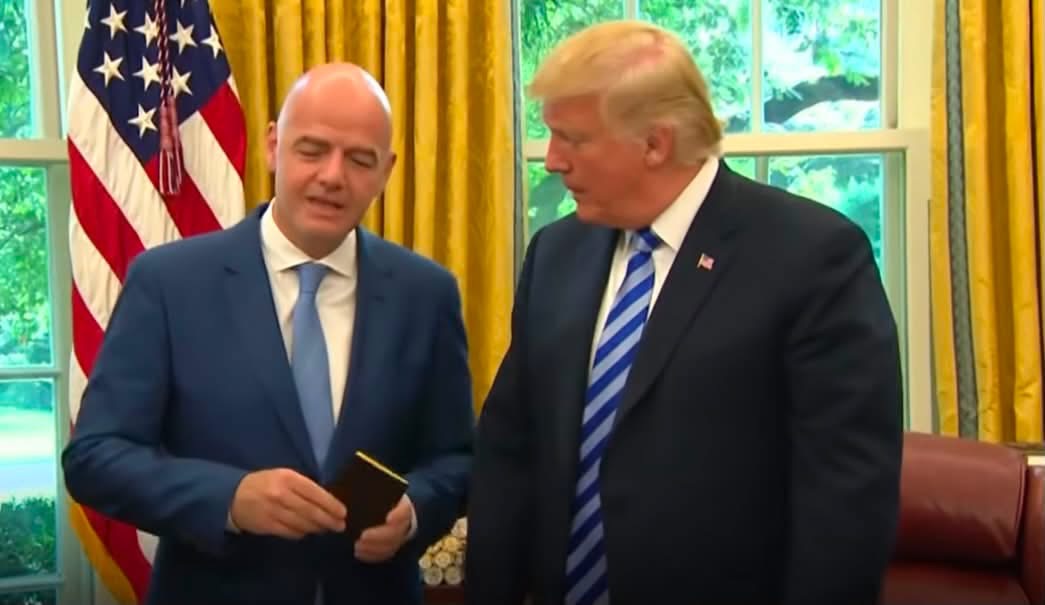
The International Olympic Committee (IOC) has formally declined to launch an investigation into FIFA President Gianni Infantino, following a complaint alleging that U.S. President Donald Trump improperly influenced FIFA decisions in the run-up to the 2026 World Cup.
The complaint, filed by the human rights organisation FairSquare, accused Infantino of violating the Olympic Charter’s principles of political neutrality through his close personal and professional ties with Trump. FairSquare pointed to the controversial reversal of U.S. men’s national team striker Folarin Balogun’s suspension as a key piece of evidence, suggesting the decision was swayed by political pressure from the Trump administration.
In a terse statement issued late Thursday, the IOC said the allegations did not fall within its mandate and that FIFA, as the governing body of world football, is solely responsible for its own internal governance and ethical oversight.
“The IOC takes note of the complaint but confirms that it has no jurisdiction over the internal affairs of FIFA, nor does the Olympic Charter grant the IOC authority to investigate the conduct of the president of an independent international sports federation,” the statement read. “We refer the matter to FIFA’s own Ethics Committee, which is the appropriate body to address any concerns regarding its leadership.”
The Balogun Incident at the Heart of the Allegations
FairSquare’s complaint centres on a contentious episode during the 2026 World Cup qualifying cycle. Balogun, a key forward for the U.S. team, received a red card in a high-stakes qualifier against Mexico. The suspension was initially upheld by CONCACAF’s disciplinary panel, but weeks later—following what FairSquare described as “unusual and opaque” communication between FIFA headquarters and U.S. Soccer Federation officials—the ban was unexpectedly overturned, allowing Balogun to participate in subsequent matches.
While FIFA officially cited “procedural errors” in the original disciplinary process, FairSquare argued that the reversal came on the heels of a private meeting between Infantino and Trump at the White House, where the U.S. President reportedly expressed strong interest in the tournament’s success and American team performance. The human rights group contends that this constituted improper interference with sporting integrity and a breach of the political neutrality that international sports bodies are supposed to uphold.
“The Balogun case is not about a single player—it is about the pattern of deference to political power that undermines the credibility of global sports governance,” FairSquare said in a statement. “We are disappointed by the IOC’s refusal to act, but we will continue to press for accountability within the football community.”
Trump’s Role and the 2026 World Cup Context
President Trump has been vocal about his interest in the 2026 World Cup, which is being co-hosted by the United States, Canada, and Mexico. Trump has frequently touted the tournament as a showcase of American soft power and has hosted Infantino and other FIFA officials at the White House on multiple occasions. Critics have long raised concerns that such close ties could blur the line between sports diplomacy and political interference.
The White House has not commented on the FairSquare complaint. A spokesperson for FIFA’s ethics committee said that any formal complaint would be reviewed in accordance with the federation’s code of ethics, but declined to confirm whether a preliminary assessment has begun.
IOC’s Rejection Raises Questions About Oversight Gaps
The IOC’s decision has drawn sharp reactions from governance watchdogs. Some legal experts note that while the Olympic Charter explicitly forbids “political interference” in sports, the Charter applies primarily to National Olympic Committees and the Olympic movement itself, not to separate bodies like FIFA. The IOC has historically avoided intervening in the internal disputes of other federations, even when those federations are recognised under the Olympic umbrella.
However, critics argue that the IOC’s refusal sets a dangerous precedent, particularly as the 2026 World Cup approaches with the U.S. as a principal host. “If the IOC cannot or will not enforce its own principles across the wider sporting ecosystem, then those principles are meaningless,” said Dr. Amanda Mwangi, a sports law professor at the University of Nairobi.
What Happens Next?
FairSquare has indicated it will now file a formal complaint with FIFA’s own Ethics Committee, which operates independently of the president’s office. Under FIFA’s rules, the committee can initiate investigations on its own accord or in response to submissions. Should it find wrongdoing, Infantino could face sanctions ranging from a reprimand to suspension, though such outcomes are historically rare.
For now, the IOC’s rejection leaves the matter squarely in FIFA’s hands—a development that will do little to assuage concerns among those who believe the world’s most powerful football body is too often insulated from genuine oversight.
As the countdown to the 2026 World Cup intensifies, this latest controversy adds another layer of scrutiny to the tournament’s governance, with questions about who—if anyone—will hold the game’s top leadership to account.