



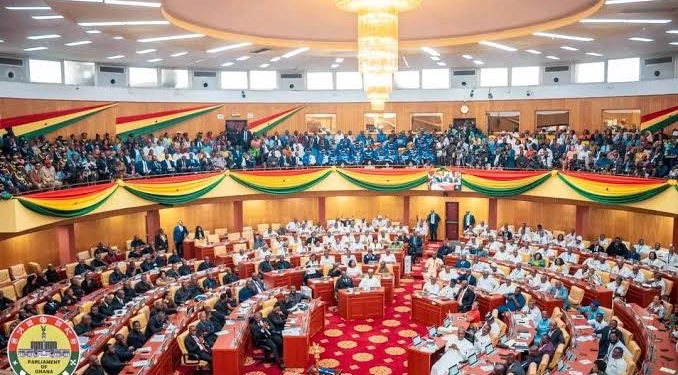
Parliament has unanimously approved the Customs Bill, 2026, a sweeping legislative overhaul that repeals the decades-old Customs, Excise and Preventive Service (CEPS) Administration Act, 1993 (Act 512), replacing it with a modern framework designed to digitise border operations, slash trade bottlenecks, and plug revenue leakages.
The bill, which now awaits presidential assent, represents the most significant reform of Ghana’s customs regime in over three decades. It consolidates fragmented customs laws into a single, coherent statute, aligning the country with the World Trade Organization’s Trade Facilitation Agreement (TFA) and the ECOWAS Common External Tariff protocols.
Strategic Shift to Risk-Based Enforcement
Beyond streamlining paperwork, the new law introduces a risk-management approach that replaces blanket physical inspections with targeted, intelligence-led checks. This shift is expected to reduce cargo clearance times at the Tema and Takoradi ports, lowering the cost of doing business for legitimate importers and exporters. Crucially, the bill establishes a legal mandate for a fully integrated digital single-window system, enabling traders to submit all regulatory documents electronically through one portal.
Revenue Imperative and Combating Illicit Trade
The passage comes as Ghana grapples with a widening fiscal gap under its IMF-supported post-COVID recovery programme. Finance Ministry sources indicate the bill aims to capture an estimated 15–20% increase in customs revenue over the next two years by curbing under-invoicing, misclassification, and smuggling—practices that currently cost the state billions of cedis annually. The bill significantly increases penalties for customs offences, including confiscation powers and stiffer fines, while establishing a dedicated anti-smuggling unit within the Customs Division.
Legislative Journey
The bill was introduced on Thursday, July 23, 2026, by Roads and Highways Minister Kwame Governs Agbodza, acting on behalf of Finance Minister Dr. Cassiel Ato Forson, in accordance with Article 106(2) of the 1992 Constitution. Following its first reading, it was swiftly referred to Parliament’s Finance Committee, which held public hearings with the Ghana Union of Traders Association (GUTA), the Chamber of Commerce, and importers’ associations. These stakeholders raised concerns about the transition timeline, which the committee addressed by inserting a six-month grace period for system familiarisation.
Bipartisan Support and Industry Reaction
During the debate, Majority and Minority spokespersons praised the bill for its transparency provisions, including mandatory publication of all tariff schedules and appeal processes. “This law is not about punishing traders—it is about predictability. If you play by the rules, your goods move; if you cheat, you face the consequences,” one legislator noted.
Business groups have cautiously welcomed the move, urging the government to complement the law with robust technological infrastructure to avoid the connectivity glitches that have plagued past digitisation efforts.
Next Steps
With Parliament’s approval secured, the bill now proceeds to President Nana Akufo-Addo for assent. Once signed, the Ministry of Finance is expected to issue implementation regulations within 90 days, detailing operational procedures, transition arrangements, and staff retraining programmes for customs officers.
Analysts say the law could prove pivotal in diversifying Ghana’s revenue base away from volatile commodity prices, provided that the political will to enforce it matches the legislative ambition. For now, all eyes remain on the Jubilee House, awaiting the President’s signature to usher in a new era for Ghanaian trade facilitation.


