



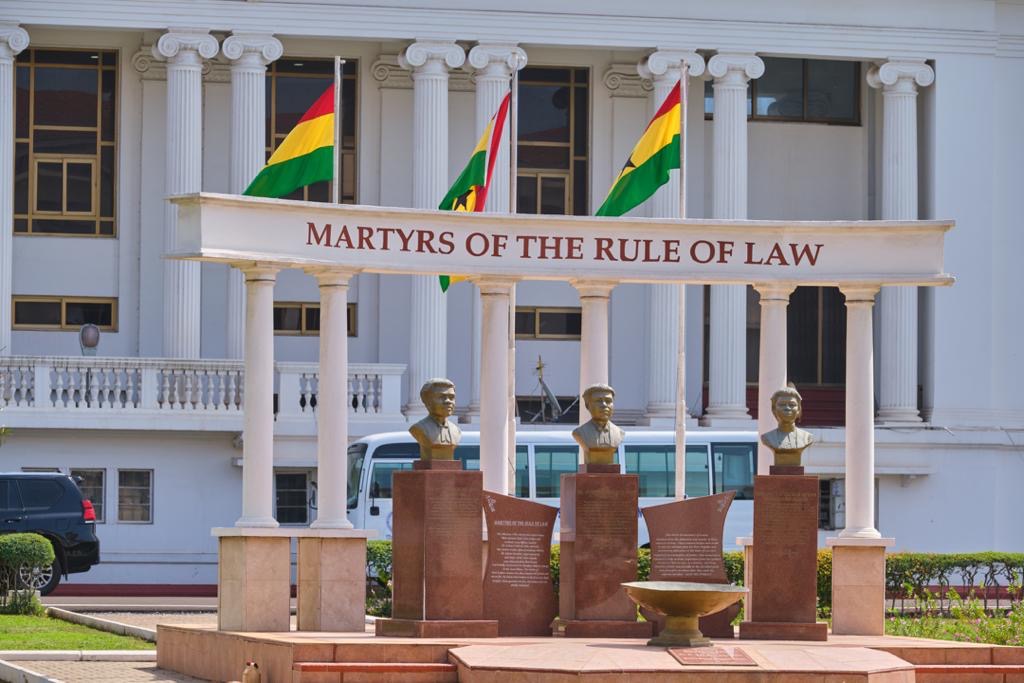
In a monumental decision that dramatically reshapes Ghana’s democratic fabric, the Supreme Court has declared the delegate-based electoral college system—used by political parties to select presidential and parliamentary candidates—unconstitutional.
A seven-member panel, presided over by Chief Justice Paul Baffoe-Bonnie, delivered the ruling by a 5-2 majority on Wednesday morning, striking down a centuries-old internal party practice that confined candidate selection to a narrow group of party executives and chosen delegates, to the exclusion of the broader, dues-paying membership.
The Constitutional Imperative
The crux of the court’s decision rests on Article 55(5) of the 1992 Constitution, which explicitly guarantees that every Ghanaian citizen of voting age has the right to join a political party and to participate in its activities. The majority justices ruled that the restriction of primary voting rights to a limited electoral college violates this constitutional guarantee of internal party democracy. The court held that every bona fide registered member of a political party is constitutionally entitled to cast a vote in the selection of parliamentary and presidential candidates.
The End of a Politically Toxic System
Historically, Ghana’s two dominant political parties—the New Patriotic Party (NPP) and the National Democratic Congress (NDC)—have operated heavily entrenched electoral college systems. In these systems, party leaders, constituency executives, regional chairpersons, and sometimes special interest delegates are the sole arbiters of who flies the party’s flag in a general election.
This system has long attracted deep public criticism. The limited number of delegates has routinely made party primaries fertile ground for “money politics,” where aspirants spend millions of cedis courting a few hundred or a few thousand influential individuals, rather than appealing to the broader party grassroots. The Supreme Court’s judgment aims to cure this democratic deficit by mandating a “one-member-one-vote” approach for all internal elections moving forward.
Safeguarding Past Primaries
In a crucial safeguard against political chaos, the court clarified that its ruling is non-retroactive. All decisions, appointments, and votes conducted in good faith prior to Wednesday’s judgment remain valid and will not be overturned solely because of the new constitutional interpretation. This protection prevents the invalidation of already-elected Members of Parliament or current flagbearers who won their seats under the old delegate-based system.
The Role of the Electoral Commission
The ruling carries significant weight for the Electoral Commission (EC). The Supreme Court held that the EC now bears a statutory duty to ensure that all internal activities of political parties conform strictly to Article 55(5). This means the EC will be legally empowered to supervise and scrutinize party primaries to verify that all registered members are genuinely allowed to participate, rather than just a select cadre of delegates.
Dissenting Opinion
The decision was not entirely unanimous. Justice Samuel Kwame Adibu-Asiedu and Justice Ernest Yao Gaewu registered their dissent. While their specific reasoning is yet to be fully detailed, legal analysts suggest the minority likely argued that political parties are private associations with the inherent right to design their own internal governance structures, including representative democracy through delegates, and that Article 55(5) does not explicitly demand direct mass voting for specific candidates.
A Logistical and Political Overhaul
The full reasons for the judgment are slated to be filed by August 5, 2026. However, the immediate implications for Ghanaian political parties are staggering. The NPP and NDC, whose membership runs into millions, now face the daunting logistical task of organizing nationwide mass ballots for every primary, rather than the comparatively simpler delegate conferences. This could push primary elections into multiple rounds or require the EC’s heavy logistical involvement.
Civil society organizations, including the Ghana Anti-Corruption Coalition, have hailed the ruling as a historic win for grassroots democracy, while political party strategists scrambled on Wednesday afternoon to draft emergency constitutional amendments to comply with the Supreme Court’s directive ahead of the next election cycle.


