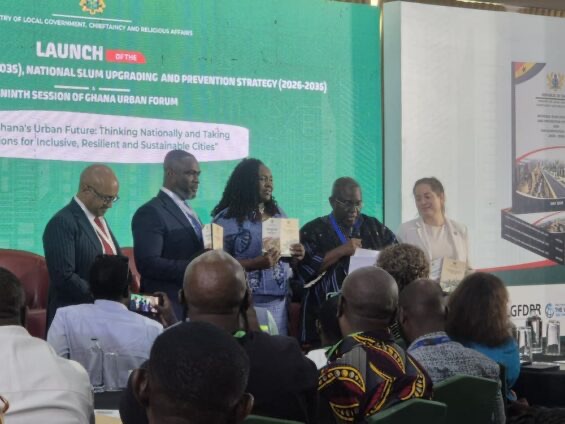
The government has unveiled a bold new 10-year National Urban Policy and a companion Slum Upgrading and Prevention Strategy, acknowledging that decades of rapid urbanisation have outpaced planning efforts, leaving cities besieged by recurrent flooding, acute housing shortages, gridlock, and sprawling informal settlements.
The twin frameworks—covering the period 2026–2035—were launched on Tuesday during the opening of the 9th Ghana Urban Forum in Accra, held under the theme “Resetting Ghana’s Urban Future: Thinking Nationally and Taking Local Actions for Inclusive, Resilient and Sustainable Cities.” The event drew policymakers, metropolitan chiefs, development partners, and urban planners, all grappling with the reality that Ghana’s urban population has exploded from roughly 4 million in the 1980s to an estimated 20.4 million today. By 2030, nearly two out of every three Ghanaians will live in urban areas—a demographic shift that demands a fundamental rethinking of infrastructure, governance, and service delivery.
Self-Critique and Lessons from the Past
In a keynote address delivered on behalf of President John Mahama by Dr. Nii Moi Thompson, Board Chairman of the National Development Planning Commission (NDPC), the President offered a candid assessment of the country’s first National Urban Policy, introduced in 2012. A comprehensive review, he said, revealed that implementation achieved only about 50 percent of its intended outcomes.
While the earlier policy made strides in improving urban safety, spatial planning, and environmental awareness, it fell short on critical fronts: affordable housing delivery, sustainable urban financing, robust research and data systems, and, most critically, institutional coordination. “The gap between policy and implementation persisted,” the statement read, citing weak inter-agency collaboration, inadequate budgetary allocations, poor integration of the policy into sectoral plans, and insufficient monitoring and evaluation mechanisms as the primary culprits.
The new policy, therefore, is designed not merely as a blueprint but as an actionable, accountable framework. Its core pillars include: promoting sustainable urban growth, enforcing effective land-use planning, building climate resilience into infrastructure, improving innovative financing models for urban projects, accelerating affordable housing development, digitising governance and service delivery, and ensuring equitable access to basic services for all residents—regardless of their formal or informal status.
A Strategy to Reverse Slum Proliferation
Speaking at the launch, the Minister for Local Government, Chieftaincy and Religious Affairs, Ahmed Ibrahim, underscored the significance of the accompanying National Slum Upgrading and Prevention Strategy. He described it as a twin-track approach: on one hand, upgrading existing informal settlements with improved drainage, sanitation, roads, and tenure security; on the other, preventing new slums from emerging through proactive land-use planning, affordable housing incentives, and stricter enforcement of building regulations.
“We cannot continue to build policies that gather dust on shelves,” Minister Ibrahim warned. He urged all Metropolitan, Municipal, and District Assemblies (MMDAs) to immediately integrate these frameworks into their annual development plans and budgets, stressing that “the success of these policies will depend entirely on the rigour of their implementation, not the elegance of their language.” He also assured delegates that his ministry would take the lead in coordinating, monitoring, and evaluating progress, with regular scorecards to track tangible improvements in the lives of ordinary Ghanaians.
Housing Policy Review to Align with New Vision
In a related development, the Minister for Works, Housing and Water Resources, Kenneth Gilbert Adjei, announced that his ministry has already begun a comprehensive review of Ghana’s National Housing Policy to align it with the new urban strategy. He indicated that the revised housing policy would prioritise affordable, climate-responsive housing designs, resilient infrastructure that can withstand floods and other climate shocks, and stronger public-private partnerships to mobilise the massive capital required to close the housing deficit—currently estimated at over 2 million units.
“We are looking at innovative financing instruments, such as housing bonds, land value capture, and developer obligations, to shift from state-led provision to a market-enabled, socially inclusive model,” Adjei stated. He also emphasised the need to coordinate with the Ministry of Finance to ensure that the new policy is backed by sustained funding rather than short-term donor projects.
Expert Reactions and Broader Implications
Urban policy experts welcomed the launch but cautioned that implementation remains the real test. Professor Kwasi Asare, a urban planning lecturer at the University of Ghana, noted that “Ghana has had some of the best-written policies in Africa, yet our cities still struggle with basic sanitation and affordable housing. The difference this time must be in the financing—cities need their own revenue-raising powers and dedicated urban funds, not just central government allocations.”
Environmental groups also praised the explicit focus on climate resilience, especially given that Accra and other coastal cities are increasingly vulnerable to sea-level rise and frequent flooding. The new policy mandates that all new developments undergo climate risk assessments and that flood-prone areas be zoned for green spaces rather than dense housing.
A Decade to Transform Ghana’s Urban Landscape
The two policy frameworks will guide Ghana’s urban development agenda from 2026 to 2035, with government hoping they will strengthen planning, reduce the growth of informal settlements, and build more inclusive, resilient, and sustainable cities. The Ministry of Local Government has committed to publishing annual progress reports and to establishing a multi-stakeholder oversight committee to track milestones.
As the forum continues through the week, participants are expected to workshop specific implementation plans, including pilot projects in selected municipalities and the design of a national urban observatory to collect real-time data on housing, migration, and infrastructure. For now, the launch signals a clear acknowledgment that Ghana cannot afford another decade of fragmented urban management—and that the future of its 20 million city dwellers hangs on the translation of policy into pavement, pipes, and homes.