



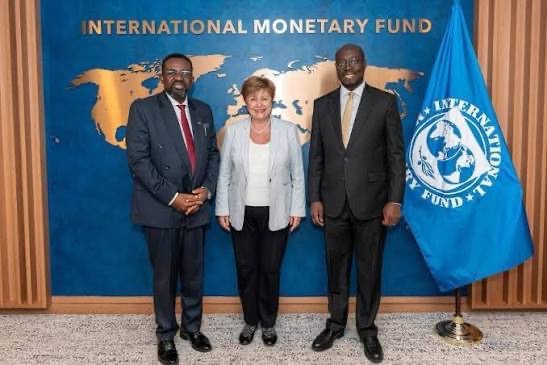
— The International Monetary Fund (IMF) has endorsed a more flexible fiscal path for Ghana starting in 2027, allowing the government to slow the pace of fiscal consolidation and increase development spending without jeopardising its long-term debt reduction targets.
In its latest Article IV Consultation and proposed Policy Coordination Instrument (PCI) report, the Fund said recent improvements in Ghana’s debt position and macroeconomic stability justify a reassessment of the country’s medium-term fiscal strategy . The endorsement marks a significant policy shift as Ghana transitions from a three-year, US$3 billion Extended Credit Facility (ECF) programme — which concluded in July 2026 — into a 36-month non-financing PCI focused on sustaining reform momentum .
Primary Surplus Target to Be Reduced
According to the report, Ghana’s primary fiscal surplus target could be reduced from 1.5 per cent of Gross Domestic Product (GDP) to 0.5 per cent from 2027 without undermining the country’s legally mandated objective of reducing public debt to 45 per cent of GDP by 2034 . The Fund noted that the 2026 budget’s 1.5 per cent primary surplus target remains consistent with current programme objectives, but the lower target from 2027 would provide room for growth-enhancing expenditure .
However, the IMF stressed that the adjustment would depend on continued implementation of structural reforms to strengthen revenue mobilisation, public financial management and oversight of state-owned enterprises .
“The lowering of the fiscal primary surplus will be supported by an ambitious package of fiscal structural reforms to contain quasi-fiscal pressures and safeguard debt sustainability,” the report stated .
Development Needs Justify Relaxation
The IMF noted that Ghana faces significant financing needs to achieve the Sustainable Development Goals, estimating that the country would need to spend more than 16 per cent of GDP by 2030 on areas such as education, healthcare and infrastructure . It said increased investment in labour-intensive sectors, including agriculture and energy, could attract private sector participation, improve value addition and create employment opportunities, particularly for young people .
Under the proposed PCI, Ghana is expected to increase primary spending from 2027, with greater emphasis on capital expenditure, while pursuing additional revenue through tax reforms and improved compliance, including reviews of customs, excise and income tax legislation .
Authorities Welcome Flexibility
The Fund said Ghanaian authorities agreed that the more relaxed fiscal stance was justified by improvements in debt dynamics and ongoing reforms . Finance Minister Dr Cassiel Ato Forson had previously affirmed the government’s commitment to fiscal discipline, stating that Ghana “must never return” to the path that necessitated the IMF bailout .
“The authorities viewed the more relaxed fiscal stance as justified by strong policy action and sustained improvement in debt dynamics,” the IMF said . The government indicated that the additional fiscal space would be directed towards priority development programmes and job creation while maintaining commitment to fiscal reforms .
Context of Progress
The IMF’s endorsement comes against the backdrop of significant economic progress under the ECF programme. Inflation has fallen to 5.3 per cent, international reserves have nearly doubled to US$11.9 billion — sufficient to cover four months of imports — and the primary budget balance has swung back to a surplus equivalent to 2.1 per cent of GDP . Ghana’s risk of debt distress has also been reduced to moderate, earlier than projected when the programme was approved .
The Fund cautioned, however, that the fiscal space must be matched with strong reforms, particularly in strengthening public financial management, containing quasi-fiscal pressures, and enhancing oversight of state-owned enterprises . The central bank’s exposure to gold-related losses through the Domestic Gold Purchase Programme — which recorded losses of GH¢22 billion in 2025 — has also been highlighted as a key risk that must be addressed .


