



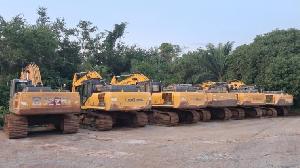
For decades, the Bono Region was heralded as Ghana’s breadbasket—a lush expanse of cocoa forests, yam fields, and cashew orchards that fed the nation. But today, the region’s signature green has been replaced by the muddy brown of excavated earth, and its life-giving rivers are running toxic.
While the illegal artisanal mining phenomenon, locally known as galamsey, continues to grab national headlines, it is the farmers, fishers, and families of Bono who are paying the ultimate price. As the national government struggles to curb the menace, the region’s water bodies—once vibrant sources of drinking water and irrigation—are now carrying heavy metals, and its agricultural backbone is crumbling under the weight of illegal excavators.
The Environmental Toll
The Tano River, which meanders through the heart of the region, has become a silent casualty. Recent water quality assessments conducted by the Environmental Protection Agency (EPA) indicate that the Tano, alongside smaller tributaries like the Bia and the Black Volta, is now heavily silted with elevated concentrations of mercury and arsenic.
“Galamsey operations have rendered the river undrinkable. The water is thick with mud, and fishing has completely collapsed,” said Joseph Adu, a local fisherman in Nkoranza who has spent the last three decades on the river. “I used to catch enough tilapia to feed my family and sell the rest. Now, I cannot find a single fish.”
The environmental degradation goes deeper than the water. Mining pits have scarred over 2,000 hectares of arable land in the Bono Region in just the last two years, according to the regional agricultural directorate. Topsoil—the very foundation of the region’s agricultural prowess—has been stripped away, turning fertile ground into barren, water-filled craters.
A Crushing Economic Blow
The economic impact is devastating. The region accounts for a significant portion of Ghana’s cocoa output, but thousands of cocoa farmers have watched their livelihoods vanish. In the villages of Tain and Jaman North, entire farms have been swallowed by mining concessions leased to illegal operators, often without the landowners’ consent.
“For my father, the land was his bank,” explained Akua Mensah, a widow and mother of three in Wenchi. “We produced 60 bags of cocoa last season. This year, because the excavators dug next to our farm, the roots were cut, and the soil is poisoned. We produced nothing.”
The ripple effects are felt across the supply chain. Local food prices have skyrocketed as the supply of cassava, yam, and maize diminishes, pushing many rural households into food insecurity. Furthermore, the Ghana Water Company Limited has reported a 300% surge in water treatment costs in the region, as they struggle to filter out excessive turbidity and heavy metals—a cost that is inevitably passed on to taxpayers.
The Public Health Crisis
Perhaps the most insidious cost is the toll on human health. The Bono Regional Health Directorate has recorded a sharp increase in skin diseases, gastrointestinal infections, and kidney dysfunctions in communities downstream of mining activities. Health officials suspect that the acute rise in cases is directly linked to the use of mercury, which miners use to amalgamate gold, as well as the consumption of contaminated fish and water.
“Doctors told me my kidneys are failing, and they think it’s from the water I drank for years,” said Kofi Badu, a 58-year-old farmer from Berekum who is currently receiving dialysis at the Sunyani Regional Hospital. “We never knew the water was killing us. We just thought it was a bit dirty.”
The Fight Back
The government, through the military task force “Operation Halt,” has conducted several sweeps across the region, destroying mining equipment and arresting suspects. However, enforcement has proven elusive. Miners, often backed by powerful syndicates, operate under the cover of darkness, only to return once the soldiers depart.
The Regional Minister, addressing a recent emergency meeting in Sunyani, acknowledged the severity of the situation. “We are losing our heritage, and we are losing our food security,” he stated. “The military is doing its best, but we need community buy-in. We must stop the financing of these illegal operators.”
Environmental experts warn that even if galamsey were stopped tomorrow, the damage is not easily undone.
“Restoring these lands will require massive reclamation efforts, including re-greening and soil decontamination. It could take 20 to 30 years and cost millions of cedis,” noted Dr. Esi Amoah, an environmental scientist at the University of Energy and Natural Resources. “The government must prioritize a long-term remediation plan, not just enforcement.”
A Crossroads
As the regional capital of Sunyani simmers with growing frustration, the Bono Region finds itself at a crossroads. The glittering appeal of gold has torn a community apart, leaving behind a population grappling with polluted rivers, bankrupt farmers, and a dying heritage.
For the farmers of Bono, the dream of a golden harvest has been replaced by the nightmare of a poisoned land. “We are not asking for much,” said farmer Kwame Asare, standing near the edge of an abandoned pit. “We just want the government to give us back our land and our water. We want our future back.”
Until a sustainable solution is found, the rivers of Bono will continue to flow brown, and the region’s voice—once the loudest in the national agricultural choir—will remain a desperate plea for survival.


