



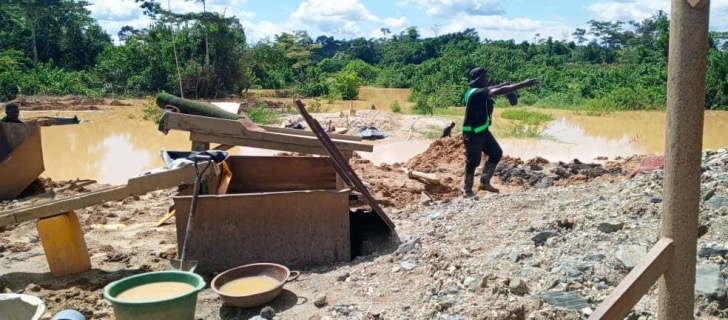
Illegal miners cleared from forest reserves keep returning to the same sites with new equipment, prompting the Forestry Commission to shift from periodic raids to permanent, round-the-clock camps in affected areas, the Western Regional Manager of the Commission, Nana Poku Bosompim, has said.
Speaking on TV3’s Key Points programme on Saturday, August 8, 2026, Mr Bosompim revealed the scale of the challenge: “We see new changfan machines every day. You burn them, and they keep bringing them in.” He explained that miners often relocate to other sections of a forest when enforcement teams arrive, only to return to previously cleared locations after officers withdraw. “They know for sure that we are not going to be there 24 hours, seven times a week,” he said.
Eight-day operation at Cape Three Points
Mr Bosompim was speaking about an eight-day operation at the Cape Three Points Forest Reserve in the Western Region, during which 125 changfan machines and 202 industrial water pumps were destroyed. The operation also led to the arrest of 41 people and the destruction of 59 makeshift camp structures used as mining camps. Among those arrested were four women picked up in the forest after 2 a.m. According to Mr Bosompim, 27 of the suspects have been remanded by a Circuit Court in Takoradi, with the remaining suspects expected to appear from Monday.
Permanent camps as a new strategy
The Commission has started establishing permanent camps inside the Cape Three Points Forest Reserve to maintain a sustained presence and prevent miners from returning to cleared areas. This move aligns with a broader national initiative: in May 2026, the Forestry Commission inaugurated 10 forest protection camps and two checkpoints in hotspot areas, with support from the UK government. Seven camps are in the Ashanti Region and three in the Western Region at the Subri River Forest Reserve.
The camps are equipped with communication gadgets and weapons, each comprising an office, four bedrooms, a furnished kitchen, and a toilet. They serve as permanent bases for trained forest guards to provide 24-hour surveillance.
Scale of destruction and risks to guards
The intervention comes as illegal mining continues to devastate Ghana’s forest reserves. A national satellite survey revealed that as of December 31, 2024, 8,923.8 hectares of forest reserves—equivalent to 12,500 FIFA-standard football fields—across 45 reserves and a national park had been heavily impacted by galamsey. The most affected regions are Ashanti, Western and Western North.
Forest guards face severe risks: records show 34 field officers sustained life-threatening injuries from attacks by illegal miners over the past five years, while between 2017 and now, 23 staff from the Wildlife Division have been killed or maimed by poachers and illegal chainsaw operators.
Calls for stronger action
The Coalition Against Galamsey—comprising professional bodies, labour unions, environmental groups and civil society organisations—has called on the government to strengthen the Forestry Commission with adequate logistics, funding and personnel, and to establish permanent security camps in forest reserves. The Coalition has cited the Cape Three Points Forest, Atewa Forest, Afua Hills and the Draw River Forest Reserve as areas facing continued pressure.
Meanwhile, the government has reported some progress. On August 7, 2026, Deputy Lands Minister Alhaji Yusif Sulemana disclosed that nine forest reserves previously under the control of illegal miners had been reclaimed. However, he admitted: “We still have a long way to go in this course.”


