



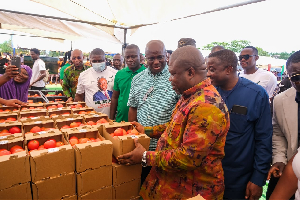
The government has announced plans to rehabilitate all 22 existing irrigation facilities in the Volta Region by the end of 2027, as part of a broader push to shift Ghanaian agriculture from heavy dependence on rainfall to reliable, year-round irrigated farming.
Food and Agriculture Minister Eric Opoku made the announcement during the national launch of the Ghana Tomato Self-Sufficiency Initiative (GHATSI) at Anloga in the Volta Region. The initiative, rolled out on 15 September 2026 by the Ministry of Food and Agriculture in partnership with FarmMate Limited, aims to build a dependable domestic tomato value chain, cut reliance on imports, raise farmer incomes and eventually support processing and exports.
Opoku said the rehabilitation drive responds directly to President John Dramani Mahama’s directive to accelerate the move away from rain-fed production. An assessment of irrigation infrastructure nationwide had shown that many facilities, some constructed decades ago, were operating well below their designed capacities because of deterioration and inadequate maintenance. The government will therefore prioritise restoring existing assets while developing new ones to expand farmers’ access to water.
In the Volta Region specifically, two new irrigation dams are also being pursued (with earlier indications pointing to sites at Have and Kpando Aziave). In addition, two new excavators will be supplied to the Volta Regional Coordinating Council to support the dredging of lagoons, streams and rivers, improving water flow for irrigation.
The minister further unveiled plans for mobile irrigation systems to make water access more flexible for farmers. Each unit comes with a 10-horsepower diesel pump, medium-sized pipes, 44 sprinklers and 44 risers, and can irrigate about five acres. The government will subsidise 60 per cent of the cost; farmers cover the remaining 40 per cent (GH¢23,800), with a two-year hire-purchase option available for those unable to pay upfront. One hundred water-pumping machines have already been distributed through the Regional Minister, and procurement is underway for an additional 500.
Complementary measures include improved seeds and fertiliser. The Ministry has reached an agreement with the Council for Scientific and Industrial Research (CSIR) to develop high-yielding tomato varieties capable of 25–30 tonnes, expected to be ready by the end of November for procurement and distribution. Organic fertiliser has also been procured, with 200 cartons earmarked for subsistence and vegetable farmers in the Volta Region. The free fertiliser support was introduced as an emergency response after losses linked to the Akosombo Dam spillage and drought in parts of northern Ghana.
Volta Regional Minister James Gunu welcomed the package, describing it as evidence of significant government investment in the region’s agriculture. He noted that the Volta Region received more than 20,000 bags of fertiliser after hosting National Farmers’ Day, followed by further allocations to each of its 18 district assemblies. The region has also benefited from 180,000 birds under the Feed Ghana poultry programme and two of the ten Farmers’ Service Centres being built nationwide this year.
Gunu highlighted the region’s strong potential for tomato production, especially in Anloga, Keta, Akatsi North and Agotime Ziope, and called for GHATSI to be expanded to more communities. He also urged the establishment of


