



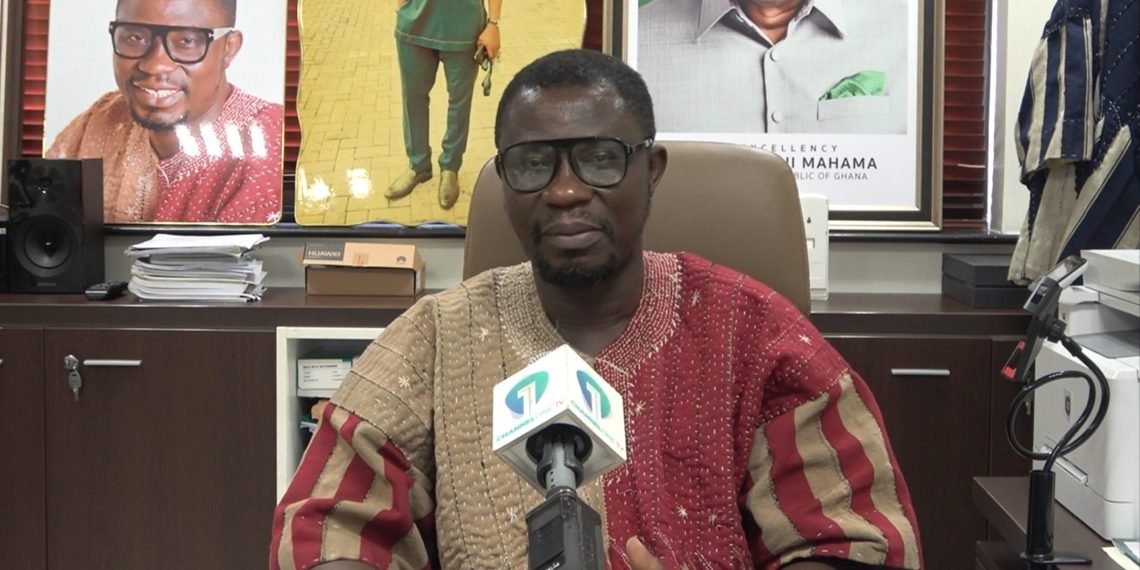
The Member of Parliament for Ashaiman and a member of Parliament’s Defence and Interior Committee, Ernest Norgbey, has alleged that some security officials are deliberately undermining the John Mahama administration by manipulating the system and leaking sensitive information to individuals linked to the previous government.
Mr Norgbey said some officials inherited from the previous administration remain in strategic positions and are allegedly using their access to frustrate the government’s efforts to tackle illicit drug trafficking.
“There are people who are at the helm of affairs who are making sure that this government does not succeed,” Mr Norgbey said on Eyewitness News on Tuesday, September 22, 2026.
According to him, some of the officials allegedly provide information to political actors outside government, allowing them to anticipate security operations and exploit weaknesses within the system.
“They are allowing the system, they are opening up the system, they are corrupting the system, and the same people will come back and come and leak information and tell people, I mean, cronies from the other side that this is what is happening,” he alleged.
The Ashaiman MP — a three-term legislator who also serves on Parliament’s Security and Intelligence Committee and Finance Committee — said the government should review the deployment of personnel at the country’s entry and exit points, particularly those responsible for detecting and preventing the movement of narcotics.
He argued that security infrastructure, including scanning and drug-detection systems at the country’s ports and airport, could be undermined if personnel operating them compromise the system.
“If you cannot as much as reshuffle people who are watching you or helping your government look bad, that’s incompetence to the highest order,” he said.
Mr Norgbey called for an internal reshuffle of personnel at strategic entry and exit points to prevent further manipulation of the system. “Those people must be reshuffled. Until then, we’ll continue to see all this,” he added.
A season of seizures
His comments come amid heightened scrutiny of Ghana’s narcotics-control system following major cocaine seizures linked to consignments originating from Ghana.
At the centre of the controversy is the September 10, 2026 seizure of nearly 3.9 tonnes of cocaine at France’s Port of Dunkirk, valued at more than US$260 million and concealed in a container of plastic waste that had departed from Ghana. Ten suspects, including four Customs officers, were subsequently arrested in Ghana. Four accused persons have been arraigned and remanded into custody, with their next court appearance scheduled for October 13, 2026.
In August 2026, police intercepted 866 parcels of suspected cocaine concealed in sacks of gari at a warehouse within the Tema Harbour enclave, reportedly destined for London. Other cases include the March 2025 seizure of more than 3.3 tonnes of cocaine at Pedu Junction in Cape Coast, the interception of about 120 slabs of cocaine along the Takoradi-Cape Coast highway, and the June 2026 seizure by Australian authorities of 320 kilogrammes of methamphetamine from a charcoal consignment traced to Ghana.
The Minority in Parliament has formally invoked Article 112(3) of the 1992 Constitution and Order 53 of Parliament’s Standing Orders to demand an emergency recall, saying the seizures collectively exceed US$1 billion. The caucus wants the Ministers responsible for Interior, Transport and National Security, as well as officials from NACOC, the Ghana Ports and Harbours Authority, Ghana Revenue Authority, Ghana Immigration Service and National Intelligence Bureau, to account to Parliament.
NPP demands dismissals
The opposition New Patriotic Party has called for a parliamentary inquiry into the seizures, with National Organiser Henry Nana Boakye demanding the establishment of a special bipartisan committee with full powers to summon witnesses and compel the production of documents. The NPP has also demanded the immediate removal of heads of key state institutions responsible for Ghana’s ports, airports, customs, intelligence and security — including the Acting Director-General of the Ghana Ports and Harbours Authority, the Director-General of the Narcotics Control Commission and the National Security Coordinator.
“We therefore call on the Speaker to recall the House without delay,” Nana Boakye said.
Government MPs have pushed back, arguing that investigations should be left to institutions mandated to handle criminal and narcotics-related cases. The governing NDC has downplayed the calls for a bipartisan parliamentary probe, with Deputy General Secretary Mustapha Gbande rejecting the NPP’s demand as “needless”.
President John Dramani Mahama has since chaired a high-level meeting of security chiefs, receiving a detailed briefing on investigations into the trafficking of narcotic drugs through Ghana’s ports, and has ordered an inter-agency task force to tackle the crisis within two weeks.
NACOC has also been forced to deny claims by New Tafo MP Vincent Ekow Assafuah that one of the suspects in the Dunkirk case was a presidential escort. Deputy Director-General Alexander Twum-Barimah said background checks on all suspects in custody found no indication that any served as a close protection officer for the President or Vice President.
Mr Norgbey’s intervention adds a new dimension to the debate — an allegation from within the governing party’s own ranks that elements of the state security apparatus are actively working against the administration’s anti-narcotics efforts.


