



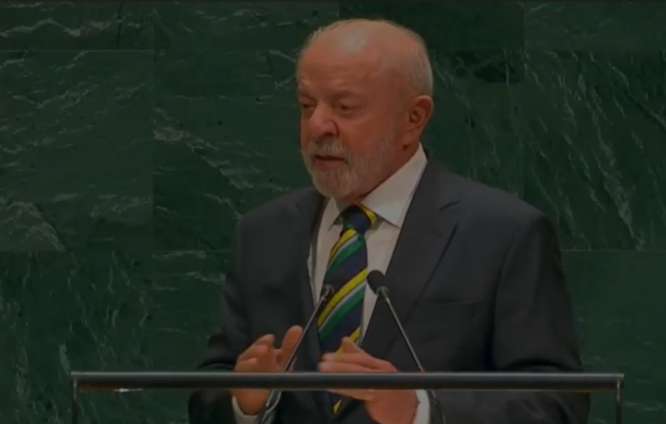
Brazilian President Luiz Inácio Lula da Silva has commended President John Dramani Mahama and the people of Ghana for their leadership in advancing the global reparatory justice agenda, describing the Ghana-led UN declaration on the transatlantic slave trade as a correction of a historical distortion.
President Lula made the remarks during his address to the 81st United Nations General Assembly in New York on Tuesday, where he referenced the landmark UN declaration recognising the trafficking of enslaved Africans and racialised chattel enslavement of Africans as the “gravest crime against humanity.”
“This General Assembly recently corrected a historical distortion in the world map. It recognised the trafficking of enslaved Africans as the gravest crime against humanity,” Lula said.
He added that the international community must now move beyond recognition and focus on issues critical to humanity’s future. “It approves a more accurate representation of the world map. Now, it needs to focus on issues crucial for the future of humanity. We are called to choose between multilateralism or unilateralism, democracy or extremism, sovereignty or subordination,” he stated. “These choices require courage, political will, and clarity of objectives. This is what we expect from a statesman.”
A historic resolution
The declaration, formally titled the Declaration of the Trafficking of Enslaved Africans and Racialised Chattel Enslavement of Africans as the Gravest Crime against Humanity, was adopted by the UN General Assembly as Resolution 80/250 on March 25, 2026, following a Ghana-led initiative championed by President Mahama in his capacity as African Union Champion on Advancing the Cause of Justice and Payment of Reparations.
The resolution was adopted with 123 member states voting in favour, three against — Argentina, the United States and Israel — and 52 abstentions, including European Union member states and the United Kingdom. The resolution invokes one of the most serious categories of international criminal law, expressly linking the transatlantic slave trade to peremptory norms of international law (jus cogens) and reaffirming their imprescriptible character while calling for the opening of discussions on mechanisms of reparative justice.
President Mahama first announced Ghana’s intention to introduce the resolution during his address to the 80th UN General Assembly in September 2025, when he declared that “the spirit of Nkrumah” had entered the chamber. Ghana subsequently led the initiative on behalf of the African Group, securing its adoption six months later.
From recognition to action
The development has since been followed by concerted efforts to translate the UN declaration into practical measures. In June 2026, Ghana hosted the High-Level Consultative Conference on the Next Steps to the Landmark United Nations Resolution on the Trafficking of Enslaved Africans at the Kempinski Hotel Gold Coast City and the Accra International Conference Centre from June 17 to 19.
The conference, convened under the auspices of President Mahama as AU Champion, brought together Heads of State and Government, ministers, international organisations, scholars, legal experts and civil society representatives from across the world. High-level attendance included President Bassirou Diomaye Faye of Senegal, President Joseph Nyuma Boakai of Liberia, President Netumbo Nandi-Ndaitwah of Namibia, Prime Minister Mia Amor Mottley of Barbados, and President Adama Barrow of The Gambia, alongside delegations of the 123 UN member states that supported the resolution.
Delivering the keynote address, President Mahama described the adoption of the landmark resolution as a defining moment in the international community’s acknowledgement of the scale, brutality and lasting impact of the trafficking of enslaved Africans. He emphasised that the objective “is not to re-open old wounds but to heal those wounds,” stressing that the pursuit of reparatory justice must be guided by truth, understanding, reconciliation and constructive engagement.
The conference concluded with the adoption of the Accra Next Steps Commitments on Reparatory Justice, a 46-paragraph document outlining practical steps towards reparatory justice through restitution, compensation, rehabilitation, institutional reforms and assurances of non-repetition. Among the main goals are truth and acknowledgement, legal justice, restitution of cultural artefacts, global governance reforms, compensatory reparations, gender justice, psychological rehabilitation, diaspora engagement, debt relief, financial justice, technology transfer, public health and climate justice.
A defining moment of the conference was the special Juneteenth commemoration held on June 19 at Christiansborg Castle in Osu, chosen for its profound historical relevance to the transatlantic enslavement. Under torchlight, with libation, music and interfaith prayers, delegates honoured the millions whose lives were lost, reaffirming the conference motto, “Never Again.”
Three global panels established
President Mahama announced the establishment of three global panels to advance the reparatory justice agenda: a Global Advisory Panel on Reparative Justice comprising Heads of State, eminent leaders and public figures; an Expert Panel on the Restitution of Cultural Artefacts to facilitate the return of cultural property and historical treasures to their rightful communities; and a Global Legal Panel on Reparative Justice to explore legal pathways and strengthen international legal understanding on reparations.
Foreign Minister Samuel Okudzeto Ablakwa, who welcomed participants to the conference, lauded President Mahama for his leadership in tabling the resolution and paid tribute to all 123 member states “for standing on the right side of history.” He noted that Ghana was once a major departure point during the transatlantic slave trade but now serves as “a sanctuary for healing, remembrance and reparatory justice.”
Brazil’s longstanding support
Brazil has been among the most prominent countries supporting Ghana’s initiative. President Lula had earlier announced Brazil’s full support for the Ghana-led resolution during the CELAC-Africa Summit in Bogotá, Colombia, on March 21, 2026, held on the International Day for the Elimination of Racial Discrimination.
“Brazil supports the African Group at the United Nations in recognising human trafficking and the slave trade as among the gravest atrocities in human history,” Lula said at the summit. He acknowledged that despite Brazil’s public policies promoting racial equality, including affirmative action, “we remain far from settling our historical debt to Africa after more than 350 years of slavery.”
Historians estimate that more than 12 million Africans were forcibly taken from the continent during the transatlantic slave trade, with Brazil emerging as one of the principal destinations. Today, Brazil is home to one of the largest populations of people of African descent outside the continent, with 153 million people of African descent living across Latin America and the Caribbean.
Brazil issued a formal apology to its Black population for slavery in November 2024, with Attorney General Jorge Messias stating that the government “asks forgiveness for the subjection of our ancestors to slavery.” In June 2026, Lula signed decrees titling eight quilombola territories and declared that the debt to Africans “cannot be paid with money.”
Global momentum
The reparatory justice campaign has gathered what Foreign Minister Ablakwa described as “unprecedented momentum” since the adoption of the resolution. The UN Committee on the Elimination of Racial Discrimination issued authoritative guidance in September 2026 concluding unambiguously that perpetrators of the transatlantic enslavement must provide reparatory justice, providing what Ghana’s Ministry of Foreign Affairs described as “the legal foundation beneath the moral authority of Resolution A/RES/80/250.”
CARICOM held its Third Reparations Conference in September 2026 under the theme “From Resolution to Action,” building on the Accra outcomes. Chairman of the CARICOM Reparations Commission Hilary Beckles said the adoption of the UN resolution reflected a “global revolution of ideas” driven by centuries of resistance and resilience among enslaved Africans and their descendants.
In his closing remarks at the Accra conference, President Mahama noted that the iniquities of the slave trade remain. “The demographic that slavery affected is still the poorest part of the world, which is rigged against the descendants of slaves and the victims of slavery,” he said. “So, our work goes beyond reparations. It goes beyond the return of artifacts. It goes into advocacy for creating a more equal world that offers opportunities to everyone and a world that is fair and just.”
Ghana is expected to host a high-level side event during the 81st UN General Assembly in September 2026 to further advance the global campaign, which President Mahama announced in August 2026.
Additional reporting by Winifred Lartey. This story was compiled from JoyNews sources, the Ministry of Foreign Affairs of Ghana, GhanaWeb, Graphic Online, Xinhua, and international wire reports.


