



The Ghana National Petroleum Corporation (GNPC) says spatial data analysis using Geographic Information Systems (GIS) could unlock over one billion barrels of oil and 2.5 trillion cubic feet of gas from stranded resources in the Tano Basin, potentially helping to reverse Ghana’s declining oil production.
The analysis forms part of efforts by GNPC to identify ways of using existing petroleum infrastructure to develop resources that may not be commercially viable as standalone projects.
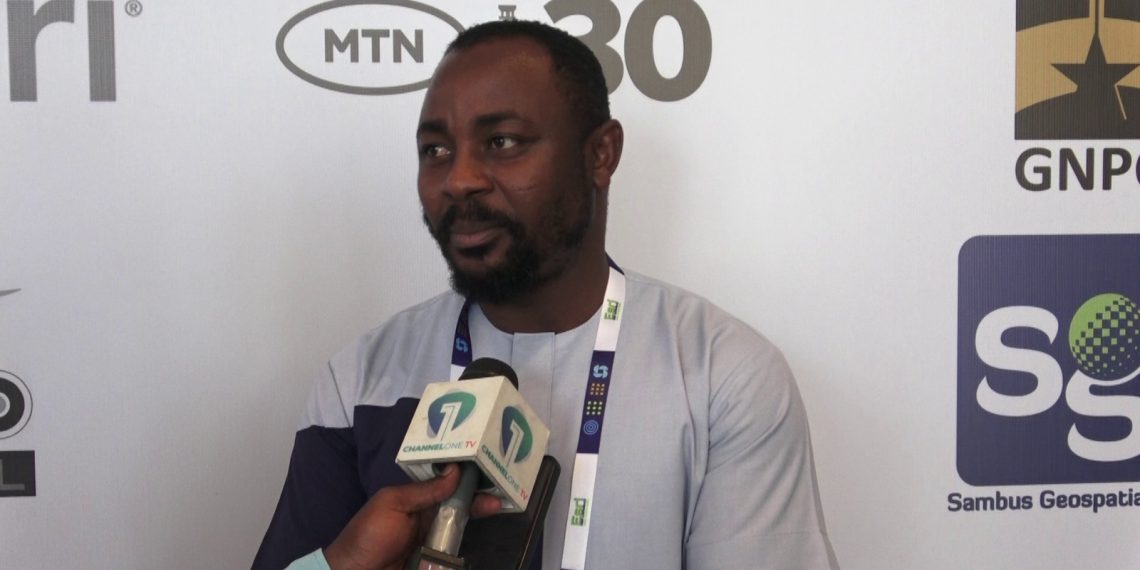
Senior Geomatic Engineer at GNPC, Mr Emmanuel Boadum Donkor, told Citi Business News on the sidelines of the Esri User Conference West Africa 2026, hosted by Sambus Geospatial Limited, that GIS is helping the Corporation identify how existing infrastructure can be connected to stranded resources to reduce development costs.
“With only the Tano Basin that we have done the analysis around, we have been able to identify over 1 billion barrels of oil that we can actually potentially add to our production rate and about 2.5 trillion cubic feet of gas that we can actually add to our current production to boost it,” he said.
A Hub-Based Approach
Mr Donkor explained that developing the resources independently could require significant capital expenditure, while a hub-based approach supported by GIS could bring several stranded resources together and make their development more commercially viable.
“If you take up the CAPEX in terms of developing the infrastructure to extract these stranded resources independently, if you compare it to doing it in the hub way which we are seeking to do, you realise that it brings down the cost of investment and then it actually boosts our confidence to be able to extract these stranded resources,” he said.
GIS as a Decision-Support Tool
GIS has become an important decision-support tool for GNPC, with Mr Donkor noting that about 80 per cent of the Corporation’s data contains location information.
“At GNPC it is a very significant part of us, as our data contains about 80 per cent location information, and that tells you how significant positioning is to our industry,” he stated.
He explained that GIS can combine information on wells, pipelines, roads, settlements, farms and environmentally sensitive areas to support decisions on petroleum infrastructure development while minimising potential impacts.
Global Recognition for GNPC’s Geospatial Innovation
The announcement comes on the back of GNPC receiving the 2026 Esri Special Achievement in GIS (SAG) Award, recognising its innovative use of geospatial technology to support petroleum development, data-driven decision-making and Ghana’s long-term energy security.
The award was presented during the Esri User Conference held in San Diego, California, where GNPC was among 197 organisations recognised globally for outstanding application of GIS from within Esri’s global community of more than 700,000 organisations.
At the conference, Mr Donkor delivered a technical presentation titled “Optimising Pipeline Routing with ArcGIS to Unlock Stranded Oil Resources in Ghana,” demonstrating how GNPC is using geospatial analysis to identify technically feasible pipeline corridors and evaluate routing options for connecting stranded and marginal offshore resources to existing infrastructure and proposed production hubs.
Background: A Sector in Decline
The Tano Basin initiative comes amid a prolonged decline in Ghana’s crude oil production. According to the Institute for Energy Security (IES), Ghana’s oil production has declined for six consecutive years, falling from a peak of 71.44 million barrels in 2019 to 37.30 million barrels in 2025, with output expected to drop further in 2026.
The IES described the trend as a structural problem rather than a temporary downturn, citing natural depletion of existing oil reservoirs, the absence of replacement reserves, operational disruptions and underinvestment in the upstream petroleum sector as key drivers.
The report identified the failure to sign a new Petroleum Agreement since 2018 as one of the most significant policy shortcomings, noting that Ghana’s production remains dependent on just three ageing offshore fields — Jubilee, Twenoa-Enyenra-Ntomme (TEN) and Sankofa Gye Nyame (SGN).
Government’s Broader Recovery Strategy
The GNPC analysis aligns with the government’s broader efforts to revitalise the upstream petroleum sector. President John Dramani Mahama has announced that Ghana has secured over $3.5 billion in upstream investment commitments, including approximately $2 billion from Jubilee partners for drilling up to 20 new wells and $1.5 billion from OCTP partners for additional field development and exploration activities.
The government has also signed several agreements to advance exploration in the Tano Basin. In September 2026, Ghana signed a Memorandum of Understanding with Shell Overseas Holdings and Chevron Sub-Saharan Africa Ventures to advance exploration and production activities in the South Deepwater Tano block, which has an estimated hydrocarbon potential of more than 3 billion barrels.
Separate MoUs were also signed with Eni Ghana and Vitol Upstream Tano Limited covering blocks GH WB 3 and GH WB 8 in the Tano Basin, spanning approximately 2,100 square kilometres.
Next Phase
Mr Donkor said the next phase of the Tano Basin initiative will depend on reaching agreement on how the identified opportunities can be implemented.
The proposed approach could allow Ghana to leverage infrastructure already in place rather than developing separate facilities for individual stranded resources, potentially reducing the capital expenditure required to bring new production online.


