



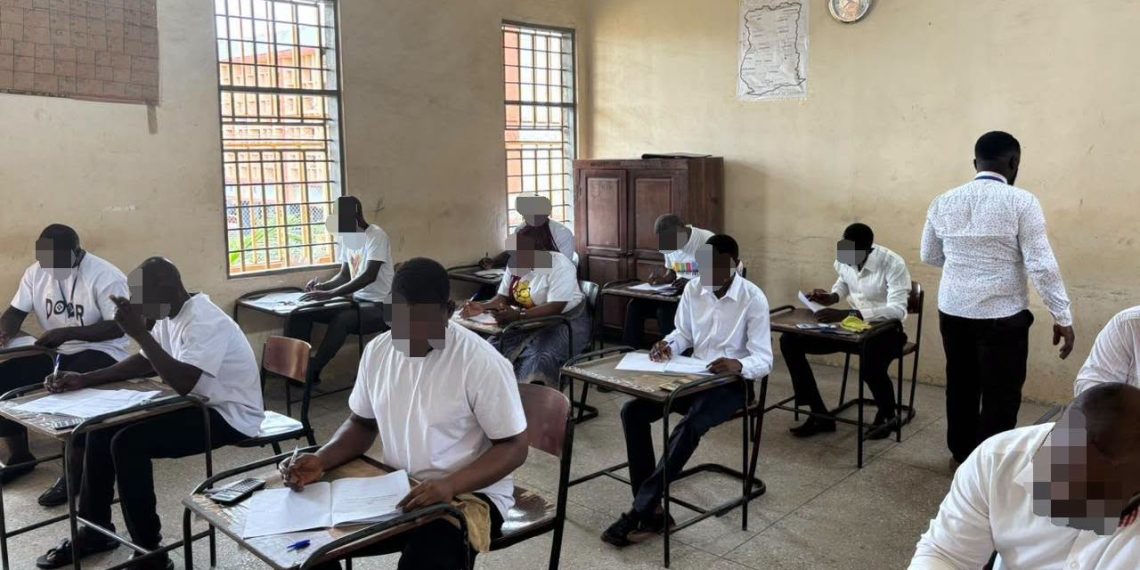
Thirty-seven inmates of the Nsawam Medium Security Prison have sat for the Teacher Licensure Examination as part of efforts by the Ghana Prisons Service to support their rehabilitation through education.
The inmates, who have completed their degree programmes, took the examination at the prison facility on Monday, September 14, 2026.
According to the Ghana Prisons Service in a Facebook post on Tuesday, September 15, the examination was conducted under strict supervision by two external invigilators, with support from officers of the Service.
The Service said the initiative forms part of its commitment to using education as a key tool for the reformation, rehabilitation and reintegration of inmates into society.
It added that providing inmates with opportunities to pursue education and acquire professional qualifications would improve their prospects of securing productive livelihoods after their release.
The participation of the 37 inmates in the Teacher Licensure Examination is expected to contribute to their rehabilitation journey by equipping them with qualifications that could enable them to pursue careers in teaching and other productive areas.
The Ghana Prisons Service said the initiative reflects its broader efforts to equip inmates with knowledge and skills that can support their successful reintegration and enable them to contribute positively to society after serving their sentences.
A Growing Culture of Education Behind Bars
The landmark examination sitting is the latest in a series of educational milestones recorded within Ghana’s prison system under the leadership of Director-General of Prisons, Mrs Patience Baffoe-Bonnie, the first woman to head the Service.
In May 2026, 21 inmate students at the Reformers Senior High School within the Nsawam Medium Security Prison sat for the Oral English paper of the 2026 West African Senior School Certificate Examination (WASSCE), underscoring the Service’s commitment to academic advancement for inmates.
The Service has reported that over 1,500 inmates have accessed formal education since 2019, with many achieving a 100 percent pass rate. More than 700 inmates have benefited from formal education and been certified to pursue further studies through partnerships with tertiary institutions such as the University of Cape Coast, Accra Metropolitan University and Pentecost University.
Partnerships Driving Rehabilitation
The educational initiatives are part of the Service’s comprehensive “Think Prisons 360 Degrees” agenda, which aims to transform prisons from mere custodial facilities into centres of rehabilitation, education and skills development.
In April 2026, the Ghana Prisons Service signed a Memorandum of Understanding with Pentecost University to strengthen rehabilitation and capacity-building programmes for inmates. The partnership is expected to create a long-term impact through structured training and reformation initiatives.
Under the agreement, a joint steering committee will oversee the implementation and sustainability of the initiative. The Director-General highlighted capacity building as one of the major challenges confronting the Service, adding that the partnership would facilitate the development of tailored training programmes focused on practical skills acquisition.
Teacher Licensure: A Pathway to Professional Practice
The Teacher Licensure Examination, conducted by the National Teaching Council (NTC), is a mandatory requirement for anyone seeking to practice as a professional teacher in Ghana. The examination is designed to enable qualified teachers to acquire a professional licence and ascertain whether candidates meet the demands of the National Teachers’ Standards.
Candidates must hold a Bachelor of Education Degree or a Postgraduate Diploma in Education to be eligible. The examination covers General Professional Knowledge, Grade-level Specialism Pedagogy, and Subject Content Knowledge.
For the 37 inmates at Nsawam, passing the licensure examination would open a pathway to formal employment as professional teachers upon their release, marking a significant step toward their reintegration into society.
Rehabilitation Over Punishment
The initiative aligns with President John Dramani Mahama’s vision for prison reform. In April 2026, the President reiterated his government’s commitment to reforming the Ghana Prisons Service, stressing that “prison is not a place to wish your enemy.”
President Mahama endorsed the “Think Prison, Think 360 Agenda,” emphasising rehabilitation, reintegration and the overall well-being of inmates and officers.
The Prisons Service is also expanding its vocational and industrial training programmes. Plans are underway to establish five prison-based industries in tailoring, cabinetry, shoemaking, packaging and prefabrication to equip inmates with marketable skills and support their reintegration.
With the 37 inmates now awaiting their licensure results, the Nsawam Medium Security Prison continues to demonstrate that education can serve as a powerful tool for transformation, offering hope and opportunity to those seeking to rebuild their lives behind bars.


