



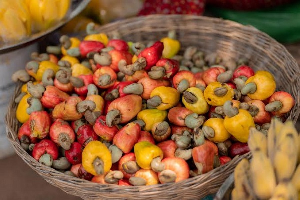
The cashew industry is poised to become a major engine of Ghana’s agricultural transformation and rural job creation, with the government setting an ambitious target of processing between 50 and 60 per cent of the crop locally each year.
The Tree Crops Development Authority (TCDA) has projected that Ghana’s cashew sector could generate over US$660 million in annual revenue with improved regulation, processing infrastructure and export support .
Currently, the industry exports about US$300 million worth of cashew annually, but more than 90 per cent of production is shipped as raw nuts rather than processed kernels — a situation officials describe as a major missed opportunity for value addition and economic growth .
A Sector Employing Nearly One Million Ghanaians
Cashew is one of Ghana’s most valuable export commodities, supporting approximately 890,000 people, most of whom are smallholder farmers in the Bono, Bono East, Ahafo and Savannah regions . An additional 200,000 people are engaged in trading, transportation and processing across the value chain .
Despite this substantial employment footprint, weak regulation, inconsistent pricing and limited local processing capacity have prevented the sector from reaching its full economic potential .
A Paradox in Ghana’s Cashew Economy
Ghana produces an estimated 262,000 tonnes of raw cashew nuts annually, yet exported approximately 444,000 tonnes in 2025, mainly to Vietnam and India . The gap is largely explained by an estimated 165,000 tonnes of raw cashew nuts imported informally from Côte d’Ivoire, Mali and Burkina Faso and subsequently exported through Ghana’s Tema Port .
While Ghana has approximately 65,000 tonnes of installed processing capacity, only around 15,000 tonnes was utilised in 2025, leaving most of the country’s processing infrastructure idle .
Mr Antonio Manuel Caramelo Raposo, President of the Association of Cashew Processors of Ghana, said the country was losing significant economic opportunities by exporting raw cashew nuts.
“Every tonne we export raw is a factory job, a tax cedi and a unit of foreign exchange we are choosing to send to Vietnam and India instead of keeping in Ghana,” he stated .
President Mahama Declares End to Raw Cashew Exports
The government’s push for local processing was underscored by President John Dramani Mahama in February 2026 when he declared that Ghana would no longer export raw cashew nuts, raw shea nuts or unprocessed rubber.
Speaking at the inaugural Ghana Tree Crops Investment Summit in Accra, the President invited investors to build processing capacity locally .
“I want to travel and be able to buy cashew and see produce of Ghana, not produce of India or produce of some third-party country,” he said .
The President announced a target of $2 billion in annual export earnings from each of Ghana’s six priority tree crops by 2035, bringing total export revenues from the sector to $12 billion. The six crops are cashew, coconut, oil palm, rubber, mango and shea .
High Costs and Financing Constraints
The study identified high investment and operating costs as major obstacles to the growth of Ghana’s cashew-processing industry. Establishing a modern 20,000-metric-tonne processing factory would cost approximately US5.3 million in Vietnam .
Ghanaian processors also face high electricity costs, expensive imported machinery and interest rates of around 20 percent, compared with approximately nine percent in Vietnam .
Government Interventions and Support
The government has rolled out a series of interventions to address these challenges. The TCDA has set a minimum producer price of GH¢12.00 per kilogramme for raw cashew nuts for the 2025/2026 crop season, applying to nuts meeting specified quality standards .
Under the $200 million World Bank-supported Ghana Tree Crop Diversification Project, 7.8 million cashew seedlings are being distributed to over 30,000 farmers, with 52,775 households set to benefit directly and 185 small and medium enterprises receiving matching grants to support processing and value addition .
A Memorandum of Understanding has also been signed between the Ministry of Food and Agriculture and B5 Plus Limited for the establishment of a large-scale cashew processing plant under a Build-Operate model .
Industry observers say local processing could help stabilise farm-gate prices, reduce post-harvest losses, and deepen rural industrialisation, especially in cashew-growing regions.
“When we process our cashew locally, we create jobs, strengthen farmers, and keep Ghanaian wealth within Ghana,” the Minister of Food and Agriculture, Mr Eric Opoku, stated during the MoU signing .


