



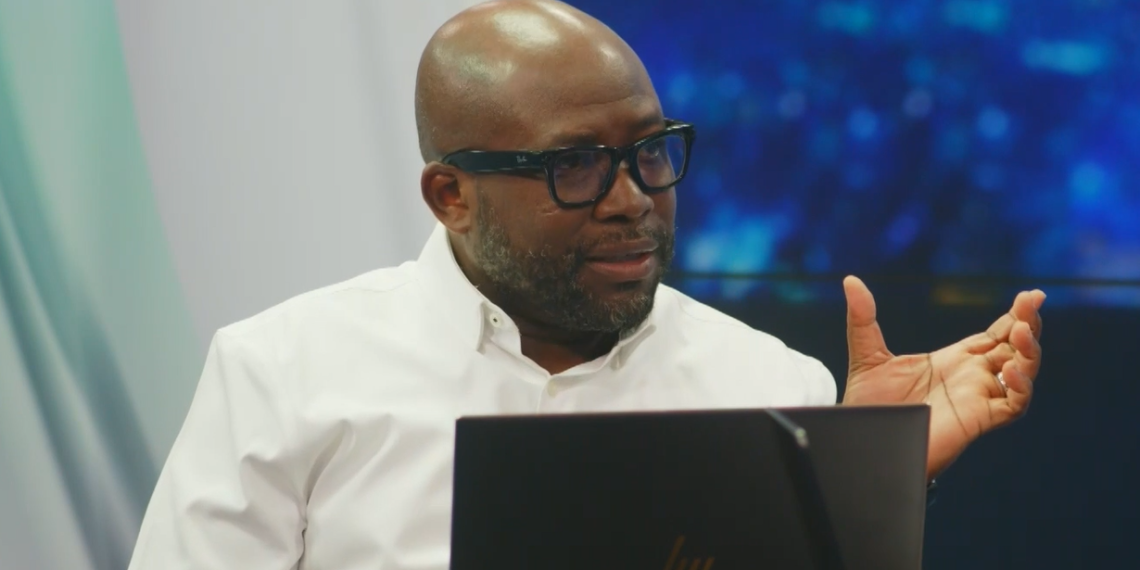
Ghana has “missed the boat” in its fight against illegal small-scale mining, commonly known as galamsey, due to political and economic considerations that derailed what was once a decisive government crackdown, according to Senyo Hosi, Convenor of the One Ghana Movement.
Speaking in an interview with Bernard Avle on Channel One TV’s The Point of View on Wednesday, September 30, Hosi said the country’s best opportunity to tackle the menace came during former President Nana Addo Dankwa Akufo-Addo’s first term, when the government imposed a sweeping ban on small-scale mining.
“I’ve maintained that we missed the boat in the fight to stop galamsey with our default strategy, and that’s sometime in former President Nana Addo Dankwa Akufo-Addo’s first term,” he said. “I think he really put his presidency on the line when he promised that, but he gave that up and everything else is now history. We actually missed that particular boat.”
The 2017 Crackdown and Its Unraveling
The Akufo-Addo administration’s anti-galamsey campaign began in March 2017, when the government placed a ban on all forms of small-scale mining—both legal and illegal—in response to growing public outcry over environmental degradation. The ban was initially intended to last six months but was extended to 20 months, finally lifted in December 2018.
The government established the Inter-Ministerial Committee on Illegal Mining, headed by then-Environment Minister Prof. Frimpong Boateng, to oversee the ban’s implementation. In July 2017, a joint military-police task force dubbed Operation Vanguard was deployed to the Ashanti, Eastern, and Western Regions—the areas most ravaged by illegal mining.
Hosi acknowledged that the former president’s initial approach significantly curtailed small-scale mining. “The fight was real, and the former president really stopped small-scale mining significantly,” he said. But he argued that political considerations eventually took precedence over sustainable policymaking.
“There was also some realism that had to be adjusted to policy, and that was politics. And unfortunately, politics took sway over sustainable policymaking, and we are actually where we are.”
2020 Election Fears Forced a Retreat
Hosi said concerns over the 2020 general election contributed directly to the scaling back of the administration’s approach. “He was worried about his 2020 election. He had to take a step back. The NDC folks were taking advantage of his fight,” he said.
The political fallout from the mining ban was indeed significant. The New Patriotic Party lost several parliamentary seats in mining constituencies in the 2020 elections, with analysts attributing the losses to economic hardships caused by the ban on small-scale mining. Kwadwo Nsafoah Poku, an energy expert, noted that the NPP lost four key parliamentary seats—Evalue Ajomoro Gwira, Upper West Denkyira, Amenfi Central, and Prestea Huni Valley—due to the total ban.
According to Hosi, opposition parties exploited the situation. “Yes, it is politically tolerated because of the political consequences of fighting it as we ideally should, and that’s what really got Nana Addo Dankwa Akufo-Addo to sort of backtrack in his early fight.”
The political competition, he argued, has continued to undermine efforts to tackle galamsey across party lines.
Economic Dependence Deepens the Crisis
Beyond politics, Hosi pointed to the economic dependence of mining communities on illegal mining as a fundamental obstacle. With youth unemployment and underemployment pervasive, galamsey has become a critical source of livelihood for many.
According to Hosi, some young people can reportedly earn between GH¢2,000 and GH¢10,000 a week through galamsey, creating a powerful financial incentive to remain in the sector despite its illegality. “Where formal jobs are scarce, NAIMOS raids cannot outcompete galamsey earnings,” he wrote in a recent opinion piece.
The scale of the economic entanglement is substantial. A 2025 government report found that in Tontokrom in the Ashanti Region, about 70% of the population is involved in mining. In Dakupe in the Savanna Region and Tarkwa Brennang in the Western Region, the figure rises to approximately 80%. Germany’s Ambassador to Ghana, Frederik Landshöft, has estimated that about one million people are engaged in artisanal and small-scale mining.
“The silence is not consent. It is evidence of how tightly galamsey is bound to people’s survival in these communities,” Hosi said.
A Point of No Return?
Hosi said the situation has deteriorated to a point where Ghana is “practically” at a point of no return. Recent data from the Ministry of Lands and Natural Resources paints a stark picture: 8,900 hectares of forest reserves—roughly equivalent to 12,500 football pitches—have been destroyed by illegal mining. Nine of Ghana’s 288 forest reserves have been severely impacted.
As of July 2026, authorities had arrested 258 people in anti-illegal mining operations and seized or immobilised 234 excavators, 2,728 pumping machines, 1,724 changfan machines, and 461 motorbikes and tricycles used in illegal mining activities. More than 4,000 excavators are being held at the country’s ports under stricter clearance systems.
Yet Hosi has argued that enforcement raids merely “reset the clock” without delivering lasting results. “If every raid merely resets the clock, then what exactly are we changing and what are we winning?” he asked in a separate opinion piece published on September 29. He called for measuring outcomes—such as cleaner rivers, restored lands, and safer mining practices—rather than merely counting arrests and seized equipment.
Lands and Natural Resources Minister Emmanuel Armah-Kofi Buah has acknowledged that prosecution, not arrest, remains the primary challenge. “The challenge we are having is not the arrest. It is the prosecution,” he said at a policy dialogue in Accra.
A Call for a New Strategy
Hosi maintained that enforcement remains necessary but cannot succeed alone against a system that is economically rewarding and socially embedded in mining communities. He called for a strategy that combines enforcement with measures to change the economic incentives sustaining illegal mining.
“We can win the fight against galamsey but only by changing how we fight, measuring outcomes and refusing to mistake activity for progress,” he said.
The One Ghana Movement convenor’s comments come as the government of President John Dramani Mahama faces mounting pressure to address the galamsey crisis, with calls growing for a state of emergency to be declared. As Ghana grapples with the legacy of a missed opportunity, Hosi’s assessment serves as both a cautionary tale and a call to action: without addressing the political and economic forces that sustain galamsey, the cycle of raids and returns is likely to continue.


