



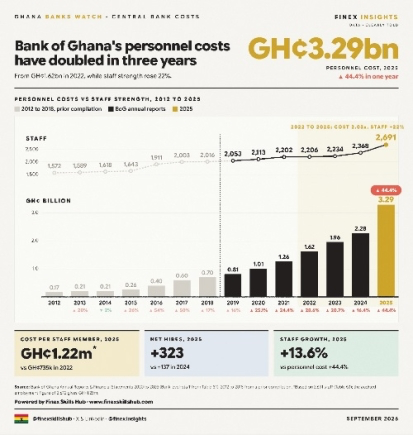
The Bank of Ghana’s personnel costs have more than doubled in just three years, rising far faster than the size of its workforce, according to the central bank’s annual reports and audited financial statements. The figures have renewed questions about the bank’s operating cost structure at a time when it is already grappling with record financial losses and negative equity.
Personnel costs increased from GH¢1.62 billion in 2022 to GH¢3.29 billion in 2025, representing growth of approximately 103 per cent. Over the same period, reported staff strength rose from 2,206 to 2,691, an increase of about 22 per cent. The divergence between the two trends provides an important perspective on the central bank’s operating costs.
A Steady Climb, Then a Sharp Jump
Personnel costs rose steadily from GH¢1.26 billion in 2021 to GH¢1.62 billion in 2022, GH¢1.96 billion in 2023 and GH¢2.28 billion in 2024. But 2025 produced a much larger jump: personnel costs increased by 44.4 per cent in a single year, from GH¢2.28 billion to GH¢3.29 billion.
Staff numbers also increased substantially during the year, but at a slower rate. The bank’s human-resource report shows staff strength rising from 2,368 in 2024 to 2,691 in 2025, an increase of 13.6 per cent. BoG says it recruited 395 people while 72 exited, resulting in a net intake of 323 employees. This means the increase in workforce size explains only part of the movement in personnel costs.
Dividing personnel costs by reported year-end staff strength provides another perspective. In 2022, personnel cost amounted to approximately GH¢735,000 for every staff member reported at year-end. By 2025, that ratio had increased to approximately GH¢1.22 million, a rise of about 66 per cent.
That figure should not be interpreted as the average salary of a Bank of Ghana employee. Personnel cost is an accounting expense category, rather than a disclosure of individual salaries, and the published financial statements do not provide enough details to determine precisely how the increase was distributed among salaries, pensions, allowances and other employee-related costs.
Personnel Now Dominates Operating Expenses
The scale of the increase is also evident within BoG’s broader operating expenses. The bank reported GH¢5.22 billion in other operating expenses in 2025, up from GH¢4.10 billion in 2024. Personnel costs alone accounted for about 63 per cent of the 2025 total, compared with approximately 56 per cent the previous year. In fact, the GH¢1.01 billion increase in personnel costs accounted for roughly 90 per cent of the year-on-year increase in this operating-expense category.
That makes personnel expenditure an increasingly important part of any discussion about the bank’s operating cost structure.
Discrepancy in Staff Numbers
There is also a small but notable discrepancy within BoG’s 2025 Annual Report. The human-resource section reports staff strength of 2,691 at December 2025, while the audited financial statements state that 2,672 persons were employed by the bank at the same date. The difference of 19 employees does not materially alter the overall trend, but clarification would improve consistency in the bank’s public reporting.
Governor Points to Evolving Mandate and Specialised Skills
The Governor of the Bank of Ghana, Dr Johnson Asiama, in an interview with Graphic Business, provided some context for the increase, pointing to changes in the bank’s responsibilities and the need to recruit specialised skills.
He said the bank was evolving and had taken on areas of work that previously received less attention, including the monitoring of virtual assets, data analytics, artificial intelligence and cyber monitoring. The BoG has established specialised departments on artificial intelligence, data analytics and virtual assets to strengthen oversight of Ghana’s evolving financial sector. According to Dr Asiama, those functions required additional personnel and new skills as the financial sector became more technology-driven.
“The central bank is a big institution. We need different skills, different people,” Dr Asiama said during a Monetary Policy Committee educational observership programme, noting that fintech and virtual assets, including cryptocurrency, are areas where demand for specialised skills is growing.
He also said the bank had to recruit to replace employees who leave through retirement. Between 54 and 60 staff members retire from the bank each year, he said, making recruitment necessary even without an expansion of the workforce.
Competition for Talent
The Governor also pointed to the cost of attracting and retaining specialised employees. He said the bank had to remain competitive in its remuneration because employees with skills in areas such as technology, data and fintech could move to other employers if their compensation was not competitive.
The available figures show that the bank’s workforce increased by about 22 per cent between 2022 and 2025, while personnel costs increased by about 103 per cent. The Governor’s explanation suggests that the gap is partly associated with recruitment in specialised areas, replacement of retirees and the cost of retaining skilled employees. However, the published figures do not separately quantify how much of the GH¢1.67 billion increase over the period came from new employees, pay adjustments, pensions, allowances or other employee-related expenses.
A Broader Context of Financial Strain
The personnel-cost surge comes against the backdrop of significant financial challenges at the central bank. BoG recorded an operating loss of GH¢15.63 billion for the 2025 financial year, up from GH¢9.49 billion in 2024. Its negative equity has ballooned to GH¢93.82 billion.
The central bank’s total operating expenses nearly doubled to GH¢37.91 billion in 2025, up from GH¢18.89 billion the previous year. A significant portion of this increase was attributed to the cost of open market operations, which rose sharply to GH¢16.73 billion from GH¢8.60 billion in 2024, reflecting the high-interest-rate environment that prevailed during the period. The bank also recorded revaluation and exchange losses of GH¢5.47 billion, reversing a gain of GH¢2.17 billion in the previous year, and losses on gold-related transactions remained substantial at GH¢9.05 billion.
Despite these rising costs, the bank’s operating income grew significantly to GH¢22.28 billion, supported by strong gains from gold sales and increased interest income. However, these gains were insufficient to offset the scale of expenditure.
The Majority in Parliament has defended the bank’s financial position, arguing that negative equity in central banks is “an accounting condition” and not a sign of insolvency. Eric Afful, Chairman of the Economy Committee, pointed to similar experiences at the European Central Bank, the US Federal Reserve and the Reserve Bank of Australia, which all recorded losses during periods of policy tightening.
The 40 Per Cent Benchmark
Dr Asiama has indicated that the pace of recruitment would moderate after the recent expansion. He said the bank undertook significant recruitment in 2025 and expected personnel costs to decline in growth terms from 2026, with recruitment eventually being aligned more closely with annual retirements.
The Governor said the more useful measure, in his view, was personnel cost relative to the bank’s total operational costs rather than the absolute personnel-cost figure. He said the bank’s internal benchmark was for personnel costs not to exceed 40 per cent of operational costs and maintained that the current level was below that threshold.
That assertion, however, points to an area where clearer disclosure would help. The bank’s financial statements provide the absolute personnel-cost figure and other operating expenses, but a consistent presentation of the specific operational-cost base used for the 40 per cent benchmark would allow readers to assess the ratio directly.
Looking Ahead
For now, the numbers show a sharp increase in the cost of maintaining the bank’s workforce. The Governor’s explanation adds that the increase was linked to recruitment, retirements, new regulatory and technological functions, and the need to compete for specialised skills.
The next set of annual financial statements should therefore provide a useful test of whether the expected moderation in recruitment translates into slower growth in personnel costs. With the bank’s broader financial position already under intense scrutiny, the trajectory of its personnel expenditure will remain a key indicator of how Ghana’s central bank is balancing its expanding mandate against fiscal discipline.


