



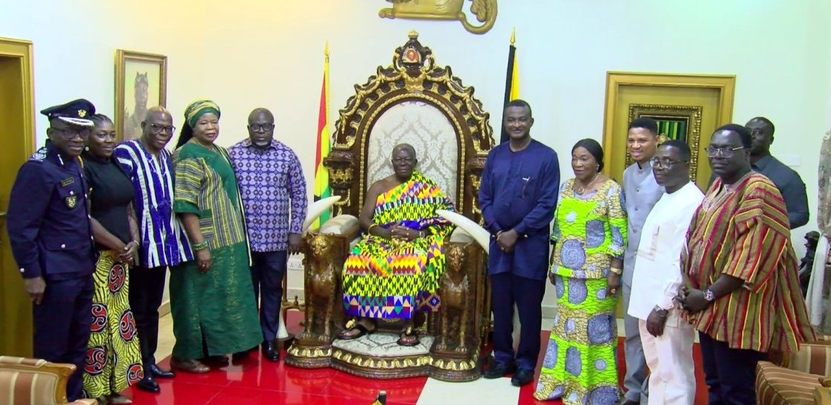
The Asantehene, Otumfuo Osei Tutu II, has called on the Ghana Revenue Authority (GRA) to intensify efforts to broaden the country’s tax base by bringing more players in the informal sector into the tax net, stressing that domestic revenue generation must take precedence over external borrowing for national development.
Speaking during a courtesy call by the Board and Management of the GRA at the Manhyia Palace on Saturday, the Asantehene acknowledged the Authority’s progress in revenue mobilisation under its current leadership but noted that significant gaps remained, particularly in the informal economy.
“The focus has always been on workers in the formal sector, while there are many others in the informal sector who can be educated on the need to pay taxes to support national development,” Otumfuo said.
He suggested that artisans and tradespeople — including hairdressers, mechanics, and commercial drivers — could be organised into cooperatives to facilitate their identification and integration into the tax system. Such a structure, he argued, would make it easier for the GRA to register, monitor, and collect taxes from individuals and small businesses that currently operate outside the official tax regime.
The Asantehene further urged the GRA to adopt innovative approaches to revenue collection while strengthening existing mechanisms to minimise leakages. “I have observed an improvement in revenue collection since the current Board and Management took over. This is due to the policies you have put in place. Despite these gains, some leakages still exist, and I urge you to work at addressing them,” he stated.
The monarch also called on GRA staff to rally behind the leadership to ensure the successful execution of its mandate.
GRA Reforms and Public Concerns
The GRA is currently implementing a series of tax reforms aimed at improving efficiency, enhancing compliance, and expanding the tax base. These include the deployment of digital systems, automation of processes, and stricter enforcement measures.
However, some of these reforms have drawn criticism from segments of the business community, with concerns raised over the pace of implementation, the complexity of new systems, and the potential impact on businesses. This has prompted calls for broader stakeholder engagement and sensitisation to ease the transition.
Mr. Ricketts Hagan, Board Chairman of the GRA, told the Asantehene that the Authority was actively engaging stakeholders to address concerns and ensure smooth implementation. He cited the introduction of new digital platforms, including the Publican AI system, as part of efforts to modernise tax administration and boost revenue.
“I’m sure you heard noise about not being able to comprehend, but people are beginning to understand the system,” Mr. Hagan said, adding that the Authority was committed to transparency and public education.
The Commissioner-General of the GRA, who also spoke during the visit, outlined the various reform measures being pursued and appealed for public cooperation and understanding. He reiterated that the reforms were necessary to place the country on a sustainable fiscal path.
Broader Context: Informal Sector and Tax Compliance
The informal sector in Ghana accounts for a significant portion of economic activity, estimated by some analysts to constitute upwards of 70% of employment and a substantial share of Gross Domestic Product (GDP). However, its contribution to tax revenue remains disproportionately low due to challenges such as poor record-keeping, lack of formal registration, and limited enforcement capacity.
Economists have long argued that expanding taxation into the informal sector is critical for reducing Ghana’s dependence on external financing and for stabilising public finances. The government’s medium-term revenue strategy has identified the informal sector as a key frontier for domestic resource mobilisation.
The Asantehene’s remarks reinforce calls by fiscal policy experts for a more inclusive tax regime that balances the need for revenue with the capacity of small-scale operators to comply.
A Call for National Commitment
Otumfuo Osei Tutu II’s appeal comes at a time when Ghana is grappling with fiscal pressures, including high debt levels and the need to finance infrastructure and social programmes. The government has set ambitious domestic revenue targets as part of its post-COVID-19 economic recovery agenda and International Monetary Fund (IMF) programme commitments.
The Asantehene’s call is also significant given his traditional and moral authority, which carries weight in shaping public opinion and encouraging voluntary compliance. By urging informal sector workers to embrace taxation as a civic duty, he is lending royal backing to a policy area that has historically faced resistance.
While the GRA has made strides in improving collection, the informal sector remains a vast, untapped reservoir of potential revenue. The challenge for the Authority will be to design systems that are simple, fair, and transparent, while ensuring that the burden on small-scale operators does not become onerous.
As the GRA continues its reform push, the Asantehene’s message serves as a timely reminder that sustainable development must be funded from within, and that every citizen and business — regardless of size — has a role to play in building the nation.


