



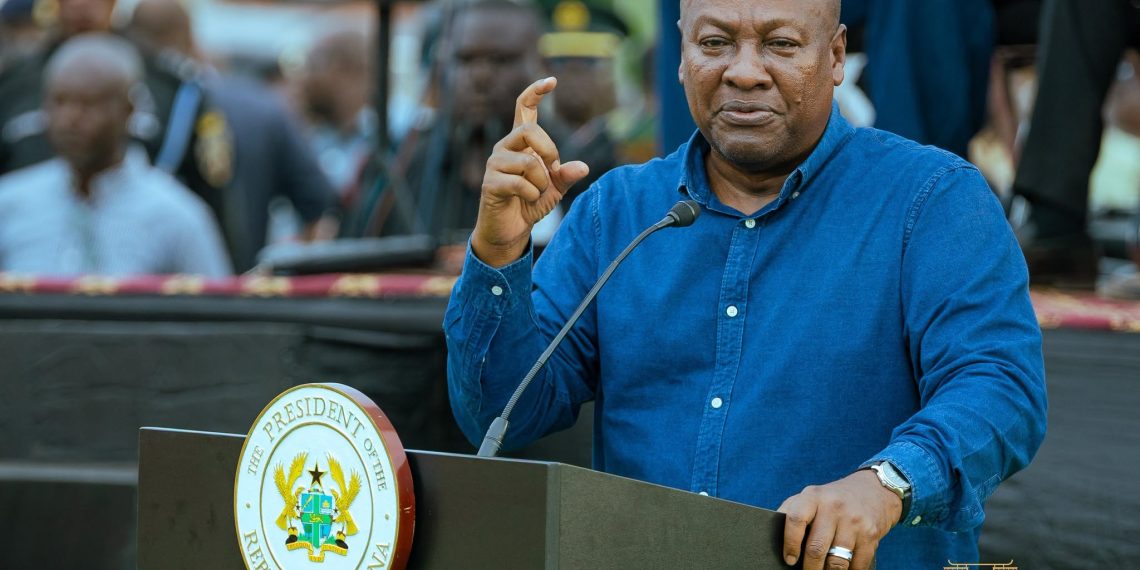
President John Dramani Mahama has issued a firm pledge to sustain the government’s crackdown on illegal mining—known locally as galamsey—even as he acknowledged the heavy financial and logistical toll of keeping reclaimed forest reserves safe from re-invasion. Speaking during his ongoing “Resetting Ghana” tour of the Upper East Region, the President declared that progress is being made, but the battle is far from over.
“We will not give up the fight,” Mahama told a gathering of traditional leaders, youth groups, and regional officials in Bolgatanga. His remarks came amid growing public concern over the environmental devastation caused by illegal mining, which has poisoned rivers, stripped topsoil, and destroyed vast tracts of Ghana’s remaining tropical forest.
NAIMOS at the Forefront of the Crackdown
The President credited the National Anti-Illegal Mining Operations Secretariat (NAIMOS)—a multi-agency task force established earlier this year—with intensifying operations across the country. According to Mahama, NAIMOS has seized hundreds of excavators and changfang machines (the large, mechanised sluice boxes used by artisanal miners) and successfully driven illegal operators out of numerous forest reserves.
“Out of the almost 49 forest reserves that were invaded [by illegal miners], we have been able to clear as many of them as possible of illegal miners,” Mahama stated. However, he conceded that initial efforts to hand cleared areas back to the Forestry Commission proved insufficient, as forest guards were routinely intimidated or outnumbered by returning miners.
Military Detachments: A Costly but Necessary Measure
To address this recurring problem, the government has adopted a new strategy: deploying military detachments to permanently garrison reclaimed reserves. “After we clear a forest reserve, we now put a military detachment there,” the President explained. He acknowledged the cost implications—feeding soldiers, providing logistics, and maintaining a continuous presence—but insisted the expense is unavoidable.
“That means we will have to spend more money to feed the soldiers and provide logistics for them to continue to stay in the forest, but we will not give up the fight,” he reaffirmed.
The military presence is intended to serve as a credible deterrent, preventing miners from sneaking back under cover of darkness or using political connections to resume operations. The President noted that in several reserves, the military had successfully stopped re-encroachment for weeks, a significant improvement over the previous pattern of clearing and rapid reoccupation.
The Scale of the Galamsey Crisis
Illegal mining is one of Ghana’s most intractable environmental crises, with successive administrations struggling to enforce regulations. While small-scale mining is legally permitted under Ghanaian law, the vast majority of galamsey operations are unlicensed, often involving foreign nationals, and use mercury and cyanide in ways that contaminate water bodies and farmland.
Environmental groups estimate that over 60% of the country’s major rivers—including the Pra, Offin, and Birim—are now heavily polluted, affecting drinking water for millions and decimating freshwater fisheries. Forest reserves such as the Atewa Range and Tano-Offin have lost significant tree cover, threatening biodiversity and carbon sequestration capacity.
The economic toll is also severe. The Ghana Water Company has repeatedly warned that treating polluted water costs millions of cedis annually, while agricultural productivity in mining-affected districts has plummeted. The government’s own data suggests illegal mining accounts for nearly 40% of Ghana’s gold output, but generates little formal tax revenue and is often linked to organised crime and human trafficking.
A Political and Social Minefield
Mahama’s tough stance on galamsey comes with political risks. Illegal mining provides livelihoods for an estimated 1.5 million Ghanaians directly or indirectly, many of whom are youth in rural areas with few alternative employment options. Previous crackdowns have sparked protests and political backlash, with some communities accusing the state of favouring large-scale foreign mining companies over local artisanal operators.
To mitigate this, the President’s tour has emphasised that the government is working on alternative livelihood programmes, including skills training, agricultural support, and small-business grants for affected communities. However, these programmes remain nascent, and critics argue that without a comprehensive economic transition plan, the military presence will only displace the problem rather than solve it.
Mixed Reactions from Stakeholders
Environmental advocacy groups, including the Ghana Environmental Protection Association, have welcomed the military deployment but called for more transparent monitoring and quarterly public reports on the status of each reserve. “We appreciate the commitment, but we need to see sustained enforcement, not just a short-term surge,” said one activist who attended the Bolgatanga event.
Meanwhile, some mining-affected communities have expressed frustration, noting that the crackdown has reduced income for legitimate small-scale miners who hold licenses but are now caught up in the dragnet. The President assured them that licensed operators with valid permits would be protected, but also urged them to comply with all environmental regulations.
Looking Ahead: A Long-Term Strategy?
The President’s remarks signal that his administration views galamsey as a national security issue, not merely an environmental one. The military deployment is expected to expand to cover all 49 affected reserves within the next six months, with additional troops drawn from the Ghana Armed Forces’ rapid response units.
However, the financial burden—estimated by the Ministry of Finance at over GH¢200 million annually for logistics and personnel—raises questions about sustainability, particularly as Ghana continues its IMF-backed fiscal consolidation. The President acknowledged this tension but remained resolute: “The cost of inaction is far greater—we are talking about our water, our forests, and the health of future generations.”
As his tour continues through the northern regions, Mahama is expected to announce additional measures, including an expansion of the task force’s mandate to include prosecution of financiers and suppliers of mining equipment, aiming to cut off the supply chain that sustains illegal operations.
For now, the President’s message is unequivocal: the fight will continue, with military force, political will, and a determination to restore Ghana’s natural heritage—no matter the price.


