



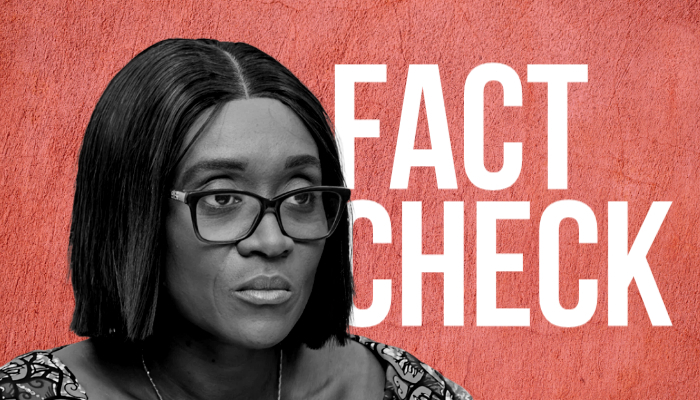
A widely circulated social media video featuring former Finance Minister and current Public Accounts Committee (PAC) Chairperson, Abena Osei-Asare, has sparked controversy over the Bank of Ghana’s (BoG) handling of losses from its Domestic Gold Purchase Programme (DGPP). In the video, Osei-Asare alleged that the central bank’s 2025 financial statements understated the programme’s losses, contrasting a reported $214 million figure with an International Monetary Fund (IMF) estimate of $1.7 billion.
However, a detailed fact-check by JoyNews Research has found the claim to be FALSE, revealing a fundamental misreading of the data and a conflation of incomparable figures.
The Claim in Question
In the video, Osei-Asare stated: “According to the IMF, the Domestic Gold Purchase Programme recorded losses to the tune of $1.7 billion, but if you recall, the Bank of Ghana in their 2025 financial statement reported $214 million as the loss. This loss of $1.7 billion is equivalent to GH¢22 billion, and that is 1.5% of our GDP.”
Her narrative implied that the BoG had deliberately downplayed its losses by more than $1.4 billion, raising questions about transparency and fiscal accountability. The video quickly gained traction on social media, prompting the central bank’s supporters and independent analysts to push back.
What the Bank of Ghana Actually Reported
The BoG’s audited 2025 financial statements, published in early 2026, do not report a 871 million**.
This net loss is broken down into two components:
· Gold for Reserves (G4R): GH¢8.85 billion net loss.
· Gold for Oil (G4O): GH¢0.20 billion net loss, though this programme was discontinued in March 2025.
The $214 million figure that Osei-Asare attributed to the BoG’s full-year financials does not appear anywhere in that document. Instead, it is a partial-year, narrow-scope estimate from the IMF’s December 2025 review—covering only the first three quarters of 2025 and only the artisanal and small-scale (ASM) doré gold component of the G4R programme.
IMF’s Own Clarification
In its December 2025 Article IV consultation report, the IMF explicitly stated: “In 2025 through end-Q3, losses from the artisanal and small-scale (ASM) doré gold transactions component of G4R have reached $214 million (0.2 percent of GDP), mostly on trading losses but also on GoldBod off-takers’ fees.”
Thus, the $214 million is not the total full-year loss; it is a sub-total for nine months, covering only one leg of the programme. It does not include losses from the large-scale gold purchases, the Gold for Oil operations, or the fourth-quarter trading activities.
The $1.7 Billion Figure Explained
The $1.7 billion (GH¢22 billion) figure that Osei-Asare cited as the IMF’s total loss is actually derived from a visualised data pack that the Bank of Ghana itself released, showing a gross loss on doré gold of GH¢21.89 billion—which rounds to GH¢22 billion. That number, as the central bank has since clarified, represents the gross trading loss before hedging gains, operational offsets, and other adjustments. It is not the net loss reported in the audited statements.
Importantly, the IMF’s own report does not present $1.7 billion as the final loss for the DGPP; rather, it references that gross figure in the context of the Bank’s own data. The IMF’s final assessment of the programme’s fiscal impact is still being finalised, and the Fund has not concluded that the BoG underreported its losses.
Why the Claim Fails
JoyNews Research identified three critical errors in Osei-Asare’s assertion:
- Misattribution of the $214 million figure – She incorrectly claims it comes from the BoG’s 2025 financial statements, when in fact it is an IMF sub-estimate for Q1–Q3 2025, limited to ASM doré gold transactions only.
- Incomparable timeframes – She juxtaposes a three-quarter IMF estimate against what she implies is the BoG’s full-year figure, when the BoG’s actual full-year net loss is $871 million—not $214 million.
- Confusion between gross and net – The $1.7 billion gross loss figure (GH¢22 billion) cited by the IMF is not the same as the net loss reported in the BoG’s audited accounts, which account for offsetting revenues, hedging, and programme management costs.
Background: The Domestic Gold Purchase Programme
Launched in 2021, the DGPP was designed to allow the Bank of Ghana to purchase locally produced gold, primarily from artisanal miners, to bolster the country’s foreign reserves and reduce dependence on external borrowing. The programme has been controversial from the start, with critics questioning its cost-effectiveness and transparency.
Two sub-programmes emerged: Gold for Reserves (G4R) , which adds gold to the central bank’s balance sheet, and Gold for Oil (G4O) , which used gold to settle fuel import bills—a barter-like arrangement that was scrapped in March 2025 amid mounting losses. The G4R component, however, continued, with the central bank buying gold from both large-scale and artisanal sources.
BoG’s Defence and the Way Forward
The Bank of Ghana has consistently maintained that its 2025 financial statements are audited by independent international firms and fully comply with IFRS standards. In a brief statement following the fact-check, the BoG reiterated that the $871 million net loss already reflects all realised trading losses, after accounting for gains from gold price movements and hedging instruments.
Meanwhile, the Parliamentary Public Accounts Committee, chaired by Osei-Asare, has yet to respond to the fact-check. However, the revelation has sparked calls for more rigorous oversight of the DGPP, with some economists suggesting that the programme’s design—particularly the reliance on artisanal gold—inherently carries high transaction costs and price volatility risks.
Conclusion: False Claim, Unfounded Allegations
JoyNews Research’s verdict stands: Abena Osei-Asare’s assertion that the Bank of Ghana understated its gold trade losses by reporting $214 million while the IMF said $1.7 billion is factually incorrect. The $214 million is a partial-year IMF sub-figure, not the BoG’s full-year net loss. The BoG’s actual reported net loss is $871 million, and the $1.7 billion gross figure is a different metric altogether.
As Ghana continues to navigate its post-IMF programme economic recovery, accurate data and transparent reporting are essential. This fact-check underscores the need for public officials to cross-reference figures before making claims that could erode confidence in the central bank—and for media and civil society to rigorously verify such assertions. The debate over the DGPP’s efficiency may continue, but this particular accusation does not hold water.


