



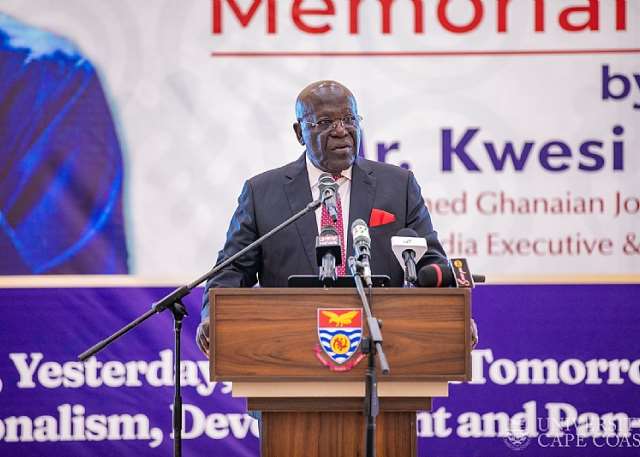
The Chancellor of the University of Cape Coast (UCC), Sir Sam Jonah, has delivered a stinging critique of Ghana’s post-independence trajectory, declaring that the nation has spent six decades consumed by political arguments over Kwame Nkrumah’s legacy while neglecting the practical nation-building that defined his administration.
Speaking at the opening of the 15th Kwame Nkrumah Memorial Lectures at UCC on Thursday, September 17, 2026, Sir Jonah said Nkrumah’s contribution should be assessed not merely through debates about his presidency but through the tangible infrastructure and institutions established during his tenure. “We have spent sixty years arguing about Nkrumah and rather less time doing what he actually did, which was to build things,” he said.
A Legacy of Concrete Achievement
The Ghanaian business titan and former CEO of Ashanti Goldfields — who transformed the company from a single-mine operation into a multinational and became the first African to list a company on the New York Stock Exchange — listed Nkrumah’s achievements with precision. “Nkrumah built. Akosombo. Tema. The motorway. The Ghana Education Trust schools. The universities, including this one,” he said.
“Whatever else is said of him, he understood that independence without industry is a flag without a factory,” Sir Jonah added. “And we, his heirs, have too often been content with the flag”.
The Akosombo Dam, completed in 1965, remains the backbone of Ghana’s hydroelectric power generation. The Tema Motorway, the Accra-Tema Harbour, the Ghana Education Trust schools, and institutions including the Kwame Nkrumah University of Science and Technology (KNUST) all stand as enduring monuments to Nkrumah’s development agenda. Between 1960 and 1966, when Nkrumah was overthrown, Ghana’s GDP increased 47 per cent, from US266 million.
The UCC Chancellor’s remarks form part of a broader reassessment of Nkrumah’s contested legacy at this year’s memorial lectures, themed “Kwame Nkrumah, Yesterday, Today and Tomorrow – Perspectives on Constitutionalism, Development and Pan-Africanism”.
A Reckoning with History
Sir Jonah also defended Nkrumah’s most controversial constitutional legacy — the Preventive Detention Act of 1958 — calling for its assessment within historical context. “The Act was passed in 1958 by a state barely a year old, which had already lived through political bombings and a violent secessionist agitation in Ashanti, and which within months would uncover a plot against the government inside its own army,” he said.
He recalled attempts on Nkrumah’s life, including the 1962 Kulungugu grenade attack, which killed a schoolgirl standing beside the then-President. Drawing parallels with Britain’s internment of citizens under Regulation 18B during World War II and the suspension of habeas corpus under Abraham Lincoln during the American Civil War, he said: “None of this makes preventive detention a good thing. It makes it a human thing – a thing to be weighed in context, not condemned in caricature.”
A Call to Teach Nkrumah’s Ideas
Sir Jonah also criticised Ghana’s education system for failing to adequately teach Nkrumah’s intellectual contributions, noting that works such as Consciencism, Africa Must Unite, and Neo-Colonialism: The Last Stage of Imperialism are given insufficient attention in Ghanaian schools and universities.
“The ideas Nkrumah stood for are hardly taught in Ghanaian schools,” he said. “Meanwhile, across the Atlantic, in the departments of African American Studies at American universities, Nkrumah is on the syllabus. He is read, assigned, examined and argued over”.
He pointed out what he described as an irony: Nkrumah was educated at Lincoln University in Pennsylvania, yet his ideas may be studied more consistently by students in American classrooms than by students in Ghana. “The American student meets Nkrumah as a thinker. Too many Ghanaian students meet him only as a statue”.
He gently commended the Vice-Chancellor and Convocation of UCC to consider adding Nkrumah’s intellectual works to the university’s curriculum. “A university which carries Nkrumah’s name on its lecture series might also carry his ideas in its curriculum,” he said. “I do not presume to write the syllabus. I merely observe that we already have the books”.
The Role of Universities
Sir Jonah also emphasised the responsibility of universities and intellectual institutions in advancing national development, arguing that they must not merely generate knowledge but help translate it into action. “A university is the one place in any country where silence is not an option – where knowing is supposed to become saying, and saying is supposed to become doing”.
He said Ghana’s development challenges should prompt a more practical engagement with Nkrumah’s legacy rather than continued arguments over his political record. Addressing students, he added: “Don’t come to these two days looking for a hero to worship or a villain to blame. Come looking for an argument in what happened”.
A Chancellor with Unique Authority
Sir Sam Jonah, who grew up in Obuasi and rose from working as a blast man in the mines to become the first Ghanaian — indeed the first African — appointed to head the Obuasi mine, brings a unique perspective to the debate. Knighted in 2003 by the then Prince of Wales (now King Charles III) as Knight Commander of the Civil Division of the Most Excellent Order of the British Empire (KBE), he became the first Ghanaian to receive the honour in the 21st century. He also holds Ghana’s highest national honour, the Companion of the Order of the Star.
His remarks carry particular weight in the Bono Region and across Ghana, where debates over Nkrumah’s legacy have often been overshadowed by political partisanship. As Chancellor of UCC — itself a beneficiary of Nkrumah’s Ghana Education Trust Fund — Sir Jonah speaks from a position of institutional and personal authority.
Kwesi Pratt Honoured as Lectures Close
The 15th Kwame Nkrumah Memorial Lectures also featured the conferment of an honorary Doctor of Letters (D.Litt.), honoris causa, on veteran journalist Kwesi Pratt Jnr., who delivered the second lecture. The honour recognised Mr. Pratt’s decades of contribution to journalism, public discourse, democracy, and the ideals of African emancipation.
Sir Jonah said the University was also recognising the importance of independent journalism, courage, and openness to new ideas to the sustenance of democracy. “In honouring him today, the University recognises that a vibrant democracy depends on courage, independent journalism, and the openness to new ideas,” he said. He described Mr. Pratt’s public life as reflecting “a relentless commitment to the public good and an unshakable belief in the power of informed civic engagement”.
Mr. Pratt, the Managing Editor of The Insight newspaper, traced his political and intellectual formation to his early years and said the ideals of Nkrumah remained a major influence throughout his life. He recalled growing up in Accra and being introduced to Nkrumahist ideas and organisations, which instilled in him the belief that there was no greater honour than contributing to the freedom of African people. He said he had spent his life working with various left-wing organisations, including the Student Movement for African Unity, the Kwame Nkrumah Revolutionary Guards, and the Socialist Movement of Ghana.
“My dreams may not be realised in my lifetime. They may be gone. But as long before the dream of a united Africa under the banner of scientific socialism would be realised,” he said. “Until that time comes, until freedom comes, when like all of us, we are compelled to give up our body and our spirit, we shall continue to struggle until final victory”.
The Kwame Nkrumah Memorial Lectures: A Storied Tradition
The Kwame Nkrumah Memorial Lectures were instituted in 1974 and inaugurated in 1976 to promote discussion on the social, economic, and political development of Africa and the Black world. Over the decades, the lecture series has become one of Ghana’s most prestigious intellectual platforms, attracting scholars, politicians, and public intellectuals from across the continent and the diaspora.
UCC Vice-Chancellor, Prof. Denis Worlanyo Aheto, said Mr. Pratt’s decades of work as a journalist, publisher, political commentator, and public intellectual had contributed significantly to national discussions on Ghana’s political, economic, and social development, as well as African emancipation and self-determination. The university also commended Mr. Pratt’s recent book, Reparations: History, Struggle, Politics and Law, which examines reparatory justice, historical memory, and sovereignty.
In the end, Sir Jonah’s message was a call to action: the nation must stop debating Nkrumah and start emulating him. “We, his heirs, have too often been content with the flag”.


